Nixie · Volume 7
Buy a Kit or Finished Clock
The buy-it end of the decision tree — Dalibor Farný's art clocks, the kit houses, the cheap AliExpress boards, and where the tubes come from
Not everyone who wants a nixie clock wants to build one. Some readers want the glowing orange numerals on the shelf by the weekend and are happy to pay a craftsman for the privilege; others want the satisfaction of a soldering iron and a tube they sourced themselves, but would rather start from a proven board than design a high-voltage supply from a blank schematic. Both are legitimate, and both sit at the gentler end of the Vol 1 decision tree — Paths 1, 2, and 3 of § 1.3, the “buy a finished art clock,” “buy a kit and solder it,” and “buy a cheap board and source your own tubes” options. This volume maps the buy-it landscape from the hand-built art object at the top to the ten-dollar bare board at the bottom, tells you honestly what your money does and does not buy at each tier, walks through where the tubes themselves come from, and ends with a trade-off table you can hold against your own budget, skill, and patience — and against the full DIY build of Vol 6.
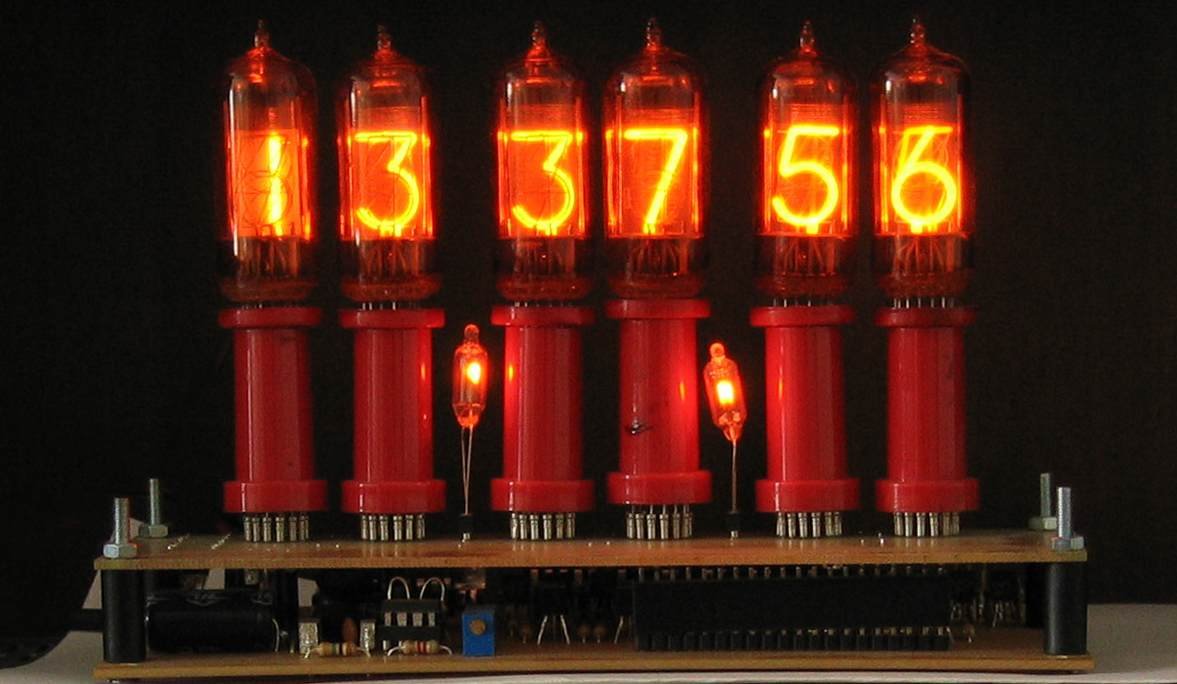
One caveat lands before anything else, the same one that governs every path in this series: a finished clock removes the high-voltage build risk; a kit or a bare board does not. The dangerous part of a nixie clock is the ~170–200 V DC anode supply behind a filter capacitor that stays charged after you unplug it (Vol 3, Vol 10). When you buy a finished clock, the maker has already built and tested that supply and stands behind it. When you buy a kit or a bare board, you assemble and energize it — the bargain price buys you a circuit board, not a reprieve from the physics. Keep that straight as you read, and treat Vol 10 (safety) as mandatory before first power-up on anything you assemble yourself.
7.1 The market overview — why nixie clocks cost what they do
There is no single thing called “a nixie clock for sale.” There is a spectrum, and where a given offer sits on it decides how much money, how much labour, and how much risk changes hands. From most-finished to least-finished:
- Finished art clock — a fully assembled, tested, warrantied clock, often a genuinely collectible object built around premium or newly-made tubes. Dalibor Farný is the canonical example (§ 7.2). Highest cost, zero build effort, zero electrical risk to you.
- Complete kit — every part in a bag plus a board and good instructions; you assemble and you wire and energize the high-voltage supply, but the design is proven and supported. PV Electronics and GRA & AFCH live here (§ 7.3). Moderate cost, moderate effort, full HV risk during assembly and bring-up.
- Cheap kit or bare board — a low-cost PCB (sometimes a parts bag, sometimes just the board) with terse documentation; you often supply the tubes yourself and you own the HV-safety problem entirely. The AliExpress tier (§ 7.4). Low cost, variable quality, full HV risk and the weakest documentation of any tier.
The reason even the cheap end commands a premium over an equivalent LED clock comes down to two things the technology cannot escape. First, the tubes: a nixie tube is either new-old-stock (NOS) glass that stopped being manufactured around 1975 and is now a depleting surplus commodity, or it is one of the handful of newly manufactured tubes that a modern maker has gone to extraordinary lengths to bring back into production (§ 7.5). Either way the display is the expensive part, and unlike an LED it does not get cheaper with scale. Second, the electronics are non-trivial: every nixie clock needs a high-voltage step-up supply and a high-voltage-capable digit driver (the 74141/K155ID1 or an HV5622-class shift register of Vol 4), neither of which appears in an ordinary low-voltage digital product. You are paying for glass that is no longer made and for a circuit that has to stand off a couple of hundred volts — which is why the cheapest credible nixie clock still costs more than a shelf full of seven-segment LED clocks.
7.2 Finished art clocks — the top of the market
At the top of the market sits the finished clock bought as a finished object — assembled, tested, cased, warrantied, and built to be looked at as much as read. This is Path 1 of the Vol 1 decision tree: the path you take when you want a flawless clock on the shelf this week, you value it as craft, and budget is not the deciding factor.
7.2.1 Dalibor Farný
The name everyone in this hobby knows is Dalibor Farný, a Czech maker who has done something almost no one else has managed: he manufactures new nixie tubes — not refurbished NOS, but newly built glass from a workshop in a castle in Moravia — and builds them into premium finished clocks. His flagship tube is the R|Z568M, a hand-built remanufacture of the large Z568M-class display, produced in small batches with the kind of getter, electrode, and glass-sealing work that the original 1960s factories did at industrial scale and that almost no one does by hand today. Reviving nixie-tube manufacture from essentially nothing — the vacuum technique, the cathode forming, the consistency batch to batch — is the reason his name carries the weight it does.
The finished clocks are sold as named lines — the Puri, the Zen, and the Cromell families are the recurring ones — built around either his own tubes or selected premium NOS tubes, in machined metal and glass enclosures with WiFi time sync, ambient sensing, and other modern conveniences hidden inside a deliberately timeless object. These are positioned and priced as collectibles: a Farný clock is comfortably a four-figure purchase (and the larger or limited pieces more), which is the four-dollar-sign option in Vol 1’s table. Treat any specific price, model name, or lead time as subject to change and best verified directly with the maker — a one-workshop operation revises its line-up and its waiting list over time, and a clock built around hand-made tubes is priced very differently from one built around sourced NOS glass.
What you pay for, concretely, is this: a complete, working, warrantied clock with zero hours at the bench and zero exposure to the high-voltage build, displayed in an object that is built to outlast its owner, using tubes that are either newly made or hand-selected. What you do not get is the making — if the build is the point for you, this is the wrong path, and Vol 6 is where you belong. If the having is the point, it is the best path in this volume.
7.2.2 Other boutique finished clocks
Farný is the apex but not the whole tier. A scattering of smaller makers and one-person shops sell finished nixie clocks — some on their own sites, many through Etsy, Tindie, and eBay — in steel, brass, wood, or acrylic cases, usually built around NOS IN-14 or IN-18 tubes (§ 7.5) rather than newly-made glass. These fill the gap between an AliExpress board and a Farný commission: a genuinely finished, self-contained clock with a real warranty and a contactable human behind it, at a mid-market rather than collectible price. The same verify-before-you-buy rule applies in full — a small shop’s stock, tube choice, and pricing move around, and a “finished” listing should make clear that the high-voltage supply is built and tested, not left to you. The community catalog at the Tube Clock Database is the right index for finding who is currently selling in this tier and reading independent build and ownership reports before you commit.
7.3 Kits to solder yourself
The middle tier is the kit: a board, a bag of parts, and good documentation, where you do the assembly and the bring-up but the design is proven and supported. This is Path 2 of the Vol 1 tree — the path for someone who enjoys soldering and wants the learning and the savings of a build without designing the high-voltage supply and writing firmware from scratch. The skill floor is honest through-hole soldering plus the discipline to bring up a high-voltage supply safely; the established kits are specifically chosen to make that as forgiving as a HV project can be, but the HV risk is real from first power-up and Vol 10 applies in full.
7.3.1 PV Electronics (UK)
PV Electronics (pvelectronics.co.uk) is the best-documented kit house in the hobby and the one most often recommended to a first-time builder. Its nixie kits — the long-running QTC and QTC+ family among them — are sold with thorough printed and online construction guides, support a range of tube types (IN-14, IN-18, and Western tubes among them), and offer the modern conveniences as options: GPS or WiFi time synchronization, multiple display modes, and dimming. Kits are typically available with or without tubes — you can buy the board and supply your own NOS glass, or buy a complete kit with matched tubes included, which is the simpler route if you do not already have tubes in hand. The documentation quality is the reason to start here: when the design is proven and the manual is good, the only genuinely hard part left is the soldering and the safety discipline.
7.3.2 GRA & AFCH (Ukraine)
GRA & AFCH is a popular Ukrainian maker whose kits and bare tube boards circulate widely on Tindie, eBay, and the maker’s own storefront. The range spans complete clock kits and “shield”-style tube boards meant to sit on a controller, covering the common Soviet tubes (IN-12, IN-14, IN-18) the maker can source close to their origin. The kits are well regarded and generally include tubes, which — given that GRA & AFCH sit near the Eastern European surplus supply — can make them a sensible way to acquire matched tubes and a board together. As with any single-shop vendor, confirm current stock, the exact tube type, and whether a given listing is a complete kit or a bare tube board before ordering.
7.3.3 Spectrum, Millclock, and other established kit houses
Below those two sit a number of established kit and finished-clock houses worth knowing. Millclock (Ukraine) sells both finished nixie clocks and kits across a range of tube sizes, including large-tube builds. Various Spectrum- and similar-branded kits appear on the marketplaces alongside them. The distinction that matters when you shop this tier is tubes-included vs bring-your-own: a kit price that looks low may be a board-only price that assumes you already own (or will separately buy) the tubes, and large tubes in particular (§ 7.5) can cost more than the rest of the kit combined. Read every listing for that line item before comparing prices across vendors.
7.4 Cheap AliExpress kits and bare boards
At the bottom of the market sit the cheap generic kits and bare controller boards sold on AliExpress and similar marketplaces — IN-12 and IN-14 clock kits, ESP8266/ESP32-based controller boards, and bare tube PCBs, frequently under USD $30–60 for a board (tubes usually extra). This is Path 3 of the Vol 1 tree: the budget entry point for someone who does not mind sourcing tubes and debugging terse instructions. It is genuinely useful and genuinely the tier that demands the most caution, because the listings are written to make half a clock sound like a whole one.
The caveats are consistent across the category. Documentation is terse or machine-translated, often with no schematic, no source code, and no support after the sale. Quality control is variable — component substitutions, cold joints on pre-populated boards, and out-of-spec parts are common, so budget time to inspect, reflow, and test before you trust a board near expensive tubes. You often supply the tubes yourself — many listings are the silicon only, and the NOS glass is a separate purchase (§ 7.5), so a board that looks like an impulse buy is really the cheap quarter of a more expensive whole. And the one that matters most: HV safety is left entirely to you. These boards generate the same ~170–200 V anode rail as any other nixie clock, and the documentation that would walk a beginner safely through bring-up is exactly what these listings omit. Read Vol 10 before energizing anything, exactly as you would for a from-scratch build.
This path is the right call for a builder who treats the cheap board as a known-imperfect starting point rather than a finished product — who will inspect and reflow it, source and test their own tubes, and bring up the high voltage with the safety discipline the listing does not mention. It is the wrong call for a first-timer who reads “kit” as “clock.” A first-timer who wants a build is far better served by a documented PV Electronics or GRA & AFCH kit (§ 7.3); a first-timer who wants a clock is better served by a finished unit (§ 7.2). Cross-reference Vol 10 for the safety discipline and the NOS-tube handling and testing that this tier in particular assumes you already know.
7.5 Sourcing the tubes
Whichever board you buy below the finished-clock tier, at some point you confront the question that defines the hobby: where do the tubes come from? Mass nixie manufacture ended around 1975, so with one notable exception every tube on the market is new-old-stock — decades-old glass that has been sitting in a warehouse, a parts drawer, or a decommissioned instrument ever since. The supply is finite and slowly depleting, which is why tube choice and tube sourcing deserve their own section even in a buy-it volume.
7.5.1 The NOS market and the staple tubes
The Soviet IN- series dominates the surplus market for the simple reason that the USSR kept producing nixies in volume later and in larger quantities than the West, so the cheapest and most plentiful tubes today are Russian (Vol 2). The clock-builder’s staples:
- IN-14 — the side-view ~18 mm tube that is the most popular clock tube in the world: plentiful, NOS by the thousands, and cheap, on the order of a few dollars each in quantity. If a board is a kit, the IN-14 is the default tube it is designed around.
- IN-12 — the end-view tube, often mounted flat on a PCB; cheap and common, the staple of the inexpensive flat-board kits.
- IN-18 — the giant (~40 mm digit), the prized and expensive one. A single IN-18 can run into the tens of dollars and a matched set of six is a serious fraction of a large clock’s cost; prices have climbed steadily as the surplus thins.
The marketplaces are eBay, surplus electronics dealers, and Eastern European sellers close to the original supply (the same channel that makes GRA & AFCH’s tube-included kits attractive). Expect to buy a few spares of any tube you build with — NOS tubes have a failure rate, and a clock with one dead digit and no matching spare is a clock you cannot finish.
7.5.2 Testing NOS tubes and spotting fakes
Two hazards come with buying decades-old glass, and both are covered in build depth in Vol 10; the orientation here is enough to shop safely. First, NOS tubes need testing before you trust them in a finished clock: a current-limited HV supply, each cathode lit in turn, a check that every numeral 0–9 strikes cleanly and fully without dim or missing segments, and an eye for cathode poisoning — the blotchy, partially-lit numerals that come from a tube that sat unused for decades and that can sometimes be exercised back to health. Test before you solder, not after.
Second, fakes and relabels are a real problem at the expensive end of the market. The large, valuable tubes — the IN-18 above all — are the ones worth faking, and the scams take two forms: relabeling a cheaper tube as a dearer one, and selling refurbished or pulled tubes as NOS. Buy large tubes from sellers with a track record, scrutinize the photos for getter condition and printing consistency, be suspicious of a too-good price on an IN-18, and prefer sellers who will test and guarantee. The Tube Clock Database and the hobby forums are the place to check a seller’s reputation before a large-tube purchase.
7.5.3 The newly-manufactured option, and a reference point
The one exception to “every tube is NOS” is newly-manufactured glass, and in practice that means Dalibor Farný’s R|Z568M-class tubes (§ 7.2). Buying new-made tubes is the way out of the depleting-surplus problem — consistent, warrantied, large, and beautiful — but it is also the most expensive glass on the market by a wide margin, on the order of a hundred-plus dollars per tube, which is why it tends to appear in finished art clocks rather than in budget kits. It is the right choice when you want a large-tube clock that you can still buy spares for in five years, and you are willing to pay collectible prices for that certainty.
As an in-hub reference point for what a clean modern nixie design looks like, the Lamina / “Awesome Nixie Clock” reference design collected in this subproject (Vol 1 § 1.6, walked through in Vol 8) is worth comparing against any board you are considering buying: it shows the expected shape of a well-laid-out nixie clock — HV supply, driver, controller, tube board — so you can judge whether a marketplace listing is a complete, sensible design or half of one.
7.6 Trade-offs — buy versus build
Here is the decision distilled. The table maps the buy-it tiers of this volume against the full DIY build of Vol 6 across the factors that actually decide the choice — and it is the practical expansion of Vol 1 § 1.4’s decision tree.
Table 1 — 7.6 Trade-offs — buy versus build
| Factor | Finished art clock (Path 1) | Solder-it kit (Path 2) | Cheap board (Path 3) | Full DIY build (Path 4/6) |
|---|---|---|---|---|
| Cost | $$$$ (four-figure; new-made tubes) | $$ (board + tubes, often bundled) | $ (board cheap; tubes usually extra) | $ parts, but your time is the cost |
| Skill required | none | through-hole soldering + HV discipline | soldering + debugging terse docs + HV | board design, firmware, HV design |
| Time | none (order and wait) | a weekend or two | a weekend plus troubleshooting | weeks to months |
| Tubes | included (new-made or selected NOS) | included or bring-your-own | usually bring-your-own NOS | you source and test (§ 7.5) |
| Documentation / support | full warranty, contactable maker | excellent (PV) to good (GRA & AFCH) | terse, often none | you are the documentation |
| HV safety exposure | none (maker built it) | full during build and bring-up | full, with the least guidance | full, start to finish |
| Result quality | collectible, flawless | very good, proven design | variable; as good as your rework | exactly what you make it |
The constant from Vol 1 holds across the table: only the finished art clock removes the high-voltage risk. Everything from a kit downward — including the full DIY build of Vol 6 — leaves the dangerous ~170–200 V supply in your hands, and Vol 10 is mandatory reading before first power-up.
Mapping back to the Vol 1 decision tree: buy a finished clock (§ 7.2) when you want the object more than the process, have no appetite for high voltage, or are buying a gift — you are paying for a working, warrantied object and total avoidance of the only genuinely dangerous part of the hobby. Buy a documented kit (§ 7.3) when you want the assembly satisfaction and the learning, accept the HV risk, and value a proven, supported design — PV Electronics is the strongest first-kit choice in this volume. Buy a cheap board (§ 7.4) only when you are comfortable sourcing and testing your own tubes, will treat the board as an imperfect head start, and have read Vol 2 for tube choice and Vol 10 for safety. And build from scratch (Path 4/6) when the making is the entire point — at which stage you have left this volume behind and joined the from-scratch builders of Vol 6.
7.7 References (Vol 7)
- Dalibor Farný — maker of newly-manufactured nixie tubes (R|Z568M-class) and premium finished clocks (Puri / Zen / Cromell lines). Four-figure finished clocks; contact the maker for current models, pricing, and lead times. https://daliborfarny.com/
- PV Electronics — UK nixie and clock kits (QTC / QTC+ family), well-documented, GPS/WiFi options, tubes-included or bring-your-own; verify current kits and tube options with the vendor. https://www.pvelectronics.co.uk/
- GRA & AFCH — Ukrainian nixie clock kits and tube boards (IN-12 / IN-14 / IN-18), widely sold via Tindie / eBay and the maker’s storefront; kits generally include tubes. Verify stock and exact tube type before ordering.
- Millclock — Ukrainian finished nixie clocks and kits across tube sizes including large-tube builds; verify current line-up and pricing. https://millclock.com/
- Generic AliExpress nixie kits and bare controller/tube boards (IN-12 / IN-14, ESP8266/ESP32 controllers) — low cost, terse documentation, variable QC, tubes usually supplied separately, HV safety left to the builder. Treat any specific listing/price as indicative and verify at purchase.
- NOS tube sourcing — Soviet IN-series (IN-12 / IN-14 / IN-18) via eBay, surplus electronics dealers, and Eastern European sellers. Buy spares; test before soldering; scrutinize large-tube listings for relabels and refurbished-as-NOS scams (testing and handling in Vol 10).
- Tube Clock Database — community catalog of tube clocks, vendor directory, builder reviews and forums; the index for finding current kit and finished-clock vendors and checking seller reputation. https://www.tubeclockdb.com/
- Lamina / “Awesome Nixie Clock” reference design — clean modern nixie clock reference held in
this subproject’s
02-inputs/Awesome Nixie Clock/; comparison point for judging a marketplace board (walked through in Vol 8). - Cross-references: Vol 1 (decision tree and paths), Vol 2 (tube families and selection), Vol 3 (the high-voltage supply), Vol 4 (digit drivers), Vol 6 (the full DIY ATMega build), Vol 8 (the collected projects), Vol 10 (safety, NOS-tube handling and testing).
Comments (0)