Nixie · Volume 11
Cheatsheet & Glossary
The laminate-ready reference card — tube data, driver tables, HV formulas, timebase notes, the two reference designs, vendors, and an A-Z of every term the series uses
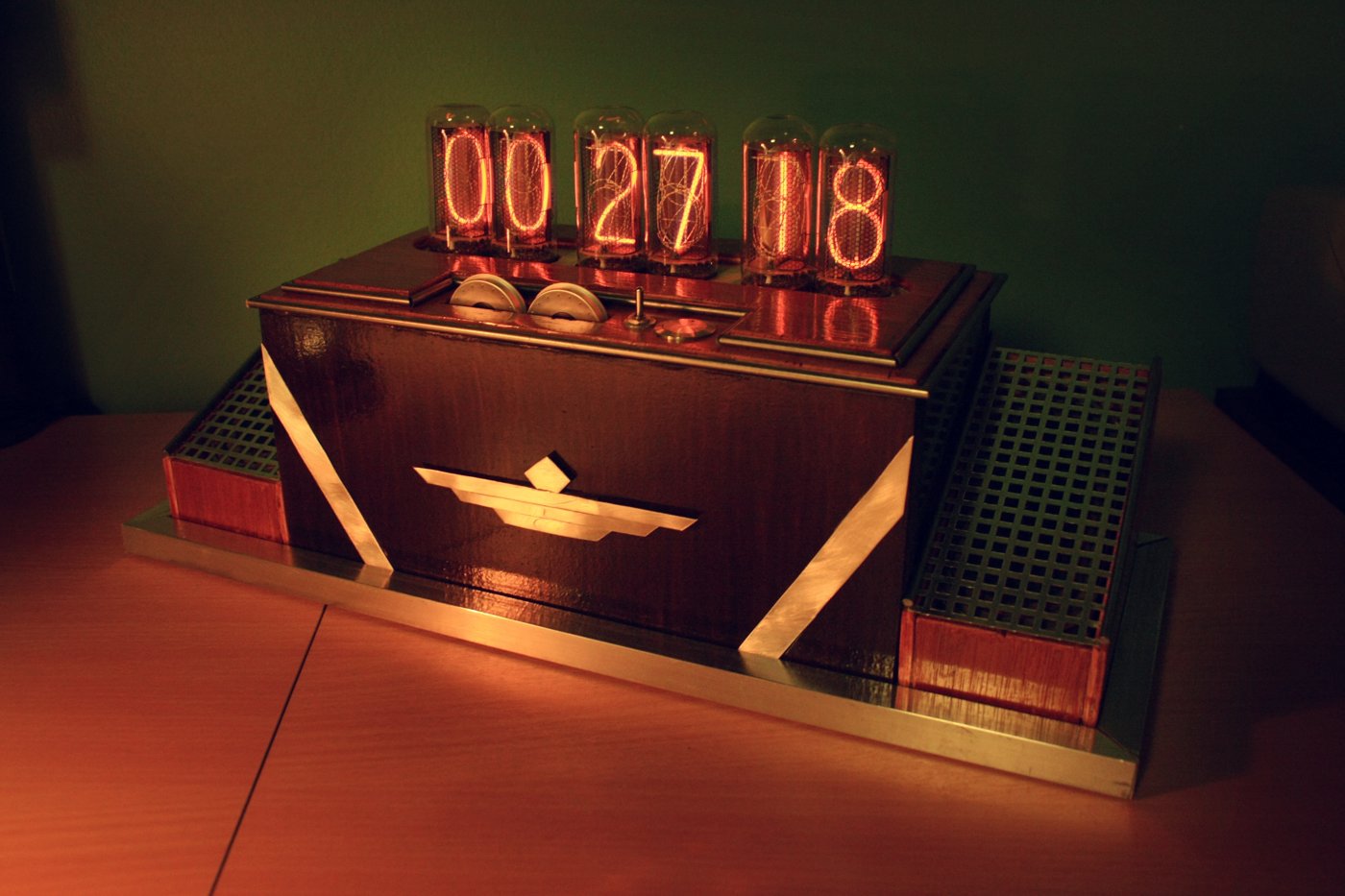
Ten volumes built the nixie clock one subsystem at a time: the glow discharge that sculpts a numeral (Vol 2), the ~180 V boost supply that strikes it (Vol 3), the drivers that ground one cathode out of ten (Vol 4), the timebase that decides which digit to light (Vol 5), and the two worked builds that tie it all together (Vols 6 and 8). This final volume carries none of that argument forward — it exists only to condense it. Everything below is a table or a one-line rule distilled from the volumes that derived it, arranged so a builder at the bench can find a strike voltage, an anode-resistor value, an RTC drift figure, or the meaning of “Penning mixture” without reading a chapter to get there. Print it, laminate it, keep it next to the soldering iron. Where a number here looks too round to trust, the volume that owns it (named in the prose) carries the full derivation and the tolerances; this card gives you the typical value and sends you there for the why.
11.1 Tube quick-reference
The headline electrical facts are remarkably uniform across the clock-sized tubes — they all strike near 170 V, maintain somewhere in 120–150 V, and want 1.5–3 mA per lit digit (≈2.5 mA nominal) — so the table below varies mostly in mechanical character: view direction and digit height. These figures mirror Vol 2’s tube-family table and Vol 3’s load table; treat the per-type strike/maintain numbers as typical values that drift up with age and vary a few volts between samples.
Table 1 — 11.1 Tube quick-reference
| Type | Origin | View | Digit height | Typical strike V | Typical maintain V | Typical digit current | Notes |
|---|---|---|---|---|---|---|---|
| IN-12 | Soviet | end-view | ~18 mm | ~170 V | ~120–150 V | 1.5–3 mA (~2.5) | Flat PCB-mount; cheap, very common; staple of flat-board kits |
| IN-14 | Soviet | side-view | ~18 mm | ~170 V | ~120–150 V | 1.5–3 mA (~2.5) | The world’s most popular clock tube; plentiful NOS, the default side-view look |
| IN-16 | Soviet | side-view | ~13 mm | ~170 V | ~120–150 V | 1.5–3 mA (~2.0–2.5) | Small, petite numerals; for compact clocks |
| IN-18 | Soviet | side-view | ~40 mm | ~170 V | ~120–150 V | ~2.5–3 mA | The giant — large, dramatic, prized and pricey; flagship “big nixie” clocks |
| ZM1210 | Telefunken / Philips | end-view | 15.5 mm | ~180 V strike / ~170 V | ~140 V | ~2.2–2.5 mA | This hub’s worked ATMega build (Vol 6); 11 cathodes (ten digits + decimal point) |
| Burroughs B-5092 | Burroughs (US) | side-view | ~15 mm | ~170 V | ~120–150 V | 1.5–3 mA (~2.5) | Classic American side-view numeric tube of the instrument era |
Two reminders that the table cannot hold. First, the anode (current-limiting) resistor is mandatory on every tube — a nixie is a negative-resistance device and will destroy itself across a stiff supply without it (§ 11.3, derived in Vol 2). Second, the strike voltage is the number the supply must clear with margin; the maintain voltage is what the tube actually drops once lit, and the gap between them is where the whole drive scheme lives.
11.2 Driver quick-reference
The classic one-chip-per-tube driver is the 74141 (and its prized Soviet clone the K155ID1 / К155ИД1): present a 4-bit BCD code, it grounds exactly one of ten high-voltage open-collector outputs and stands off the rail on the other nine. The truth table, including the blanking codes that give leading-zero suppression and the anti-poison routine a free mechanism, is the heart of Vol 4:
Table 2 — anti-poison routine a free mechanism, is the heart of Vol 4
| D C B A | Digit | Output low | D C B A | Digit | Output low |
|---|---|---|---|---|---|
| 0 0 0 0 | 0 | out 0 | 1 0 0 0 | 8 | out 8 |
| 0 0 0 1 | 1 | out 1 | 1 0 0 1 | 9 | out 9 |
| 0 0 1 0 | 2 | out 2 | 1 0 1 0 | (10) | blank |
| 0 0 1 1 | 3 | out 3 | 1 0 1 1 | (11) | blank |
| 0 1 0 0 | 4 | out 4 | 1 1 0 0 | (12) | blank |
| 0 1 0 1 | 5 | out 5 | 1 1 0 1 | (13) | blank |
| 0 1 1 0 | 6 | out 6 | 1 1 1 0 | (14) | blank |
| 0 1 1 1 | 7 | out 7 | 1 1 1 1 | (15) | blank |
Any invalid BCD code 10–15 blanks the whole tube (all outputs open). The 74141’s guaranteed off-state standoff is modest — about 55–60 V minimum — which is enough because an off cathode only needs to be pinned well below the strike voltage, not to ground; the K155ID1 has a notably higher off-state breakdown.
HV5622 (one-line summary). A 32-channel serial-to-parallel HV shift register with open-drain outputs — data / clock / latch / blank interface, daisy-chainable, one channel per cathode, so one chip drives three tubes’ worth of cathodes (30 of 32 channels). The BCD-to-decimal decode moves out of silicon and into your firmware.
Discrete drivers (key specs).
Table 3 — Discrete drivers (key specs).
| Part | Type | Rating | Role |
|---|---|---|---|
| MPSA42 | NPN, TO-92 | V_CEO ≈ 300 V | Low-side cathode sink (a true 300 V standoff, no soft-clamp needed) |
| MPSA92 | PNP, TO-92 | ≈ −300 V | High-side anode switch (for multiplexing; drive base relative to the rail) |
A worked MPSA42 base resistor for 2 mA from a 5 V pin at forced β ≈ 10: R_B = (5 − 0.8 V) / 0.2 mA ≈ 21 kΩ → use 22 kΩ.
Direct drive vs multiplex (the one-liner). Direct drive lights every tube continuously — brightest and steadiest, one driver resource per cathode. Multiplexing shares one cathode-driver set across N tubes lit 1/N of the time, saving parts at the cost of N× the peak current. The peak-current rule:
I_peak = I_avg × N → e.g. 2 mA average × 6 tubes = 12 mA peak per lit digit.
Keep the per-tube refresh ≥ ~60–100 Hz (so a six-tube scan runs ~600 Hz) or the display flickers.
11.3 HV supply formulas
Four formulas carry the whole high-voltage design of Vol 3, each with one worked number.
Boost duty cycle (CCM ideal).
d = 1 − V_in / V_out
Worked: d = 1 − 12 V / 180 V = 0.93
A 0.93 duty is why a 15:1 nixie boost runs in discontinuous mode (DCM) rather than continuous — the controller sets peak current and frequency, not a voltage-ratio duty (Vol 3 § 3.4).
Anode (current-limiting) resistor.
R = (V_supply − V_maintain) / I_digit
Worked: R = (180 V − 140 V) / 2 mA = 40 V / 0.002 A = 20 kΩ
so a 20 kΩ anode resistor sets a 2 mA digit; the 15–22 kΩ range covers the usual 180 V rail / 140 V maintain / 2–2.5 mA tubes (derived in Vol 2, applied in Vol 6).
Reservoir-cap stored energy (what makes the rail dangerous after power-off).
E = ½ C V²
Worked: ½ × 10 µF × (180 V)² = ½ × 10⁻⁵ × 32 400 = 0.16 J
— small in joules, but delivered across the chest it is what stops a heart. This is why the bleeder below is not optional.
Bleeder RC sizing.
τ = R · C ; time to fall V₀ → V_safe = τ · ln(V₀ / V_safe)
Worked: 220 kΩ × 10 µF = τ = 2.2 s; 180 V → <50 V in 2.2 × ln(3.6) ≈ 2.8 s
Continuous waste: P = V²/R = (180 V)² / 220 kΩ ≈ 0.15 W → use a ½ W part.
A permanent 220 kΩ / ½ W bleeder across the reservoir cap bleeds the rail touch-safe in under 3 seconds and stays fitted in the finished build (Vol 3, Vol 10).
11.4 Timebase quick notes
The single anchor for every accuracy figure (Vol 5):
1 ppm ≈ 0.0864 s/day ≈ 2.63 s/month ≈ 31.5 s/year.
Everything else is multiplication off that line:
Table 4 — Everything else is multiplication off that line
| Source | Accuracy | Drift | Note |
|---|---|---|---|
| DS3231 (TCXO RTC) | ±2 ppm (0–40 °C) | ~±0.17 s/day ≈ ±1 min/year | Crystal + temp-compensation inside the chip; I²C @ 0x68; 1 Hz SQW output. The one to use |
| DS1307 (RTC) | crystal-dependent | ~±1.7 s/day (±20 ppm xtal) | External 32.768 kHz crystal, no compensation; I²C @ 0x68; cheaper, drifts with room temp |
| 32.768 kHz crystal (÷2¹⁵) | ±10–50 ppm | ~±1.7 s/day @ ±20 ppm | 2¹⁵ = 32768 → a 15-stage divider gives 1 Hz; steady short-term, drifts forever |
| Mains 50/60 Hz | grid-average | seconds over weeks | Count zero-crossings (120/s @ 60 Hz); grid time-error-correction keeps long-term; loses count on outage |
Rule of thumb: a ±0.5 s/day target needs about ±5.8 ppm — beyond a bare crystal, squarely in DS3231 territory. Network/GPS sync (NTP, or a GPS 1 PPS edge) re-disciplines the local oscillator and makes the displayed time “always correct.”
11.5 The two reference designs at a glance
The hub holds two complete, contrasting builds — a microcontroller clock and a clock that counts with no CPU at all. Side by side (Vols 6 and 8):
Table 5 — that counts with no CPU at all. Side by side (Vols 6 and 8)
| ATMega Cool Nixie Clock | Relay Nixie Clock (RL1200) | |
|---|---|---|
| Brain / logic | AVR MCU — AT90S4433 (static board) / ATmega48 (nix-in-17 firmware) | 55 × Omron G2R-2-12VDC DPDT relays as self-holding ring counters (no CPU) |
| Timebase | 32.768 kHz watch crystal on Timer2 async (software RTC), or DS3231/DS1307 RTC | 4.194304 MHz crystal (2²²) → CD4521 ÷2²² → 1 Hz → twin CD4017; or mains 1 Hz via EXT IN |
| Digit drivers | 74141 BCD→decimal, one per tube; fed via 74HC595 shift chain (or multiplexed cathodes) | Relay register → decoder blocks (the latched relay both holds and displays the digit) |
| Tubes | 4 × ZM1210 (end-view, 15.5 mm), HH:MM (6 for HH:MM:SS) | 4 nixies, 12-hour (1-MIN 0–9, 10-MIN 0–5, 1-HOUR 0–9, 10-HOUR 0–1) |
| HV supply | Software-regulated boost: IRFR320 MOSFET + 100 µH + BYV27 rectifier → ~180 V | MC34063 boost → ~170 V |
| Input | 12 V DC → 7805 +5 V logic + boost | single +12 VDC rail (coils + on-board nixie boost) |
| Character | Compact, bright, self-correcting, self-cleaning (cathode-saver at 05:00) | Audibly clicks the carry up the digits; slower, hungrier, a celebrated novelty |
11.6 Vendors & resources
The buy-it landscape of Vol 7, condensed. Verify stock, tube type, and price directly — single-shop vendors revise their line-ups and waiting lists over time.
Table 6 — 11.6 Vendors & resources
| Vendor / resource | What it is | URL |
|---|---|---|
| Dalibor Farný | Newly-manufactured tubes (R|Z568M-class) + premium finished art clocks (Puri / Zen / Cromell). Four-figure | https://daliborfarny.com/ |
| PV Electronics (UK) | Best-documented kit house; QTC / QTC+ family, GPS/WiFi options, tubes-included or BYO | https://www.pvelectronics.co.uk/ |
| GRA & AFCH (Ukraine) | Nixie clock kits + tube boards (IN-12/14/18), widely on Tindie/eBay; kits generally include tubes | (Tindie / eBay / maker storefront) |
| Millclock (Ukraine) | Finished clocks + kits across tube sizes, including large-tube builds | https://millclock.com/ |
| Tube Clock Database | Community catalog, vendor directory, builder reviews — the index for checking a seller’s reputation | https://www.tubeclockdb.com/ |
| AliExpress generic kits | Cheap IN-12/14 boards + ESP8266/ESP32 controllers; terse docs, variable QC, tubes usually extra, HV safety left to you | (marketplace listings) |
NOS tubes (Soviet IN-12 / IN-14 / IN-18) come from eBay, surplus dealers, and Eastern European sellers — buy spares, test before soldering, and scrutinize big-tube (IN-18) listings for relabels and refurbished-as-NOS scams.
11.7 A–Z glossary
An A-Z of the terms used across this series.
- 74141. The classic BCD-to-decimal high-voltage decoder/driver: 4-bit BCD in, one of ten open-collector outputs grounded, the other nine standing off the rail; codes 10–15 blank the tube. One chip per tube. (Vol 4.)
- Anode mesh. The sparse grid of fine wire across the front of a nixie, held at the positive HV rail; deliberately open so you look through it at the cathodes. (Vol 2.)
- Anode resistor. The mandatory series current-limiting resistor between the HV rail and a tube’s anode; it turns the tube’s negative resistance into a stable current, R = (V_supply − V_maintain) / I_digit. (Vol 2, § 11.3.)
- BCD (binary-coded decimal). Each decimal digit held in its own 4-bit group; the format the 74141 decodes and the firmware counts in. (Vol 4, Vol 5.)
- Bleeder resistor. A permanent high-value resistor across the reservoir cap that drains the stored HV charge to a touch-safe level within seconds of power-off; not optional, stays fitted. (Vol 3, Vol 10.)
- Cathode poisoning. Sputtered metal and contaminants accumulating on rarely-lit cathodes, raising their work function so they strike unevenly — seen as haze and blue/pink mottling; reversed by cathode cycling. (Vol 2.)
- Cold cathode. An electrode that emits via the discharge itself, with no heater — the defining feature of a nixie versus a hot-cathode vacuum tube. (Vol 2.)
- Dekatron. A cold-cathode counting tube whose glow steps around a ring of cathodes one position per pulse — you read a position, not a numeral. Not a nixie. (Vol 2.)
- Direct drive. Every cathode permanently wired to its own driver, all tubes lit continuously — brightest and steadiest, most parts. (Vol 4.)
- Getter. The silvery flash inside the envelope; a reactive metal that absorbs stray gas to maintain the fill. A white/cloudy getter means a leak — the tube is dying. (Vol 2.)
- Glow discharge. The self-sustaining low-pressure-gas conduction that lights a nixie; organized into the cathode dark space, negative glow, Faraday dark space, and positive column. (Vol 2.)
- Ignition voltage / strike voltage. The anode-cathode voltage at which the gas breaks down and a cold digit first lights — ~170 V for clock tubes (range ~140–200 V). (Vol 2.)
- K155ID1 (К155ИД1). The Soviet pin-for-pin clone of the 74141, prized for a higher off-state breakdown; plentiful and cheap as NOS. (Vol 4.)
- Maintaining voltage. The lower voltage a struck tube actually drops while it conducts — typically 120–150 V; the supply must still strike at the higher number. (Vol 2.)
- Multiplexing. Lighting tubes one at a time in rapid sequence so one cathode-driver set serves all of them; trades parts for higher peak current (I_peak = I_avg × N) and tighter timing. (Vol 4.)
- Negative glow. The brightest discharge region, hugging the cathode contour within a fraction of a millimeter — what makes the numeral, and only the numeral, light. (Vol 2.)
- NIXIE. A cold-cathode neon display tube with a stack of ten full-numeral-shaped cathodes selected by switching; the orange glow is neon’s 585–640 nm emission. (Burroughs trademark, 1955.) (Vol 1, Vol 2.)
- NOS (new-old-stock). Decades-old, never-used tubes from surplus storage — the source of nearly all nixies today, since mass manufacture ended ~1975. Test before building; buy spares. (Vol 2, Vol 7.)
- Penning mixture. Neon with a trace of argon added so excited-neon-to-argon collisions ionize more readily, lowering the strike voltage — why a real nixie strikes near 170 V. (Vol 2.)
- PWM dimming / crossfade. Pulse-width modulation of the on/off state to set average brightness (anode-side for global dimming) or to fade one digit into the next over tens of milliseconds. (Vol 4.)
- RTC (real-time clock). A dedicated timekeeping chip (DS3231, DS1307) with its own oscillator, BCD time registers, battery backup, I²C interface, and a 1 Hz square-wave output. (Vol 5.)
- Sputtering. The physical knocking-loose of cathode metal by ion bombardment during the discharge; the mechanism behind cathode poisoning, slowed by a mercury fill. (Vol 2.)
- Strike voltage. See ignition voltage — the higher of a nixie’s two characteristic voltages. (Vol 2.)
A laminate-ready card is only the index. Every value here is derived, with its tolerances and its caveats, in the volume named beside it — start at Vol 1 for the map of the whole series, and read Vol 10 (safety) before you energize anything, because the gentlest figure on this card, 180 V at a few milliamps, is still a number that can stop a heart.
Comments (0)