Nixie · Volume 3
The High-Voltage Supply
Making a clean ~180 V rail from a 12 V brick, regulating it, measuring it without dying, and bleeding it down
Everything in a nixie clock is comfortable, low-voltage, twenty-first-century electronics — a microcontroller, a real-time clock, a handful of logic chips — except this one subsystem, which manufactures a couple of hundred volts of direct current out of a wall-wart and then holds that charge behind a capacitor long after you have unplugged the clock and walked away. The tubes themselves are a 1955 technology, and they ask for a 1955 voltage: a nixie will not strike until the anode-to-cathode potential clears its ignition voltage of roughly 170 V (Vol 2), so the supply has to sit comfortably above that, deliver it at a current measured in single-digit milliamps, and keep it steady enough that the digits do not visibly flicker. It is a small job in watts — a six-tube clock is a three-or-four-watt load — and a genuinely dangerous job in volts: 180 V DC across the chest is well past the threshold that stops a heart, and the reservoir capacitor will deliver that jolt seconds after power-off. Treat this volume as the engineering reference and Vol 10 as the law; read the safety brief before you energize anything described here. Throughout, a ⚠ marks a step where the rail is live.
3.1 What the tubes demand
Before you can design the supply you have to know its load, and the defining feature of a nixie load is that it is high-voltage but low-current. A glow discharge is a cold-cathode phenomenon: there is no heater boiling off electrons (the way a CRT or a vacuum tube needs), and once a digit strikes it sustains itself on a trickle. The numbers for the clock-sized tubes this hub uses — the Telefunken ZM1210 of the worked build (Vol 6), the Soviet IN-12 and IN-14 — are remarkably consistent:
Table 1 — (Vol 6), the Soviet IN-12 and IN-14 — are remarkably consistent
| Quantity | Typical value | Note |
|---|---|---|
| Strike (ignition) voltage | ~170 V | Anode-cathode potential needed to light a cold digit (Vol 2) |
| Maintaining voltage | ~120–150 V | Lower potential that keeps it lit once struck |
| Per-digit operating current | 1.5–3 mA (≈2.5 mA typical) | Set by the series anode resistor, not the supply |
| Supply rail target | 180–200 V DC | Strike voltage plus headroom for the anode resistor’s drop and rail sag |
The rail must clear the strike voltage with margin, because the anode resistor (the per-tube current-limiting resistor between the HV rail and the tube’s anode, sized in Vol 4) drops several tens of volts at operating current, and the cathode is not actually at 0 V when a high-voltage driver is holding it down — the 74141/K155ID1 driver has its own saturation drop. A 180 V rail behind a 22 kΩ anode resistor passing 2.5 mA drops 22 kΩ × 2.5 mA = 55 V across that resistor, leaving 125 V across the tube, which is above the maintaining voltage but only because the digit was struck at the moment of power-up when the full 180 V briefly appeared across the un-conducting tube. That is the whole reason the rail sits at 180–200 V and not at 150 V: you are budgeting for the strike event, not the steady glow.
The total current the supply must source is simply the sum over the lit digits plus overhead:
  I_supply = (N_lit_digits × I_per_digit) + I_separators + I_overhead

  Worked: a 6-tube HH:MM:SS clock, all digits lit, 2.5 mA each
        = 6 × 2.5 mA                 = 15.0 mA   (the digits)
        + 4 neon colon dots × 0.5 mA =  2.0 mA   (separators)
        + driver / divider overhead  ≈  1–3 mA
        ≈ 18–20 mA  →  design the supply for ~20 mA at 180 V
So the design target is a 180–200 V rail at ~20 mA, i.e. an output power of 180 V × 20 mA = 3.6 W. (Multiplexed clocks that light only one or two tubes at a time draw far less average current but must still source the full per-digit current during each tube’s lit slot — size for the peak, not the average. Multiplexing is Vol 4’s subject.) Everything that follows is about making 3.6 W of 180 V cleanly and safely from a low-voltage input, because that is the part that is interesting and the part that can hurt you. The timekeeping is a solved problem; this is not.
3.2 Topologies — boost vs. flyback
There are two switch-mode architectures that step a low DC input up to the nixie rail, and for clocks the choice is nearly always made for you. The common thread is that both store energy in a magnetic element during a “charge” phase and dump it into the output during a “release” phase, and both need the same four functional parts: an inductor (or transformer) to store the energy, a switch (a MOSFET or BJT) chopping the input, a fast high-voltage rectifier diode steering the released energy one way into the output, and a reservoir capacitor holding the rail up between pulses.
The boost (step-up) converter is the dominant choice for nixie clocks. A single inductor sits between the input and the switch; when the switch closes, current ramps up in the inductor, storing energy; when it opens, the inductor’s collapsing field forces its current to keep flowing, pushing the node voltage up until the rectifier conducts into the reservoir cap. It is the topology of choice because it is cheap (one inductor, no custom-wound transformer), it shares a ground between input and output (fine for a clock, which has no isolation requirement once a wall-wart provides the mains barrier), and a 12 V → 180 V step is squarely in its comfort zone if you run it in discontinuous mode (more on that in § 3.4).
The flyback converter replaces the plain inductor with a coupled inductor / transformer that has a turns ratio. The primary stores energy from the input; the secondary, with more turns, releases it at a stepped-up voltage. The turns ratio shares the voltage-conversion burden so the switch’s duty cycle stays moderate even at large step-up ratios, and the secondary can be isolated from the primary if you ever need that. Flyback is the right answer when the step-up ratio is extreme (it is what HV camera-flash and CCFL supplies use) or when you want isolation; for a 15:1 nixie step it is available but usually overkill, and it costs you a transformer you either wind or source.
  BOOST (the nixie default)              FLYBACK (when the ratio is extreme)

  Vin ─┬─[ L ]─┬───|>|── Vout            Vin ─┬─[ Np ║ Ns ]──|>|── Vout
       │       │   D    (C_res)               │     ║   │     D   (C_res)
      (Cin)  [SW]                            (Cin) [SW] (n:1 turns ratio
       │       │                              │     │   does the stepping)
      GND     GND                            GND   GND

  One inductor; ground shared;          Transformer shares the step-up;
  great up to ~15:1 in DCM.             moderate duty cycle; isolation possible.
For the rest of this volume the worked example is a boost converter, because that is what an MC34063 or MAX1771 nixie supply actually is, and what the owned ATMega Cool Nixie Clock’s HV stage is built around.
3.3 The workhorse parts
You do not design the control loop from transistors; you pick a switching controller and wrap the magnetics and feedback around it. A handful of parts dominate the nixie hobby, and they sort cleanly by how much current you need and how much board area you will spend.
- MC34063 — the cheap, ubiquitous boost controller. A 1.5 A internal switch, an on-chip 1.25 V reference and comparator, a current-sense pin, and an oscillator set by a single timing capacitor. It is slow (tens of kHz), the duty cycle is internally limited, and you usually add an external pass transistor for the HV switch, but it is a dollar and there are a thousand 12 V → 170–200 V nixie reference designs built on it.
- MAX1771 — a proper boost controller (it drives an external MOSFET rather than switching internally), with a 1.5 V feedback reference and current-mode control. It switches faster and regulates tighter than the MC34063, and it is the quiet favorite of builders who want a stiff, low-ripple nixie rail without buying a module.
- NCP1402 / charge-pump types — for ultra-low-power, battery-friendly displays. A charge pump (a switched-capacitor ladder, no inductor) can reach the nixie rail at very low current with tiny parts; it runs out of breath above a few milliamps, so it suits a one- or two-tube display or a multiplexed low-duty clock, not a six-tube always-on face.
- The 555-based supply — the classic hobbyist hack: a 555 timer free-running at tens of kHz drives a MOSFET into a boost inductor, with a zener or a transistor sketch of feedback setting the output. It works, it teaches the topology, and it is the least-regulated of the bunch — fine for a first light, marginal for a flicker-free clock.
- Dedicated nixie HV modules (NCH8200HV-class) — a finished postage-stamp boost board, 12 V in, ~170–200 V out at ~20–25 mA, with the inductor, MOSFET, rectifier, reservoir cap, and feedback trimmer already on it. For a builder who wants a clock and not a power-supply project, this is the pragmatic answer; it is exactly the boost design of § 3.4 done for you, and most commercial kits ship one.
Table 2 — 3.3 The workhorse parts
| Part / approach | Topology | Typical Vout | Pros | Cons |
|---|---|---|---|---|
| MC34063 | Boost (internal or ext. switch) | 170–200 V | Cheap, everywhere, simple | Slow, modest regulation, limited duty cycle |
| MAX1771 | Boost controller (ext. MOSFET) | 170–200 V | Tight regulation, low ripple, faster | Needs external FET + sense; pricier |
| NCP1402 / charge pump | Switched-capacitor | up to ~180 V | Tiny, no inductor, ultra-low-power | Only a few mA — small / multiplexed displays |
| 555 + MOSFET | Boost (discrete) | ~170–200 V | Educational, junk-box parts | Crude feedback, ripple, needs tuning |
| NCH8200HV-class module | Boost (pre-built) | ~170–200 V @ ~20 mA | Drop-in, trimmed, compact | A black box; you can’t tune what you can’t see |
3.4 A worked boost design — ~180 V from 12 V
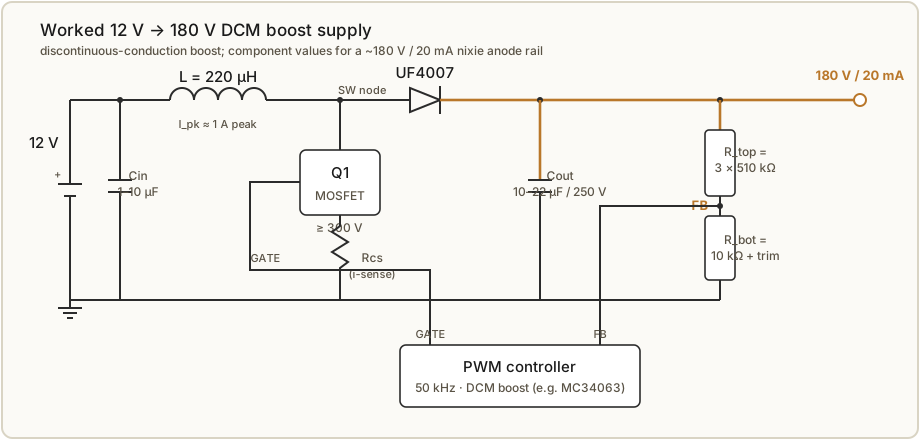
Take the § 3.1 target — 180 V at 20 mA, 3.6 W out — from a 12 V brick, and design the boost stage with the numbers shown.
Why you cannot run this in continuous mode. The textbook continuous-conduction-mode (CCM) boost relates output to input purely by duty cycle:
  Vout / Vin = 1 / (1 − d)   →   d = 1 − Vin/Vout
  Worked:  d = 1 − 12 V / 180 V = 1 − 0.0667 = 0.933  ≈ 0.93
A duty cycle of 0.93 means the switch is closed 93 % of every cycle and the rectifier conducts during only the remaining 7 %, so all the output charge is crammed into a sliver of each period — the peak currents balloon, the diode and switch losses dominate, and efficiency collapses. As a rule of thumb a practical CCM boost is held to a step-up ratio of about 5:1 (d ≈ 0.8); 180/12 = 15:1 is far past that. Two honest ways out exist: either use a flyback transformer whose turns ratio carries most of the 15:1 so the duty cycle drops back to a sane ~0.5 (§ 3.2), or — the common nixie answer — run the plain boost in discontinuous conduction mode (DCM), where the simple voltage-ratio formula no longer governs. In DCM the inductor current starts each cycle at zero, ramps to a peak, then is fully released into the output before the next cycle; the controller sets the peak current and the switching frequency, not a voltage-ratio duty cycle, and a 15:1 step is perfectly ordinary. This is precisely how an MC34063 nixie supply behaves.
Sizing the DCM boost. Pick a switching frequency the controller can sustain and work the energy balance:
  Choose  f_sw = 50 kHz,  η ≈ 0.70 (a modest HV boost)
  P_out = 180 V × 20 mA = 3.6 W   →   P_in = P_out / η = 3.6 / 0.70 = 5.1 W
  Average input current  I_in = P_in / Vin = 5.1 W / 12 V = 0.43 A

  Each cycle the inductor must store and release  E = P_in / f_sw
        E = 5.1 W / 50 000 Hz = 102 µJ per cycle

  With  E = ½·L·I_pk²  and a chosen  L = 220 µH:
        I_pk = √(2E / L) = √(2 × 10² µJ / 220 µH) = √(0.927) = 0.96 A  ≈ 1 A
So a 220 µH inductor running at 50 kHz with a ~1 A peak switch current delivers the rail. Two component ratings fall straight out of those numbers:
- The inductor must not saturate at 1 A — pick a part rated for ≥1.5 A saturation current (a 220 µH/2 A drum or toroid), and check its DCR so the I²R loss stays small (1 A through 0.3 Ω is only 0.3 W).
- The switch (MOSFET or BJT) sees the full output voltage plus margin on its drain when it is open — the drain flies up to Vout (180 V) plus the diode drop plus ringing, so use a MOSFET rated ≥300–400 V (an honest 2× margin) that can carry the ~1 A peak. A 300 V part is the floor; 400 V buys you ring-spike headroom.
The fast HV rectifier. This is the single part beginners get wrong. At 50 kHz a garden ordinary 1N4007 is useless — it is a 50/60 Hz rectifier with a slow reverse-recovery time, and at 50 kHz it spends a meaningful fraction of each cycle conducting backwards during recovery, dumping the output back toward the switch as heat. You need a fast/ultrafast recovery diode rated for the full rail with margin: the canonical nixie choice is the UF4007 — 1000 V, ultrafast — which is pin-compatible with the 1N4007 you must not use. Its 1000 V rating is luxurious for a 180 V rail, but it is cheap and it guarantees you will never lose a supply to diode breakdown or recovery loss.
The reservoir capacitor. It holds the rail up between the diode’s release pulses and sets the ripple. Voltage rating first: ≥250 V for a 180 V rail (never rate a cap at its working voltage — a 200 V cap on a 180 V rail is asking for it; 250 V or 400 V gives proper derating). Capacitance is set by the ripple you will tolerate:
  V_ripple ≈ I_load / (f_sw · C_res)
  With  C_res = 10 µF:
        V_ripple = 20 mA / (50 kHz × 10 µF) = 0.020 / 0.5 = 0.040 V = 40 mV pk-pk
40 mV on 180 V — about 0.02 % — is invisible on the tubes, and it is small only because the switching frequency is high. (This is the boost architecture’s quiet gift: the same 20 mA filtered by a 100 Hz line rectifier would need a far larger cap for the same ripple.) A 10–22 µF / 250 V reservoir is the typical nixie value; the upper end stiffens the rail against the load steps a clock makes as its digit count changes second to second.
3.5 Regulation and feedback
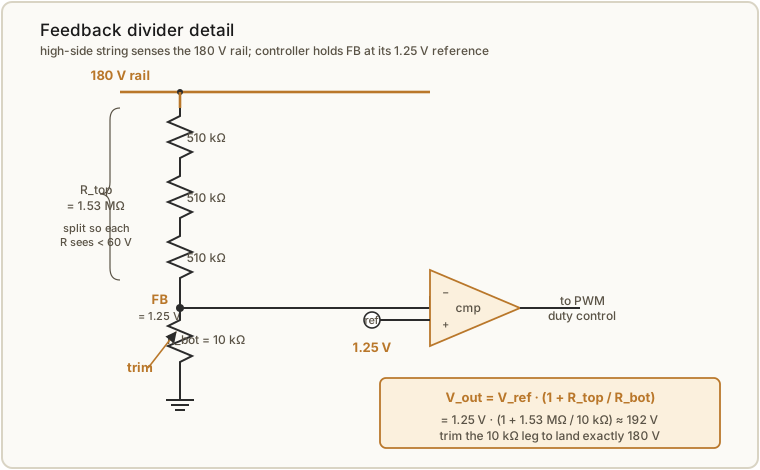
An unregulated boost would let the rail wander with input voltage and load — exactly the recipe for visible flicker — so every good nixie supply closes a feedback loop. The mechanism is universal: a resistor divider scales the high-voltage output down to the volt-or-two reference the controller can compare against, and the controller modulates the switch to hold that divided sample equal to its internal reference. For the MC34063 the reference is 1.25 V; for the MAX1771 it is 1.5 V. Working the MC34063 case:
  V_out = V_ref × (1 + R_top / R_bottom)     (R_top from rail to FB, R_bottom from FB to GND)

  Target 180 V with V_ref = 1.25 V:
        1 + R_top/R_bottom = 180 / 1.25 = 144   →   R_top/R_bottom = 143
  Choose R_bottom = 10 kΩ  →  R_top = 1.43 MΩ
  Pick the nearest values  R_top = 1.5 MΩ,  R_bottom = 10.5 kΩ:
        V_out = 1.25 × (1 + 1.5 MΩ / 10.5 kΩ) = 1.25 × 144.9 ≈ 181 V
Two practical notes that the bare formula hides:
- Divider current and dissipation. The string draws 180 V / 1.51 MΩ ≈ 119 µA, and the top resistor dissipates roughly (180 V)² / 1.5 MΩ ≈ 22 mW — negligible power, so the divider barely loads the rail and contributes a useful trickle of bleed (§ 3.7).
- ⚠ Voltage rating of the top resistor. A standard ¼ W axial resistor is rated for only ~200–250 V working voltage end-to-end, and a single 1.5 MΩ part sitting across the full 180 V rail is right at that limit with no creepage margin. Split R_top into two or three series resistors (e.g. 3 × 510 kΩ) so each sees ~60 V and the creepage distance is shared — this is standard HV-divider practice and costs nothing.
Trimming. A real supply makes R_bottom (or part of R_top) a trimmer so the rail can be set precisely; the NCH8200HV-class modules expose exactly this trimmer. Set it with the clock’s actual tube load connected, not open-circuit, because the rail sags slightly under load.
Load and line regulation, and what poor regulation looks like. Line regulation is how
much the rail moves when the 12 V brick droops; load regulation is how much it moves as the
digit count (hence the load current) changes second to second — 00:00 lights far fewer
cathode segments’ worth of current than 88:88. A regulated loop holds the rail flat
through both. If regulation is poor or the reservoir cap is undersized, the rail dips on the
heavily-lit seconds and recovers on the lightly-lit ones, and the eye sees this as the
whole display breathing or flickering in step with the count — the most common “my nixie
clock shimmers” complaint, and almost always a feedback/filtering problem rather than a tube
problem. The cure is a tighter loop (MAX1771 over a sloppy 555) and adequate reservoir
capacitance.
3.6 Measuring HV safely ⚠
A 180–200 V rail is, conveniently, within the direct DC range of any decent multimeter — a CAT III 600 V DMM reads 180 V on its volts range without a second thought, so unlike the kilovolt rails of the scope-clock hub you do not strictly need a high-voltage probe to read this rail. The danger here is not the meter’s range; it is the act of probing a live node. The discipline:
- ⚠ Clip, don’t poke. With the supply off and bled down (§ 3.7), attach the meter’s ground lead to the supply ground with an alligator clip, then clip the positive lead to the rail. Then power up and read. Probing a live 180 V point with a hand-held tip is how you end up with current across your chest when the tip slips.
- ⚠ One hand behind your back whenever a hand must be near a live HV node — keep both hands off the circuit at once so no hand-to-hand path across the heart can form.
- Mind the meter’s loading. A DMM presents ~10 MΩ input impedance. On the stiff main rail that is irrelevant, but if you probe a high-impedance node — the FB divider tap, or the raw top of a 1.5 MΩ string — the meter’s 10 MΩ loads the node and the reading reads low. Measure regulation at the reservoir cap, not in the middle of the divider.
- For anything above this rail (a multiplied rail, or for wider margin), a 10× or 100× HV probe, or a deliberate high-impedance series divider (e.g. 10 MΩ top into 100 kΩ bottom for ×101, read on the DMM and multiply), drops the meter voltage to a tenth or a hundredth and adds insulation between your hand and the rail.
- Never lay a bare probe casually on a live 200 V node “just to check” while your other hand rests on the chassis — that is how a survivable mistake becomes a fatal one.
3.7 Protection and the mandatory bleeder ⚠
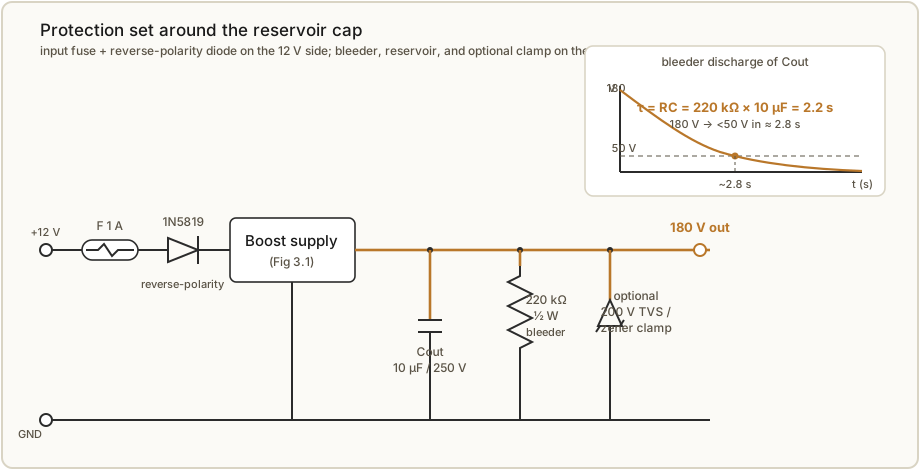
The single most important safety part in this whole volume costs a few cents: a bleeder resistor permanently across the reservoir capacitor, so that when the clock is switched off the stored charge drains to a touch-safe level on its own, in a known and bounded time, instead of lying in wait. Without it the reservoir cap holds 180 V for minutes — the feedback divider alone (1.5 MΩ) bleeds it only slowly (τ = 1.5 MΩ × 10 µF = 15 s, so ~45 s to get genuinely safe) — and a builder who unplugs the clock and reaches in ten seconds later gets the full jolt. The bleeder is not optional and it stays fitted in the finished build.
Sizing it is a trade between discharge speed and wasted power:
  Discharge is RC:  V(t) = V0 · e^(−t / RC),  τ = R·C
  Choose  R_bleed = 220 kΩ  across  C_res = 10 µF:
        τ = 220 kΩ × 10 µF = 2.2 s
  Time to fall from 180 V to a touch-safe < 50 V:
        t = τ · ln(180/50) = 2.2 s × ln(3.6) = 2.2 × 1.28 = 2.8 s
  Continuous power wasted while running:
        P = V² / R = (180 V)² / 220 kΩ = 32 400 / 220 000 = 0.147 W  →  use a ½ W part
So 220 kΩ / ½ W bleeds the rail from 180 V to under 50 V in under 3 seconds and wastes only 0.15 W keeping the clock running — a good balance. Push the resistor higher (470 kΩ) and you waste less but bleed slower; push it lower (100 kΩ) and it bleeds in a second but dissipates 0.32 W continuously. Whatever you choose, size the wattage for the continuous V²/R dissipation, not a fraction of a watt — a ¼ W part at 0.15 W runs hot; ½ W is the honest choice. As with the feedback divider, ⚠ split the bleeder into series resistors if a single part’s voltage rating is marginal.
Fusing. Put a fuse in the 12 V input — a shorted switch MOSFET turns the boost stage into a near-dead-short across the brick, and a 1 A slow-blow fuse on the input protects the brick and the board wiring from the resulting fault current. (Fusing the output side is less useful: at 20 mA the rail can’t deliver enough current to blow any sensible fuse before the damage is done — the input fuse is the one that matters.)
Reverse and overvoltage notes. Two failure modes deserve a guard:
- Runaway with no load / broken feedback. A boost converter with its feedback loop open (a cracked divider resistor, a cold solder joint on the FB pin) sees “output too low” forever and drives the switch to maximum, ramping the rail up until something breaks down — usually the reservoir cap or the rectifier. Never bench a boost supply with no load and no verified feedback; a permanent bleeder plus the always-present divider give the loop a defined bottom reference and a minimum load. For belt-and-suspenders, a series string of zeners or a TVS clamp across the rail at, say, 220 V caps a runaway before it destroys the cap.
- Reverse polarity on the input. A reversed 12 V brick can destroy the controller; a series Schottky or a reverse-protection MOSFET on the input is cheap insurance, present on most module designs.
The per-digit anode resistor that protects the tubes and the high-voltage drivers that switch the cathodes are Vol 4; the firmware that lights the digits is Vol 5; the complete worked supply inside the owned ATMega Cool Nixie Clock is Vol 6; and the safety discipline that keeps you alive — discharge procedure, one-hand rule, bleeder verification — is Vol 10, which you should have read before reaching this paragraph. A nixie supply is gentler than the scope-clock hub’s kilovolt rails, but “gentler” is not “safe”: 180 V at a few milliamps still stops a heart.
3.8 References (Vol 3)
- ATMega Based Cool Nixie Clock — designer files (ZM1210 display schematic showing the HV
boost stage and per-tube anode resistors, 74HC595/74141 driver chain, PCB gerbers
nixiepcb.zip,nix-in-17firmware). Held in02-inputs/ATMega Based Cool Nixie Clock/. - ON Semiconductor, MC34063A DC-DC converter control circuit datasheet (1.25 V reference, 1.5 A switch, boost configuration and timing-capacitor / current-sense design equations).
- Maxim Integrated, MAX1771 12 V/high-efficiency step-up controller datasheet (1.5 V reference, external-MOSFET current-mode boost).
- ON Semiconductor, NCP1402 PWM step-up converter datasheet (low-power boost reference for the charge-pump / ultra-low-power discussion).
- Vishay, UF4007 ultrafast 1000 V rectifier datasheet — the fast HV diode that replaces the too-slow 1N4007 in a switching nixie supply.
- Omnixie / NCH8200HV-class nixie HV module documentation (12 V → ~170–200 V boost module, trimmer-set output) — representative of the drop-in module path of § 3.3.
- Telefunken ZM1210 and Soviet IN-12 / IN-14 nixie tube datasheets (strike voltage, maintaining voltage, rated cathode current — the § 3.1 load numbers). Cross-referenced from Vol 2.
_shared/safety.md(hub-wide HV safety baseline) and Vol 10 (nixie-specific safety, discharge procedure, and bleeder verification).
Comments (0)