TIX · Volume 7
Buy a Kit or Finished Clock
The buy spectrum — finished novelty, documented clone, or your own design — and how to choose honestly
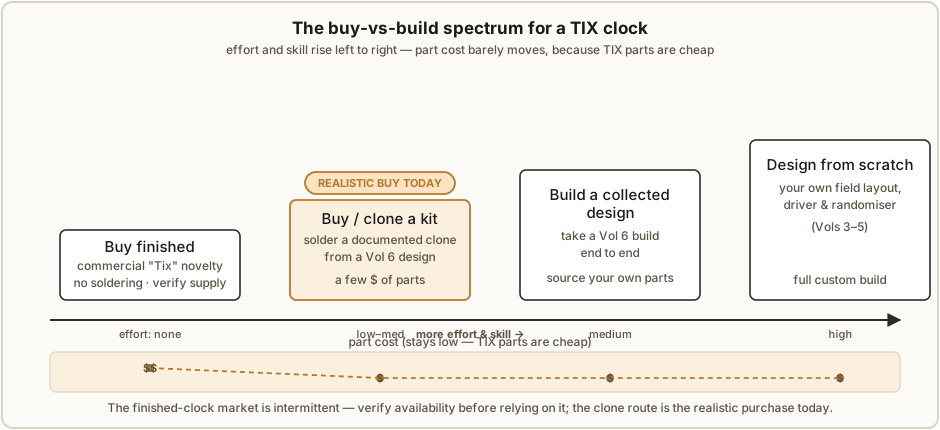
Not everyone reading this hub wants to solder. Some want a count-the-lights clock on the shelf by the weekend, and the honest question is: can you simply buy one? The short answer is yes, sometimes — and a clone is the more reliable path. The commercial “Tix” clock is a real product, but its availability has always come and gone, and there is no single dependable vendor this source can point you at. Meanwhile the two builds this hub documents (Vol 6) make a finished TIX clock out of a few dollars of commodity parts, which is why, for most makers most of the time, the realistic “buy” is a build. This volume lays out the whole spectrum without overselling any point on it: the finished-novelty genre and its uncertain supply; the clone-it route as the practical purchase; the adjacent clocks that look similar but read differently; a buyer’s checklist for whichever finished unit you find; and a skill/time/cost table that ties straight back to the Vol 1 decision tree.
The one thing this volume will not do is invent a store for you. TIX-brand units, kits, and prices move around enough that any specific seller or figure quoted here would be stale or wrong by the time you read it. Where this volume says “verify current availability,” it means exactly that — go and check; do not trust a number printed in a reference.
7.1 The finished commercial TIX clock
7.1.1 What it is
The commercial “Tix” clock is a genuine early-2000s desk novelty: a small mains- or USB-powered box with a panel of colour-coded LED cells that you read by counting, exactly the way the rest of this hub describes (Vol 2). It is the product that started the hobbyist interest — the count-the-cells encoding was clever and cheap enough that makers saw a finished unit and thought, “I could build that.” If you find one, it does what every clock in this series does: shows a 24-hour (or, on some, 12-hour) time as four counts of lit cells, re-rolling the random arrangement each minute, all at a safe low voltage.
What this source can say about the genuine article is deliberately narrow. It exists; it was a real product; and it is the direct ancestor of the DIY clones in Vol 6. Beyond that — the brand’s current owner, the active vendors, the model names, and the prices are not known to this source — and this volume will not guess at them. Treat any finished TIX clock you find as a member of a genre whose specifics you must confirm yourself before buying.
7.1.2 The SmarterEveryDay moment
Part of why the TIX clock is still rebuilt at all is a single piece of exposure: a TIX clock was featured on the SmarterEveryDay YouTube channel, and that is precisely how the uTixClock author (ujjaldey) came across the concept before building his Arduino clone.1 It is a small but load-bearing fact in this hub’s story: the commercial product seeded a popular-science video, the video seeded a maker, and the maker published a clone that this series now documents (Vol 6). The novelty and the DIY route are not separate worlds — the genre’s visibility is what keeps the clones coming.
7.1.3 Guido Seevens sold finished units too
The line between “commercial product” and “DIY project” is blurrier still, because the author of the most-cited DIY build also sold finished TIX clocks. Guido Seevens (“gweeds”), whose DIY TiX Clock Instructable anchors Vol 6, ran a website selling finished Tix clocks — and the uTixClock author noticed, while reading the Instructable, that “this website which sells the Tix Clock” belonged to the very same person whose build he was following.1 So a maker who documented a clone for free was, at the same time, a small-scale commercial seller of the finished article. That is characteristic of this niche: the people who build these clocks and the people who sell them overlap, and supply has correspondingly been small-batch and intermittent rather than a steady retail channel.
7.1.4 Availability — verify, don’t trust a printed number
The practical upshot for a buyer is a caution, stated plainly: finished TIX-clock supply has been intermittent, runs have come and gone, and this source cannot point you at a current seller, model, or price with any confidence. If you want to buy a finished unit:
- Search current listings yourself — marketplaces, the maker community, and any surviving vendor pages — and confirm the unit is actually in stock and ships, not a dead product page.
- Confirm it is a true TIX readout (count-the-cells, four colour fields) and not a binary clock or a generic LED-matrix clock dressed up with similar styling (§7.3).
- Run it past the buyer’s checklist (§7.4) before paying — especially 24 h vs 12 h and whether the time survives a power cut.
- Do not anchor on any price you read in a reference, including this one. There is no reliable street price to quote; the parts are cheap, but finished-novelty pricing is set by whoever happens to be selling, if anyone is.
If you cannot find a finished unit you trust — which is a real possibility — the clone route below is not a consolation prize. For most makers it is the better buy.
7.2 The clone / kit route — the realistic “buy” today
Because the encoding is simple and the parts are commodity, the most dependable way to get a TIX clock is to build one of the two documented designs. This hub treats that as a first-class purchase path, not a fallback, and Vol 6 is the full build; here is why it is the realistic option and what it costs in round numbers.
7.2.1 The two documented designs
Table 1 — 7.2.1 The two documented designs
| Design | Core | Timebase | Driver | Case | Build in |
|---|---|---|---|---|---|
| gweeds DIY TiX | AVR (ATmega-class), BASCOM-AVR | MCU crystal (no battery backup) | transistor-multiplexed matrix | milled wood (Rimu) | Vol 6 |
| ujjaldey uTixClock | Arduino Nano, C++ | DS1302 RTC, battery-backed | two 74HC595 shift registers | 3D-printed PLA+ | Vol 6 |
Both light the same 27-LED, 3/9/6/9 field layout (Vol 3) and both run from 5 V USB. They differ in exactly the axes a buyer cares about — does the time survive a power cut, do you need a 3D printer, do you prefer BASIC or Arduino/C++ — and Vol 1’s decision tree picks between them for you.
7.2.2 Rough order-of-magnitude cost
The headline of the clone route is that the parts are cheap, and that is the honest selling point. As a rough order of magnitude — not a quote — the uTixClock’s bill of materials (an Arduino Nano, a DS1302 RTC module, two 74HC595 shift registers, 27 LEDs, an LDR, resistors, Veroboard, and a 3D-printed shell) lands somewhere in the region of USD 15–30 of commodity components, depending on what you already have in your parts bin and where you source them. The gweeds DIY TiX is a similar few-dollars-of-parts proposition built around an AVR and discrete transistor drivers. These figures are ballpark only — treat them as “a couple of evenings and the price of a takeaway,” not as a price list, and verify current part costs when you actually buy.
What the clone route asks of you in return is skill and time, not money: soldering, a little microcontroller flashing (Vol 5), and the patient diffuser work that makes or breaks the look (Vol 8). That trade — low cash, real hours — is the whole shape of the TIX hobby.
7.2.3 Why this is the practical path
Three reasons the clone is usually the better “buy” than hunting a finished unit:
- Supply is in your hands. No waiting on an intermittent vendor; the parts are stocked everywhere and the design files are public (Vol 6 references).
- You get exactly the features you want — RTC backup, auto-dim, 24 h vs 12 h, the enclosure material — instead of whatever a novelty happened to ship with.
- It is the safest, gentlest build in the hub (Vol 1): 5 V USB, no high voltage, a beginner-friendly soldering project that still produces a real conversation piece.
The cost of admission is that you must be willing to solder. If you are not, you are back to §7.1 and its caveats — or to one of the adjacent clocks below.
7.3 Adjacent buyable alternatives (and how they differ)
If a finished TIX is hard to find and you do not want to solder, the temptation is to buy something that looks similar. Several adjacent products are readily purchasable, but each reads differently from a true TIX clock, and it is worth being clear about the difference before you spend.
7.3.1 Commercial binary clocks
Binary clocks are widely sold and visually cousins of the TIX clock — a grid of LEDs, no numerals. But they are not the same readout. A binary clock encodes each digit in base 2 and you read it by the positions of the lit LEDs (weights 8-4-2-1); a TIX clock encodes each digit as a plain count and you read it by how many cells are lit, never by which. That distinction is the whole personality of the TIX clock: because position carries no information, a TIX can scatter its lit cells at random and re-roll them every minute, which a binary clock can never do (move a binary LED and you have changed the number). If you buy a binary clock expecting the shimmering, re-randomising TIX behaviour, you will be disappointed — it is a different, fixed-position encoding (Vol 2 treats the boundary in full).
7.3.2 Generic LED-matrix desk clocks
There is a large genre of LED-grid or “pixel” desk clocks that show the time as scrolling or block numerals on a dot-matrix panel. These are easy to buy and often attractive, but they display actual numerals (or words), not a count of cells — they are not a count-encode clock at all. They share the LED grid and nothing of the TIX reading rule.
7.3.3 WS2812 “smart-LED” boards as a clone substrate
Worth flagging for the maker-minded: WS2812 addressable-LED boards and matrices are cheap, ubiquitous, and make an easy modern substrate for a TIX clone. Each LED is individually addressable over a single data line, so you can drop the transistor-matrix or shift-register driver entirely and just set the cells you want lit — which maps very naturally onto “light N random cells in this field.” This is not a TIX-brand product; it is a build idea (a Path-4 from-scratch design in Vol 1 terms, firmware in Vol 5). If you are comfortable in code, a WS2812 panel is arguably the lowest-effort modern way to a TIX-style clock — but it is still a build, not a purchase.
The takeaway: of the buyable alternatives, none is a drop-in substitute for a true TIX readout. Binary clocks read positions; matrix clocks read numerals; WS2812 boards are a clone substrate, not a finished product. Choose them knowing what they are.
7.4 A buyer’s checklist
Whether you are eyeing a finished novelty (§7.1) or speccing a clone to build (§7.2), the same handful of features decide whether you will be happy with it. Check each before you commit.
- 24 h vs 12 h. A 24-hour face needs the full 3/9/6/9 field layout; a 12-hour variant needs only 1/9/6/9 because the tens-of-hours is ever only 0 or 1 (Vol 2/3). Decide which you want and confirm the unit actually does it — some finished clocks are 12 h only.
- RTC battery backup. Does the time survive a power cut? The uTixClock’s DS1302 has a backup cell; the bare-AVR gweeds build keeps time only while powered (Vol 5). For a clock you unplug or that shares a switched outlet, backup matters.
- Auto-dim. Is there a light-dependent resistor (or equivalent) that dims the display in a dark room? Undimmed LEDs can be glaring at night; the uTixClock includes an LDR auto-dim (Vol 4).
- Diffusion / finish quality. This is the single biggest determinant of how good a TIX clock looks. Are the cells clean, evenly-lit squares, or nine visible round dots per field? The square-cell look is a diffuser effect, not an LED shape (Vol 8). On a finished unit, judge it from a real photo, face-on; on a clone, budget time for the diffuser stack.
- How the time is set. Buttons? An RTC that holds time across power cuts? A serial/code upload? Confirm there is a sane way to set and correct the time — and, on a clone, that the firmware exposes it (Vol 5).
- Enclosure material. Wood (milled, as in the gweeds build), 3D-printed plastic (PLA+, as in the uTixClock), or an off-the-shelf box. This is taste and durability; just know what you are getting, and that a good enclosure plus window is half the finished look (Vol 8).
A finished unit that passes all six is a good buy. A clone lets you guarantee all six by choosing them yourself — which is, again, why the clone route is so often the better purchase.
7.5 Skill / time / cost trade-off
Here is the whole spectrum in one table, aligned to the four paths of the Vol 1 decision tree. It is the buyer’s-eye companion to that tree: read down the column that matches how much you want to do yourself.
Table 2 — 7.5 Skill / time / cost trade-off
| Buy finished | Build a clone | Design from scratch | |
|---|---|---|---|
| Vol 1 path | Path 1 | Path 2 / 3 | Path 4 |
| Skill needed | none | beginner soldering + a little MCU flashing | electronics design + firmware |
| Time | minutes (if you can find one) | a couple of evenings + diffuser work | weeks of design + iteration |
| Cash cost | unknown — verify; novelty pricing | ~USD 15–30 of parts (rough order of magnitude) | similar parts cost, much more of your time |
| Availability | intermittent — verify current sellers | excellent — commodity parts, public files | excellent — you source everything |
| You control features | no — whatever it ships with | yes — RTC, auto-dim, 24/12 h, case | fully |
| Covered in | Vol 7 (§7.1) | Vols 6, 7 | Vols 3–5 |
Read the table the way Vol 1’s decision tree reads: stop at the first row that fits. If you genuinely just want a finished clock and can find one you trust, buy it (§7.1, with the checklist). If you can hold a soldering iron, the clone is cheap, available, and yours to spec — the realistic buy for most readers. And if you want to bend the encoding to your own ideas — a different field layout, a 12-hour face, WS2812 cells, your own randomiser — that is Path 4 and the engineering volumes (Vols 3–5) are where you will live.
Whichever path you pick, the look comes down to the diffuser stack and enclosure (Vol 8) — the electronics will work the first time, but a TIX clock with undiffused LEDs looks unfinished no matter how it was sourced.
7.6 References (Vol 7)
- DIY TiX Clock by gweeds (Guido Seevens), Instructables, 2011 — the AVR /
transistor-multiplexed collected build; author also sold finished TIX clocks. Held in
02-inputs/DIY-TiX-Clock.pdf. Source: http://www.instructables.com/id/DIY-TiX-Clock/. - uTixClock by ujjaldey, Instructables — the Arduino Nano + DS1302 + 2×74HC595 collected
clone; prompted by a TIX clock shown on SmarterEveryDay; credits Seevens’s design. Held in
02-inputs/UTixClock.pdf. Source: https://www.instructables.com/id/UTixClock/. - Cross-references: Vol 1 (the four buy/build paths and the decision tree), Vol 2 (TIX vs binary — why the readouts differ), Vol 6 (the two builds end to end), Vol 8 (diffuser stack and enclosure — the finished look).
Footnotes
-
Sourcing facts in this volume come from the two collected builds and the shared TIX source facts for this hub. The commercial “Tix” clock is a real early-2000s desk novelty that was featured on the SmarterEveryDay YouTube channel — which is how the uTixClock author found the concept. Guido Seevens (“gweeds”), author of the collected DIY TiX Clock, also sold finished TIX clocks commercially; the uTixClock author found “this website which sells the Tix Clock” and realised it belonged to the same person whose Instructable he was reading. Beyond these facts, the brand’s current availability, vendors, model names, and prices are not known to this source and are not asserted here — verify current availability yourself before buying. The rough USD 15–30 parts figure for the uTixClock is an order-of-magnitude estimate of commodity-component cost, not a quoted price. ↩ ↩2
Comments (0)