TIX · Volume 2
Reading a TIX Clock — the Encoding
Count, don't locate: the four colour fields, why they are sized 3/9/6/9, and how a digit becomes a count of lit cells
A TIX clock keeps its secret in plain sight. The face is lit, the pattern is obvious, and a first-time viewer still cannot read it — because the one instruction they are missing is the whole of the encoding: count the lit cells; ignore where they are. Vol 1 stated the rule in a sentence and a figure; this volume takes it apart properly. We define the count-not-position rule rigorously, walk the four colour fields and why each is the size it is, map a time to four counts and back with a fistful of worked examples, and then justify the single most surprising property of the clock — that it can scramble its own display every minute and still tell the same time. We close with an information-theory aside that explains, with numbers, why a TIX clock “wastes” most of its LEDs, and why that waste is exactly the point.
Everything here is about the reading. The physical grid of LEDs and its diffusion are Vol 3; the firmware that chooses which cells to light is Vol 5. This volume is the contract between them: the rule both must honour for the clock to mean anything.
2.1 The count-not-position rule, stated rigorously
Let a field be a fixed set of n LED cells of one colour. At any minute some subset of those cells is lit. Write k for the number of lit cells — the count. The encoding is:
The digit a field displays is k, the number of its cells that are lit. The identity of which cells are lit carries no information whatsoever.
Formally, two lit-cell patterns P₁ and P₂ in the same field are equivalent — they
display the same digit — if and only if |P₁| = |P₂|, that is, if they have the same number of
lit cells. Their positions, their adjacency, their left-or-right arrangement: all irrelevant.
A field of n cells therefore has exactly n + 1 distinguishable states (counts 0, 1, 2, …,
n), no matter how many physical arrangements — 2ⁿ of them — those states are spread
across.
This is the formal sense in which a TIX clock is unary, or base-1: a digit d is represented by d tally marks (lit cells), and you read it by tallying. It is not a binary clock. A binary clock assigns each LED a positional weight (8, 4, 2, 1) and you read the pattern; move one LED and the value changes. A TIX field assigns every cell the same weight — one — so the pattern is free to change without the value changing. That single difference (weight-by-position vs weight-all-equal) is the clock’s entire personality, and §2.4 shows what it buys.
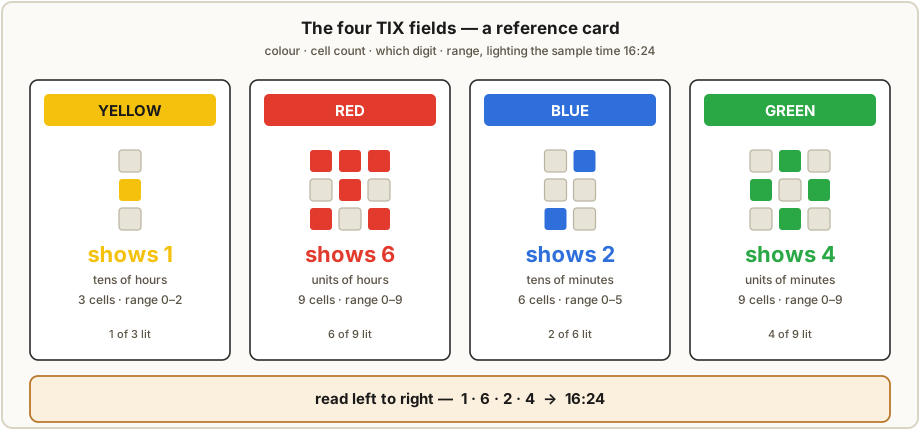
2.2 The four fields: colour, size, digit, range
A 24-hour time is four decimal digits, H₁ H₀ : M₁ M₀. TIX gives each its own field, in
reading order left to right, and colours each field distinctly so four counts never blur into
one. The collected builds — gweeds’ DIY TiX and ujjaldey’s uTixClock — both use the same scheme
of yellow / red / blue / green and the same 3 / 9 / 6 / 9 cell counts, for 27 LEDs
total.12
Table 1 — 2.2 The four fields: colour, size, digit, range
| # | Field (colour) | Cells | Digit | Range it must cover | Why this size |
|---|---|---|---|---|---|
| 1 | yellow | 3 | tens of hours H₁ | 0–2 | largest value is 2 (the “2” of 23h) |
| 2 | red | 9 | units of hours H₀ | 0–9 | largest value is 9 |
| 3 | blue | 6 | tens of minutes M₁ | 0–5 | largest value is 5 (the “5” of :59) |
| 4 | green | 9 | units of minutes M₀ | 0–9 | largest value is 9 |
The sizing rule is simple and worth stating because it is the only reason the field sizes look irregular: each field has exactly as many cells as the largest digit it ever needs to show. A unary field of n cells can display 0…n, so to show a maximum digit d you need n = d cells — no more (the extra cells would never light), no fewer (you could not reach d).
- Tens of hours in 24-hour time runs 0, 1, 2 only (00–09h → 0, 10–19h → 1, 20–23h → 2), so its maximum is 2 and it needs 3 cells. (Three cells, max count 3, so the state “3” is unreachable and unused — a deliberate spare, since the digit never exceeds 2.)
- Units of hours runs 0–9, maximum 9, needs 9 cells.
- Tens of minutes runs 0–5 (minutes are 00–59), maximum 5, needs 6 cells.
- Units of minutes runs 0–9, maximum 9, needs 9 cells.
Hence 3 / 9 / 6 / 9. The colours are a reading aid, not part of the maths: with four counts to take in at a glance, distinct hues let the eye segment the face into fields without rules or gaps doing the work (Vol 3 covers colour choice and the square-cell look).
2.2.1 The 12-hour variant: 1 / 9 / 6 / 9
Drop to a 12-hour face and only the first field changes. Hours then read 1–12, so the tens-of-hours digit is only ever 0 (for 1–9 o’clock) or 1 (for 10, 11, 12) — maximum 1, needing just 1 cell. The layout becomes 1 / 9 / 6 / 9, a 25-LED clock. The other three fields are identical because units-of-hours (now 0–9, e.g. the “2” of 12), tens- and units-of-minutes are unchanged. The collected builds are both 24-hour, so 3/9/6/9 is the layout this series carries throughout; the 12-hour case is noted for designers laying out their own face (Vol 3).
2.3 Mapping a time to four counts, and reading one back
The encoding is a two-way street. To encode a time, split it into its four digits and light that many cells in each field. To decode, count and concatenate.
Encoding HH:MM → counts:
H₁ = ⌊HH / 10⌋→ lightH₁of the 3 yellow cells.H₀ = HH mod 10→ lightH₀of the 9 red cells.M₁ = ⌊MM / 10⌋→ lightM₁of the 6 blue cells.M₀ = MM mod 10→ lightM₀of the 9 green cells.
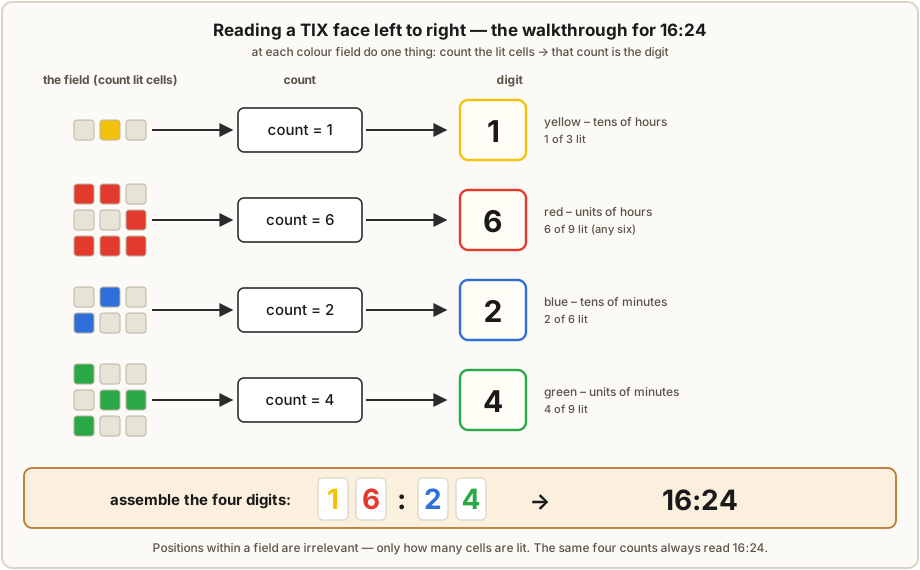
Decoding (the fluent reading technique) is the reverse, and it is genuinely fast once the colours are learned. Scan left to right by colour, and at each field do one thing — count:
- Yellow — count lit cells → tens of hours.
- Red — count lit cells → units of hours.
- Blue — count lit cells → tens of minutes.
- Green — count lit cells → units of minutes.
Then concatenate: (yellow)(red):(blue)(green). No place-value arithmetic, no weighting — four
small counts, each 0–9, read off in order. With practice you stop counting the larger fields
one-by-one and start recognising small quantities at a glance (the perceptual trick called
subitising handles up to four or five lit cells without deliberate counting), so a TIX clock
becomes nearly as quick to read as numerals once the colour order is reflex.
2.3.1 Worked examples
The five canonical examples below are taken directly from the uTixClock source’s own worked
cases, written here as aY bR cB dG = “a yellow, b red, c blue, d green cells lit”.2 The last
two are the extremes of the range.
Table 2 — 2.3.1 Worked examples
| Lit counts | H₁ H₀ : M₁ M₀ | Reads | Note |
|---|---|---|---|
| 0Y 0R 0B 0G | 0 0 : 0 0 | 00:00 | midnight — see the quirk in §2.5 |
| 0Y 1R 1B 2G | 0 1 : 1 2 | 01:12 | one red, one blue, two green |
| 1Y 1R 3B 9G | 1 1 : 3 9 | 11:39 | |
| 1Y 6R 2B 4G | 1 6 : 2 4 | 16:24 | the Vol 1 hero time |
| 2Y 3R 4B 7G | 2 3 : 4 7 | 23:47 | |
| 2Y 3R 5B 9G | 2 3 : 5 9 | 23:59 | the maximum — every field near full |
| 0Y 0R 0B 0G | 0 0 : 0 0 | 00:00 (blank) | the minimum — every field dark |
Work one by hand. 16:24: tens-of-hours ⌊16/10⌋ = 1 → 1 yellow; units-of-hours
16 mod 10 = 6 → 6 red; tens-of-minutes ⌊24/10⌋ = 2 → 2 blue; units-of-minutes
24 mod 10 = 4 → 4 green. So 1Y 6R 2B 4G, exactly the count in the table. Reading it back is
the same steps in reverse: see one yellow, six red, two blue, four green → 1 6 : 2 4 → 16:24.
The maximum the clock can ever show is 23:59 = 2Y 3R 5B 9G — two of three yellow, three of nine red, five of six blue, nine of nine green. No field is ever fully lit and maximal at once except green; the blue field at its maximum shows 5 of 6, the yellow shows 2 of 3, because those fields carry a deliberate spare cell (§2.2). The minimum is 00:00, all fields dark — which, on the shipped uTixClock, is exactly what midnight looks like (§2.5).
2.4 Randomisation as the reader experiences it
Here is the property that makes a TIX clock more than a colour-coded tally. Because position carries no information (§2.1), the firmware is free to choose which cells light up to reach each field’s count — and it re-rolls that choice every minute.2 A reader watching 16:24 for its full minute sees one frozen arrangement; come back at 16:25 and not only has green ticked from 4 to 5, but the whole face has reshuffled, every field’s lit cells flung to new positions even where the count did not change.
Make this concrete. The units-of-minutes field is 9 cells showing, say, 4. The number of ways to choose which 4 of 9 cells are lit is
C(9, 4) = 9! / (4! · 5!) = 126so “units = 4” alone has 126 distinct faces. Multiply across all four fields and a single time
like 16:24 — C(3,1) · C(9,6) · C(6,2) · C(9,4) = 3 · 84 · 15 · 126 = 476 280 distinct
lit-cell arrangements, every one of them reading 16:24. The clock will, quite literally, almost
never show you the same face twice for the same minute.
Why a binary clock cannot do this. In a binary field the LEDs are weighted 8-4-2-1 and the
value is the pattern: light the 8-cell and the 4-cell and you have 12; move either lit cell to
a different position and you have a different number (or nonsense). There is exactly one
valid arrangement per value, so a binary clock has nothing to randomise — its display is
pinned. A TIX field, weighting every cell equally, has C(n, k) valid arrangements for the
value k, and the randomiser is free to walk among them at will. The shuffling is not a
gimmick bolted on; it is a direct consequence of choosing a count encoding over a positional
one. (Vol 5 covers how the firmware actually draws the random subset each minute.)
This is why §2.1 insists the rule be stated as an equivalence: the clock treats all
C(n, k) arrangements of a count as the same display, and exploits that equivalence as its
signature visual effect. The randomness is the encoding wearing its inefficiency proudly.
2.5 Edge cases and unambiguity
Counts are never ambiguous. Because a field’s value is just “how many are lit,” there is no pattern to misparse — no leading-zero confusion, no orientation to get wrong, no two values that share an arrangement. Every face maps to exactly one time, and the only way to misread it is to miscount. The fields’ fixed colours and sizes mean even a half-lit display is unambiguous: three of nine red is always 3, wherever the three sit.
The blank-midnight quirk. At 00:00 all four digits are zero, so every field is dark and the entire face goes blank — there is genuinely nothing lit. On the shipped uTixClock build this is a known quirk: midnight reads as an unlit clock rather than, say, a deliberate “all cells briefly flash” indicator, so for one minute a powered, working clock is indistinguishable from an unpowered one.2 It is harmless (00:01 lights a single green cell and the face returns) but worth knowing before you assume a dark clock has lost power. The source documents the behaviour but not a workaround; designing one (a heartbeat cell, or showing 00:00 as a brief full-face test) is left to the builder and noted in Vol 5.
The near-full 23:5x cases. At the top of the range the face is dense: 23:5x lights two of three yellow, three of nine red, five of six blue, and the green field marching 0→9 through the final ten minutes of the hour. 23:59 (2Y 3R 5B 9G) is as full as the clock ever gets — and is a good calibration face, because if green ever reads 10 (impossible — only 9 cells) or blue reads 6 (impossible at any real minute — tens-of-minutes never exceeds 5) you have a wiring or firmware fault, not a time. The unused states (yellow’s “3”, blue’s “6”) are useful precisely as impossible readings: they should never appear, and if they do, something is wrong (Vol 5).
2.6 An information-theory aside: the productive waste
A TIX clock spends 27 LEDs to show a time that a four-digit numeric display shows in four characters, and it is worth seeing how extravagant that is, because the extravagance is the aesthetic.
A field of n cells using a unary count has n + 1 states and therefore carries
log₂(n + 1) bitsof information, regardless of its n physical LEDs. The 9-cell red field carries
log₂(10) ≈ 3.32 bits but spends 9 LEDs to do it. A positional binary code would carry those
same ~3.32 bits in 4 LEDs (4 bits = 16 states ≥ 10); a BCD seven-segment digit uses 7
segments but each segment is positional, so it too beats unary on LED count for the larger
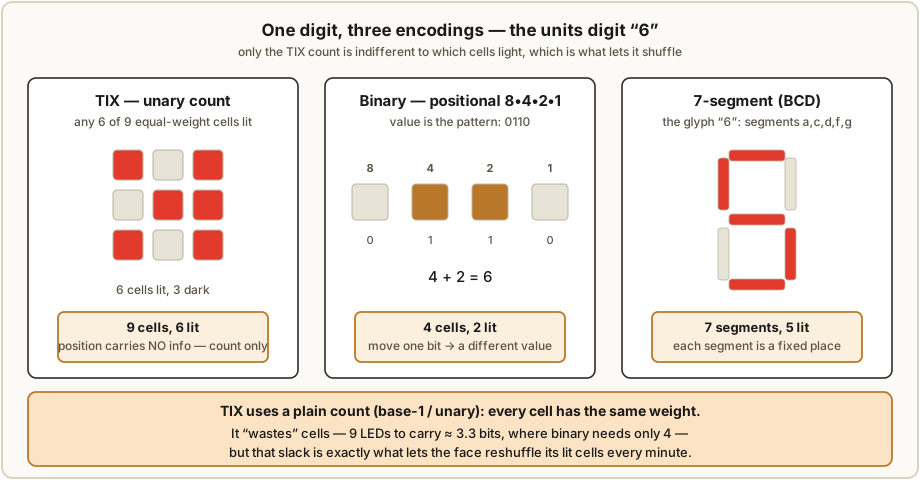
digits. Unary is the least dense encoding there is — it spends one LED per unit of value — and
that is the deliberate trade: the “wasted” cells are the slack the randomiser plays in (§2.4).
A denser code would be unshuffleable.
Tally it across the whole clock: 27 LEDs carry, at most,
log₂(3+1) + log₂(9+1) + log₂(5+1) + log₂(9+1) =
2 + 3.32 + 2.58 + 3.32 ≈ 11.2 bits — and a day has 1440 minutes, needing only
log₂(1440) ≈ 10.5 bits, so the clock’s encoding is even a little more wasteful than the
fields’ raw capacity suggests (the impossible states — yellow 3, the unreached high counts —
account for the slack). A purely positional binary clock shows all 1440 minutes in 11 LEDs.
TIX uses 27. The 16 “extra” LEDs buy nothing but the count-not-position aesthetic and the
half-million reshufflings of §2.4 — which, for a desk object whose entire job is to be quietly
interesting, is a bargain.
The table below shows the same single digit — a units digit of value 6 — rendered three ways, to make the density difference tangible.
Table 3 — 2.6 An information-theory aside: the productive waste
| Encoding | How “6” is shown | Cells used | Cells lit for “6” | Position carries info? |
|---|---|---|---|---|
| TIX (unary count) | 6 of 9 same-weight cells lit, anywhere | 9 | 6 | no — count only |
| Binary (positional) | weights 8-4-2-1 → light 4 and 2 | 4 | 2 | yes — pattern is the value |
| 7-segment (BCD) | segments a,c,d,f,g lit (the glyph “6”) | 7 | 5 | yes — each segment is a fixed place |
2.7 Summary — the encoding in five lines
- A TIX clock shows 24-hour
HH:MMas four colour fields; the count of lit cells in each is one digit, and the positions are meaningless. - The fields are yellow / red / blue / green, sized 3 / 9 / 6 / 9 to their largest digit (a 12-hour face is 1 / 9 / 6 / 9); 27 LEDs in the collected 24-hour builds.
- Read left-to-right by colour: count, count, count, count →
(Y)(R):(B)(G). - Because position is information-free, each count has
C(n, k)valid faces, so the firmware re-rolls the arrangement every minute — something a positional binary clock cannot do. - The encoding is deliberately unary (most LEDs are “wasted”); that inefficiency is the slack the randomiser lives in, and the whole aesthetic of the clock.
The physical display that these counts live on — the LED grid, the colours, the square cells and diffusion — is Vol 3; the firmware that computes the four counts and draws the random subset each minute is Vol 5.
2.8 References (Vol 2)
Footnotes
-
DIY TiX Clock by gweeds (Guido Seevens), Instructables, 2011 — AVR (ATmega-class) in BASCOM-AVR scanning a transistor-multiplexed LED matrix; yellow/red/blue/green fields, 3/9/6/9 cells, 27 LEDs, 24-hour. Held in
02-inputs/DIY-TiX-Clock.pdf. Source: http://www.instructables.com/id/DIY-TiX-Clock/. ↩ -
uTixClock by ujjaldey, Instructables — Arduino Nano + DS1302 RTC + two 74HC595 shift registers, 27 LEDs (Y3 / R9 / B6 / G9), 24-hour, per-minute random arrangement. The worked examples (00:00, 01:12, 11:39, 16:24, 23:47) and the blank-midnight behaviour are taken from this build’s source. Held in
02-inputs/UTixClock.pdf. Source: https://www.instructables.com/id/UTixClock/. ↩ ↩2 ↩3 ↩4
Comments (0)