Numitron · Volume 9
Care, Reliability & Low-Voltage Safety
Why the clock can't bite you, why the tubes are the fragile part, and how to make a Numitron last its rated decade
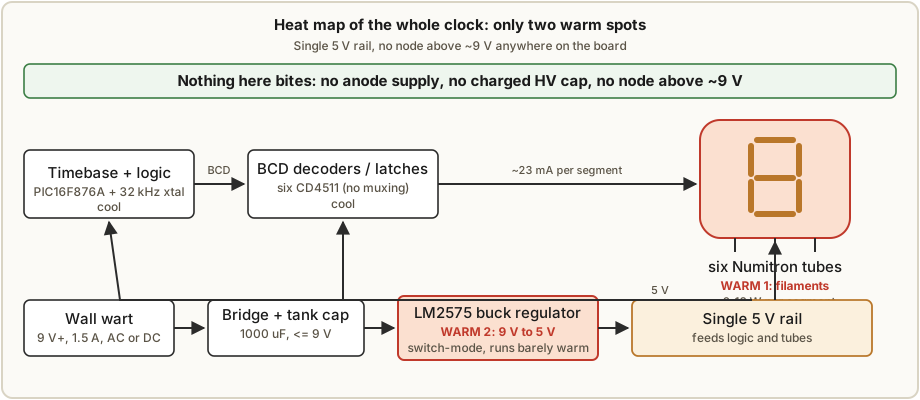
Every other deep dive in this hub opens its safety volume with a warning. The Scope/CRT volume opens with several kilovolts and a tube that can implode; the Nixie volume opens with a 170 V anode rail and the reminder that sustained DC is hard to let go of. This volume opens with a shrug. A Numitron clock runs on a single 5 V rail, drawn from a wall wart through a buck converter, and there is no high voltage anywhere in it — no anode supply, no charged filter capacitor lying in wait, nothing that can hurt you. As the designer’s own user manual puts it, in plain capitals, the clock “USES A SAFE LOW VOLTAGE.”1
So this volume inverts the usual frame: the thing that needs protecting is not you but the tubes. Numitrons are scarce cold-war surplus (Vol 6), fragile vacuum devices whose flexible fly leads transmit any bending stress straight to a glass seal, and once a tube loses its vacuum it is dead and cannot be repaired. Everything here — reading the getter, handling the leads, running the filaments a touch cool, keeping static off the SMD chips — is about making a six-tube clock last the decade-plus its tubes are rated for. The genuine electrical-safety section is short and honest, and comes first to get it out of the way.
9.1 Low-voltage safety, stated honestly
The honest version takes one paragraph, and then one caveat.
The clock is powered by an external wall wart — the designer specifies one able to supply at least 1.5 A at a minimum of 9 V, AC or DC — feeding a bridge rectifier and a 1,000 µF tank capacitor, then an LM2575 switch-mode buck regulator that steps everything down to the 5 V the logic and the tubes run on.2 The mains-to-low-voltage conversion happens inside the wall wart, out in the plastic brick where it belongs, behind its own approvals. Everything on the clock board itself lives at 9 V or below, and the business end — the part you actually touch when setting the time or swapping a tube — is at 5 V. There is no node on the board that can deliver a shock. The user manual notes the designer would still rather you didn’t poke a powered board (good habit, not a hazard), but states outright that it “IS SAFE IF USED WITH THE POWER SUPPLY PROVIDED.”1
The one real caveat is moisture, and it is a caveat about the clock, not about you. The manual is explicit: do not operate the clock in a damp or wet environment — “NOT THAT THIS WOULD NECESSARILY BE DANGEROUS, BUT IT WILL DAMAGE THE CLOCK.”1 At 5 V there is no electrocution risk from a little condensation; the failure mode is corrosion and leakage current quietly killing traces, the SMD chips, and the bare fly-lead solder joints at the tube bases. Keep the clock dry for the clock’s sake, not for yours. Beyond that, ordinary bench care applies — don’t short the supply, mind the soldering iron — exactly as the hub’s shared safety baseline files Numitron under its lowest tier: “the hazard there is component damage, not personal injury.”3
9.1.1 The only things that get warm
Because there is no high voltage, there is also very little heat, and it comes from exactly two places.
The first is the tubes themselves. Each lit segment is a tungsten filament running white-hot — that is the whole point — but the power involved is tiny: about 5 V × 23 mA ≈ 0.12 W per segment.4 A digit averages four or five lit segments, six digits gives the clock a steady-state draw on the order of 2–3 W of glowing filament, and the brief all-segments-lit startup flash peaks higher (the math is in 9.1.2). This is warm-to-the-touch at most, nothing like a real light bulb’s envelope.
The second is the LM2575 buck regulator, with a small design story behind it. The designer “considered a linear regulator” for the 5 V rail, but in testing “the part became hotter than I was comfortable with while testing in a circuit like this,” so he switched to the switch-mode buck converter instead.2 That is the textbook reason to prefer a buck at this load: a linear part burns the entire input-to-output voltage difference as heat (dropping 9 V to 5 V at ~1 A means dissipating ~4 W in the regulator), whereas a switching buck converts most of that excess and runs cool. See Vol 5’s power-supply walk-through for the full circuit; the takeaway here is that the LM2575 is the warmest component on the board and was chosen to be barely warm. (The construction manual notes it may be mounted with a screw and isolation pad, but that this is “not required”5 — a sign of how little heat it makes.)
9.1.2 The current budget, and why the supply is oversized
The startup self-test lights all segments of all six tubes at once for about a second. The designer works the arithmetic out directly: 7 segments × 6 tubes × ~23 mA ≈ 966 mA — “very close to the one amp limit when all Numitron segments are lit when first plugged in (or after reset).”6 That is why the specified wall wart wants 1.5 A minimum: the headroom covers the inrush surge plus the LED ring plus regulator overhead, so the supply never sags at the worst instant of every power-up. In normal timekeeping the tubes draw far less than that peak — only the digits’ lit segments draw current, and the clock spends its life well under half an amp.
9.2 Tube lifetime: a rated decade, and the failure mode that matters
Here is the headline number, and the reason a Numitron clock is a keeper rather than a consumable. The article claims Numitrons are “typically rated for over 100,000 hours (~11.5 years) of operation,” and draws the contrast deliberately: “compared to some Nixies that are rated for only 5,000 hours (~200 days!).”7 Run continuously, a healthy IV-9 should outlast more than a decade of the build, the enclosure, and quite possibly your interest in it.
That longevity rests on what a Numitron is. As established in Vol 2, it is “not a traditional tube (valve) in that there is no electron emission involved; it only has filaments, and as such is more analogous to the light bulb than any other electrical device.”8 No electron emission means none of the slow-poison failure modes that limit a nixie’s life. The article spells out the three a Numitron is immune to: it does not suffer sputtering, where electrode metal slowly coats the inside of the glass and dims the display; it does not suffer cathode poisoning, “that requires a potentially distracting anti-cathode poisoning software routine”; and it carries none of the high-voltage baggage that goes with a glow-discharge tube.7 One practical consequence for the firmware (Vol 4): a Numitron clock needs no anti-poisoning / cathode-exercise routine at all — there is no cathode to poison and nothing to exercise. The PIC just keeps time.
So what does end a Numitron’s life? Two things, in order of how likely you are to cause them: a lost vacuum (almost always self-inflicted, through mechanical mishandling), and a burned-out filament (slow, and largely under your control through how hard you drive it). The rest of this volume is those two stories.
9.3 What kills a Numitron, and how to avoid it
9.3.1 Cracked seal / lost vacuum — the number-one killer
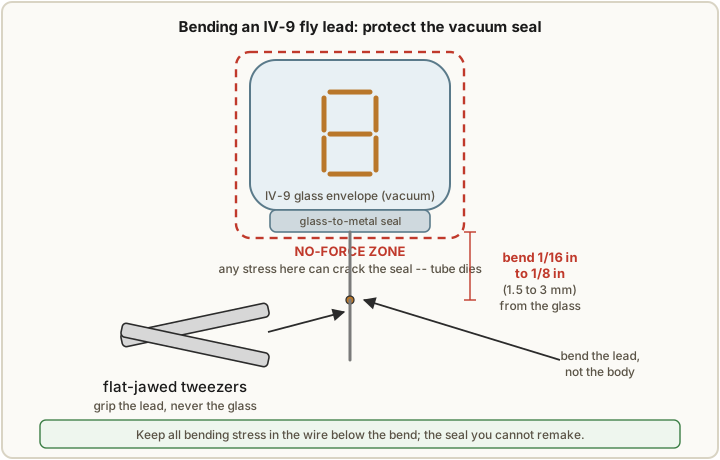
The IV-9 is still a vacuum tube, and “the wires of the IV-9 pass via a sealed hole through the glass envelope. Great care must be taken to ensure no stress (from bending or soldering) is transferred to the glass, which may cause it to crack.”9 This is the single most common way a hobbyist destroys a tube, and it happens at exactly one moment: when you straighten and bend the fly leads to fit the board. Those leads are not just wires — they are the seal. Force applied to a lead, or worse to the glass body itself, can fracture the glass-to-metal seal, air leaks in, and the vacuum is gone.
The construction manual’s rule is precise: hold the tube gently with flat-jawed tweezers, and bend each lead approximately 1/16” to 1/8” (≈ 1.5–3 mm) from the glass, putting “absolute minimum stress on the glass of the tube.”10 Bend the lead, never the body. Support the lead between the bend and the glass so the stress stays in the wire and never reaches the seal. Take the same care when soldering — let the joint cool before you move the tube, and don’t tug a lead to reposition a half-soldered tube. Vol 5 covers the full lead-forming sequence step by step; this volume’s contribution is the why: every one of those gentle bends is protecting a seal you cannot remake.
9.3.2 How to read the getter — silvery good, white dead
A Numitron tells you whether its vacuum is intact, if you know where to look. At the crown of the tube is the getter — a small patch of reactive metal flashed onto the glass during manufacture, whose job is to mop up stray gas molecules and keep the vacuum hard. On a healthy tube the getter is bright silvery / mirror-like. When air leaks in, the getter reacts with it and turns chalky WHITE. The construction manual is blunt about what that means: “When the silvery top turns white, it cannot be used anymore; air has somehow leaked in.”11
Read the getter like a fuel gauge with two states:
- Silvery, mirror-bright → vacuum intact, tube is good.
- Cloudy / milky / chalk-white → vacuum lost, tube is dead.
A white-topped tube cannot be repaired, cannot be re-pumped on any hobbyist bench, and is worthless on the surplus market — so check the getter on every tube the moment it arrives, again after you’ve formed the leads, and once more before final assembly. A tube that survived shipping silvery but went white after you bent its leads is telling you exactly what went wrong. This is also the first thing to inspect when buying surplus (Vol 6): if a seller’s photos show a white-topped tube, walk away. The hero image for this volume is precisely this comparison — learn to spot it at a glance.
9.3.3 Over-current / over-voltage — running the filaments cool for longer life
The IV-9 is happiest at its rated point: about 5 V across the common, ~23 mA per segment.4 Push it past that and you are doing to a tungsten filament exactly what over-volting does to an ordinary incandescent bulb — running it hotter, brighter, and shorter-lived. The lamp-life-versus-voltage relationship is steep and well known from ordinary bulbs: a filament run even modestly above its rating gets dramatically hotter and burns out far sooner; run it a little under rating and it dims slightly but lasts much longer. A Numitron segment obeys the same physics. The practical risk in a build is a wiring slip — a wrong common connection, a missing current limit — that doubles the segment current; that is a fast way to cook filaments. Get the drive right (Vol 3) and the tubes coast at their rated 23 mA.
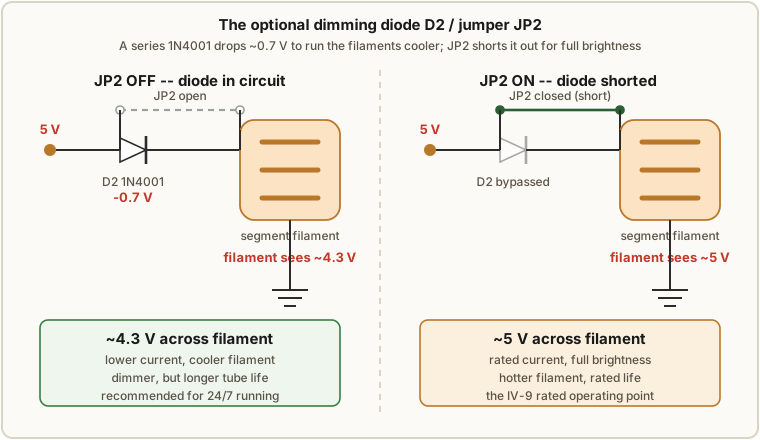
The designer built in an optional way to deliberately run the tubes a touch cooler for longer life, at the cost of a little brightness: a series dimming diode, D2 (a 1N4001), with a shorting jumper JP2. The diode sits in series with the tube common; its forward voltage drop of about 0.7 V subtracts from the 5 V rail, so the filaments see roughly:
V_filament ≈ 5 V − 0.7 V ≈ 4.3 VLower voltage → lower segment current → a cooler filament → a longer-lived tube — the same voltage-versus-life trade an incandescent bulb makes. The designer describes it as “a rudimentary option for lowering the brightness of the Numitrons and lower the current requirement slightly … It simply relied on the forward voltage drop of the diode, with a jumper to short it.”12 Install the diode and leave the jumper off for the dimmer, cooler, longer-lived setting; fit the jumper cap (or short D2 with a wire) for full brightness at the rated point.13 It is genuinely optional — “not really required and may be left off the board”12 — but if you intend the clock to run continuously for years, the diode-in / jumper-out setting is the cheapest life insurance the design offers. The brightness loss is modest; the life gain follows the steep bulb-life curve in your favor.
9.3.4 Thermal cycling and turn-on inrush
There is one more filament stress, the gentlest of the three: cold-start inrush. A tungsten filament has a much lower resistance cold than hot — tungsten’s resistance climbs several-fold as it heats — so at the instant of power-up, before the filament warms, it briefly draws more current than its steady-state rating. This is the same inrush that occasionally pops an ordinary bulb the moment you flick the switch, and it makes every power-up a small thermal-shock event for the segments. At the IV-9’s modest ~23 mA the absolute inrush is tiny and this is not a major concern — but it is real, repeats at every power cycle, and combined with the all-segments startup self-test, argues mildly against pointlessly power-cycling the clock. Leaving the clock running avoids both the inrush surge and the panel’s thermal cycling; that, plus the rated 100,000-hour filament life, is why these clocks are happiest left on. The inrush phenomenon and its interaction with the current budget are treated in more depth in Vol 3.
9.4 ESD discipline — the chips, not the tubes
The Numitron tubes themselves are robust against static — a filament does not care about a few kilovolts of harmless static potential the way a MOSFET gate does. The silicon is another matter. The board is full of static-sensitive CMOS: the PIC16F876A, the six CD4511 decoders, the 74HC164 shift register, the CD4017 and ULN2803 in the LED ring. The designer could not be more emphatic, and from hard experience:
“Another important thing to keep in mind is static protection — especially in the winter when houses become dry, and static discharges (even so small that you can’t feel them) are guaranteed to destroy or damage many of the parts in this project.”14
The phrase to internalize is “even so small that you can’t feel them.” The static discharge that zaps a CMOS input is far below the ~3,000 V threshold you need to feel a spark, and dry winter air is the worst offender. So the precautions are not optional theater:
- Wear a grounded anti-static wrist strap connected to a good ground. The construction manual calls it “essential,” and describes the designer’s own setup — a bare copper wire along the workbench edge, clipped to a water pipe, so the strap is always one clip away.15
- Work on an anti-static mat, and unpack new parts on it rather than on carpet or a bare desk.15
- Handle ICs by the body, leave them in their conductive tubes/foam until placement, and keep the iron’s tip grounded (an anti-static soldering station, as the designer uses).
The reason this matters more than it first appears is the failure mode. A part killed outright by static is annoying but easy: it’s dead, you find it, you replace it. The genuinely costly outcome is a damaged part — one that powers up and mostly works but misbehaves intermittently or has one weak pin. As the manual warns, “a damaged part is really the worst case scenario since a dead part is relatively easy to find and replace. Finding a part that appears to work but not the way it should … can lead to much frustration and a failed or abandoned project.”15 On a board where the CD4511s end up buried under the soldered-in Numitron tubes and are “virtually impossible to reach once they are installed,”16 an ESD-damaged decoder you can’t get at again is exactly the kind of failure that ends a build. Strap up before you start.
9.5 Handling and storage of spare tubes
Because the tubes are the scarce, irreplaceable part — and because the surplus stock is “(rapidly) dwindling” and will eventually “be gone forever”17 — treat spares the way you’d treat the last of anything. Vol 6 covers sourcing and judging surplus; this is how to keep what you’ve got alive on the shelf.
- Buy spares now. While IV-9s are still cheap cold-war stock, a few extra tubes are the best insurance a six-digit clock can have — when one dies in five years there may be none to buy. Cross-reference Vol 6 for where and how.
- Protect the leads in storage. The fly leads are the seal; a tube rattling loose in a parts bin can have a lead snagged and bent at the glass — the exact stress that cracks a seal (9.3.1). Store tubes individually, leads cushioned or left in their original foam/packaging, not jumbled together.
- Keep them dry. The same moisture caution that applies to the running clock applies to stored tubes — damp storage corrodes the leads and degrades solderability.
- Inspect the getter on arrival and before use. Check every spare is still silvery (9.3.2) when it comes in and again before you install it; a tube can survive the eBay journey and still be dead.
- Lamp-test before you commit. The CD4511’s built-in lamp-test function — the same one the clock fires at every startup to flash all segments18 — is your tube tester. Before soldering a tube into the buried-decoder position it can’t easily leave, light every segment and confirm all seven (plus the decimal point) glow evenly. A tube with one dead segment looks fine in storage and fails only when a numeral needs that segment; catch it on the bench, not after final assembly.
9.6 Operating care — keeping a finished clock healthy
Once built and cased (Vol 7’s acrylic-sandwich enclosure), a Numitron clock asks very little. The short list:
- Keep it dry. The single firmest instruction in the user manual — no damp, no wet (9.1).1
- Don’t shock the panel sandwich. The board hangs suspended between two acrylic/polycarbonate panels on brass spacers,19 with six glass tubes soldered to it by their fly leads. A sharp knock transmits through the rigid sandwich to those seals — the same mechanical stress that kills a tube during assembly can kill one in service. Move the clock gently; don’t set it down hard.
- Mind ventilation. The heat load is small (9.1.1), but the regulator and the tubes still want air. Don’t bury the clock in an unventilated cabinet or drape it; the open acrylic-sandwich form factor exists partly so the whole thing breathes.
- Prefer leaving it on. Between the steep filament-life curve, the avoided turn-on inrush (9.3.4), and
the avoided thermal cycling of the panel, a Numitron clock is happiest running continuously. Its rated
100,000-hour tube life (9.2) is a continuous-operation number — let it run.
Do those four things and the limiting factor on the clock’s life becomes the tubes’ rated decade-plus, not anything you did to them. That is the whole goal of this volume: a clock that can’t hurt you, looked after well enough that it outlives the trend that made you build it.
9.7 References (Vol 9)
Footnotes
-
Bill van Dijk, Numitron Clock User Manual (firmware V3.1 / board V2), held in
02-inputs/TheNumetron/: “THE CLOCK USES A SAFE LOW VOLTAGE, AND ALTHOUGH I DO NOT RECOMMEND TOUCHING THE CIRCUIT BOARD, IT IS SAFE IF USED WITH THE POWER SUPPLY PROVIDED. PLEASE DO NOT OPERATE THE CLOCK IN A DAMP OR WET ENVIRONMENT, NOT THAT THIS WOULD NECESSARILY BE DANGEROUS, BUT IT WILL DAMAGE THE CLOCK!” ↩ ↩2 ↩3 ↩4 -
Bill van Dijk, “Build the Numitron — A Six-Digit Clock,” Nuts & Volts, September 2016 (the build article), held in
02-inputs/TheNumetron/: power supply section — buck converter for 5 V, bridge rectifier for AC-or-DC wall warts, 1,000 µF tank capacitor, “Be sure the wall wart can supply at least 1.5 amps of current at minimum nine volts,” and “Though I considered a linear regulator, the part became hotter than I was comfortable with while testing in a circuit like this.” ↩ ↩2 -
_shared/safety.md(Clocks hub safety baseline): Numitron filed under the lowest hazard tier — “Generally safe; normal bench care” — and “The hazard there is component damage, not personal injury.” ↩ -
Build article and IV-9 datasheet: the IV-9 “operates on five volts at about 23 mA per segment.” Per-segment power ≈ 5 V × 23 mA ≈ 0.12 W. Held in
02-inputs/TheNumetron/. ↩ ↩2 -
Numitron Clock Construction Manual, held in
02-inputs/TheNumetron/: “The regulator (IC3) may be mounted with a screw and isolation pad, but that is not required.” ↩ -
Build article, power-supply section: “7x6 segments at about 23 mA = 966 mA total. Maximum current required for the project peaks therefore very close to the one amp limit when all Numitron segments are lit when first plugged in (or after reset).” ↩
-
Build article, “Numitron vs. Nixie?” section: Numitrons “do not suffer from failure states such as ‘sputtering’ …”; “They don’t encounter cathode poisoning that requires a potentially distracting anti-cathode poisoning software routine”; and “In many cases, Numitrons will outlast Nixie tubes as they are typically rated for over 100,000 hours (~11.5 years) of operation compared to some Nixies that are rated for only 5,000 hours (~200 days!).” ↩ ↩2
-
Build article: the Numitron “is not a traditional tube (valve) in that there is no electron emission involved; it only has filaments, and as such is more analogous to the light bulb than any other electrical device.” (See Vol 2.) ↩
-
Build article: “The Numitron is still a vacuum tube, and the wires of the IV-9 pass via a sealed hole through the glass envelope. Great care must be taken to ensure no stress (from bending or soldering) is transferred to the glass, which may cause it to crack.” ↩
-
Construction manual: “Bend these wires approximately 1/16” to 1/8” from the glass downwards … Remember to put absolute minimum stress on the glass of the tube.” ↩
-
Construction manual: “When the silvery top turns white, it cannot be used anymore; air has somehow leaked in.” (The white-getter failure also appears as the far-left tube in the manual’s Figure H.) ↩
-
Build article: diode D2 and jumper JP2 “were intended to be a rudimentary option for lowering the brightness of the Numitrons and lower the current requirement slightly. It simply relied on the forward voltage drop of the diode, with a jumper to short it. It is not really required and may be left off the board.” D2 is a 1N4001 (~0.7 V forward drop) per the parts list. ↩ ↩2
-
Construction manual: “With the jumper cap left off, the Numitrons will be slightly dimmer (due to the forward voltage drop of the diode).” D2/JP2 may be eliminated and the diode replaced with a jumper wire for permanent full brightness. ↩
-
Build article, general notes: “Another important thing to keep in mind is static protection — especially in the winter when houses become dry, and static discharges (even so small that you can’t feel them) are guaranteed to destroy or damage many of the parts in this project.” ↩
-
Construction manual: “A static protection wristband connected to a good ground is essential in preventing static damage … A static discharge (even one you cannot feel) can damage or kill a part. A damaged part is really the worst case scenario since a dead part is relatively easy to find and replace. Finding a part that appears to work but not the way it should or has one dead pin can lead to much frustration and a failed or abandoned project.” Also describes the bench copper-wire ground and anti-static mat. ↩ ↩2 ↩3
-
Construction manual: the CD4511s “will eventually be covered by the Numitrons, i.e., virtually impossible to reach once they are installed.” ↩
-
Build article: the tubes “are still available for a reasonable cost on eBay from old Russian cold war stock. As stocks (rapidly) dwindle, their cost increases steadily until they will be gone forever.” (See Vol 6 for sourcing.) ↩
-
Build article: “The CD4511 also has a ‘lamp test’ function which is used to flash all segments during startup and for reset of the clock, also providing an easy way to test the Numitrons.” ↩
-
Construction manual / build article: the board is suspended between two 7” × 7” Plexiglas (or Lexan polycarbonate) panels on brass spacers (see Vol 7). ↩
Comments (0)