Numitron · Volume 1
Overview & Decision Tree
What a Numitron clock is, the ways to get one, and which path fits your bench
A Numitron clock tells the time with glowing seven-segment numerals, but the glow is not neon and it is not an LED — it is incandescence. Inside each little glass tube, seven tiny tungsten filaments are bent into the familiar seven-segment figure-eight, and a digit appears when you pass a few tens of milliamps through the filaments that make up that numeral, heating them until they glow a warm amber-white. A Numitron is, in the words of the designer whose clock this hub is built around, “more analogous to the light bulb than any other electrical device.” It is a vacuum tube with no electron emission — no cathode, no anode, no high voltage — just filaments in an evacuated envelope.1 That single fact is what makes the Numitron clock the gentle cousin of the nixie clock: same warm retro glow, same glass-tube charm, but it runs on five volts instead of a hundred and seventy, and it cannot bite you.
Note — this is the numitron technology overview. Specific numitron clocks Jeff owns or builds — their design, construction, and operation — are documented as their own deep dives in this technology’s
clocks/folder, one folder per clock, each avol*.mdseries with a Design → Building → Running spine. This volume series covers the technology in general; the per-clock dives go deep on individual units.
This ten-volume reference covers the Numitron clock at depth — the filament-incandescence physics of the tube, the way you drive a device that looks like a seven-segment LED but behaves like a string of light bulbs, the timebase and counting logic, a complete worked build from a published design whose every file is in this hub, the buy-a-kit and source-the-tubes options, the enclosure, the care and (modest) safety the tubes deserve, and a laminate-ready cheatsheet. It is written for an experienced maker with an electronics bench, a soldering iron, and — because the worked build is dense with surface-mount parts — a steady hand and a magnifying glass.
1.1 What a Numitron clock actually is
Strip away the romance and a Numitron clock is four subsystems wired together — the same four every digital clock has, with the display swapped for something gloriously anachronistic:
- The Numitron tubes themselves — incandescent seven-segment indicator tubes. Each tube holds seven filament segments (plus, on most types, a decimal-point filament) arranged in the standard seven-segment layout, sealed inside a small evacuated glass envelope. Apply current to the segments that spell a numeral and they glow. The archetypal clock tube, and the one used throughout this series, is the Soviet IV-9 (ИВ-9): it runs at about five volts and draws roughly 23 mA per segment, and it has flexible “fly leads” so it solders straight to a board with no socket (Vol 2).2
- The digit drivers — something must turn a binary-coded-decimal digit value into the right pattern of lit segments and supply the segment current. Because a Numitron is a seven-segment device drawing about 23 mA per segment at ~5 V, an ordinary BCD-to-seven-segment decoder built for LED displays — the CD4511, with a 25 mA output rating and a built-in latch — drives it directly (Vol 3). This is the single biggest difference from a nixie clock: no high-voltage driver, no exotic part.
- A timebase and counting logic — a microcontroller keeps the time from a crystal reference and updates the digits once a second. The worked build uses a Microchip PIC16F876A with a 4 MHz system crystal and a separate 32 kHz watch crystal as the accurate timebase (Vol 4).
- The structure that ties them together — power supply, user interface, and (in the worked build) a ring of 60 multiplexed LEDs that animates the passing minute. The display itself is bought, not built — you source the tubes.
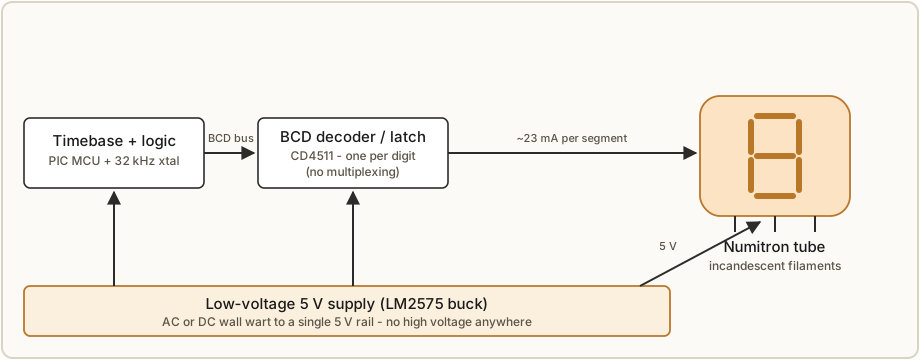
The thing that makes a Numitron clock a project rather than a purchase is not difficulty in any one subsystem — none of them is hard — but that the tubes are scarce, the look is uncommon enough that almost no one sells a finished one, and the most rewarding build in existence (the one this hub is built around) is a dense surface-mount board that rewards patience. The engineering is friendly; the craft is the challenge.
1.2 A one-paragraph history
The Numitron was introduced by RCA around 1970 — the company announced its DR-series readouts (the DR2000 / DR2010 and kin) as a low-cost, low-voltage alternative to the nixie and the just-arriving LED, and a March 1970 Popular Electronics feature put the new “Numitron” readout in front of hobbyists.3 It used the seven-segment numeric format that had been around since F.W. Wood’s 1908 patent, and for a few years it had a real edge: an incandescent segment was brighter than the LEDs of that era and, unlike a nixie or an LCD, it had almost no temperature dependence, so Numitrons turned up in gas-station pump displays, scientific instruments, and avionics — places that ran hot, cold, or outdoors. The Soviet electronics industry produced its own prolific family, the ИВ- (“IV-”) series of incandescent indicators, which is why the cheapest and most plentiful Numitrons on the surplus market today — the IV-9 and its larger sibling the IV-13 — are Russian cold-war stock. The technology was overtaken within a decade by the seven-segment LED, which drew less power, lasted even longer in theory, and shrank without limit; mass Numitron production wound down through the 1970s. The tubes never fully died — surplus IV-9s still change hands on eBay, and the warm filament glow has made the Numitron a quiet favorite of clock builders who want the nixie aesthetic without the high voltage. The full history and physics are Vol 2’s subject.
1.3 The ways to get a Numitron clock
There is no thriving commercial market in finished Numitron clocks the way there is for nixies — the tubes are too scarce and the niche too small for a Dalibor Farný equivalent. The spectrum runs from “find a rare artisan build” to “design your own board,” and the center of gravity is squarely build it yourself. This hub recognizes four first-class paths, and the series is organized so that whichever one you choose, a volume goes deep on it.
Table 1 — 1.3 The ways to get a Numitron clock
| # | Path | Effort | Cost | Covered in |
|---|---|---|---|---|
| 1 | Buy a finished artisan clock (rare; Etsy/maker one-offs) | none | $$$ | Vol 6 |
| 2 | Buy a kit and solder it (small-run / surplus-driven kits) | medium | $$ | Vol 6 |
| 3 | Build the Nuts & Volts six-digit clock from the published files in this hub | high | $$ | Vol 5 |
| 4 | Design from scratch — your own PCB and firmware | very high | $ | Vols 3–5 |
Path 3 is the worked example throughout the engineering volumes: the hub holds the complete published design for Bill van Dijk’s six-digit IV-9 Numitron clock (Nuts & Volts, September 2016) — the construction article, the full schematic, the Eagle and Gerber board files, the IV-9 datasheet, and the PIC firmware in MPASM source plus a ready-to-flash HEX, all on disk (Vol 5, with the project walk-through in Vol 8).
1.4 Decision tree — which path is right for this build
Work top-down; stop at the first “yes.”
- Do you want a Numitron clock on the shelf with no soldering, and you happen to find a maker selling one? → Path 1, a finished artisan clock. These are rare and priced accordingly; go to Vol 6.
- Do you enjoy soldering and can find a kit with tubes included? → Path 2, a kit. Kits surface and vanish with the surplus tube supply; Vol 6 covers what to look for and how to judge one.
- Do you want the best-documented Numitron clock there is, with full schematic, board files, and firmware in hand, and you’re comfortable with surface-mount soldering? → Path 3, the Nuts & Volts six-digit clock. Vol 5 is the worked build; Vols 3 and 4 are the engineering reference behind it.
- Do you want to design your own board and write your own firmware? → Path 4. Vols 3–5 are the engineering reference you will live in, and Vol 2 tells you how the tube behaves so your driver design is sound.
Whatever the path, Vol 9 is worth reading before the first power-up — not because a Numitron clock is dangerous (it runs at a safe 5 V), but because the tubes are fragile and irreplaceable: a cracked glass seal or a stressed fly lead kills a tube you cannot easily buy again, and a wiring slip that doubles the segment current will shorten its life.
1.5 The tubes — a first orientation
You cannot choose a clock without choosing a tube, so here is the orientation the rest of the series builds on. Numitrons are sorted by size and by origin, and for clock work the field narrows quickly:
- IV-9 (ИВ-9) — the small Soviet incandescent seven-segment tube, ~13 mm digit height, 5 V at ~23 mA per segment, with fly leads (no socket). This is the Numitron clock tube: small, cheap by surplus standards, plentiful enough to build a six-digit clock. It is the tube used throughout this series.
- IV-13 (ИВ-13) — the larger Soviet sibling, a taller digit for a bolder display, at a correspondingly higher segment current. A good choice when you want presence and can budget the supply current.
- RCA DR2000-series and Western types — the original American Numitrons (DR2000, DR2010, and relatives). Collectible and historically the first Numitrons, but rarer and pricier on today’s market than the Soviet IV tubes.
All of these are incandescent devices — there is no glow discharge, no cold cathode, no electron beam. Each lit segment is a small tungsten filament running white-hot, exactly like the element of a tiny light bulb, sealed in a vacuum so it does not burn up. The one consequence to carry forward is directionality and polarity freedom: because the segment is just a resistive filament, the tube’s common pin can be driven positive, negative, or even from AC — the filament does not care which way the current flows. The physics is Vol 2’s subject; the practical upshot, which shapes every driver decision in Vol 3, is that a Numitron behaves electrically like a seven-element incandescent lamp, not like a diode.
1.6 Why you cannot multiplex a Numitron (the one gotcha)
There is exactly one piece of engineering folklore worth stating up front, because it shapes the whole drive architecture. A seven-segment LED display can be multiplexed — lit one digit at a time, very fast, so persistence of vision fuses the digits into a steady display — and that is how most multi-digit LED clocks save driver pins. A Numitron cannot be meaningfully multiplexed. A filament has thermal mass; switch it on and off rapidly at a low duty cycle and it never gets fully hot, so all you have built is a dimmer. A 1-of-6 multiplex would leave each tube at roughly one-sixth brightness — far too dim to use.4 The consequence: every Numitron digit needs its own continuous driver. In the worked build that means one CD4511 BCD-to-seven-segment decoder/latch per tube (six of them), with a shift register choosing which decoder to update — a small elegant solution explored in Vols 3 and 4. (The ring of 60 LEDs around the tubes in that clock, by contrast, is heavily multiplexed — the two display technologies in the same clock demand opposite drive strategies, which is part of what makes the build instructive.)
1.7 What the owner already has collected
One project is catalogued in this subproject’s 02-inputs/, and it is a complete,
publication-grade design that anchors the entire series:
- “TheNumetron” — the Nuts & Volts six-digit Numitron clock by Bill van Dijk (Nuts & Volts, September 2016). A six-digit IV-9 clock ringed by 60 multiplexed LEDs that animate the passing minute in eight selectable patterns. The brain is a PIC16F876A at 4 MHz with a 32 kHz watch-crystal timebase; the tubes are driven by six CD4511 decoder/latches addressed through a 74HC164 shift register; the LED ring is driven by a CD4017 decade counter and a ULN2803 Darlington array; power is a LM2575 5 V buck converter behind a bridge rectifier (so it runs from an AC or DC wall wart). The hub holds the construction manual, the user manual, the build article, the full schematic, the Eagle + Gerber board files, the IV-9 datasheet, the MPASM firmware source and a production HEX, and a video of the LED patterns. This is the worked build of Vol 5 and the subject of the walk-through in Vol 8.
Note on the folder name: the collected folder is spelled
TheNumetron/, preserving the author’s original spelling. The correct device name — and the name of this subproject — is Numitron.
1.8 How this series is organized
The series moves from principle to practice to project to polish:
- Principle (Vols 2–4) — how the tube works, then the two subsystems that matter (driving the filaments, and the timebase/logic). Read these to understand any Numitron clock.
- Project (Vols 5–6, 8) — the worked six-digit build start to finish, the buy-a-kit and source-the-tubes options, and a full walk-through of the collected design.
- Polish (Vols 7, 9–10) — the enclosure and finishing; the care, reliability, and low-voltage safety the tubes deserve; and the laminate-ready cheatsheet and glossary.
1.8.1 Volume-by-volume index
Table 2 — 1.8.1 Volume-by-volume index
| Vol | Title | Read it for |
|---|---|---|
| 1 | Overview & Decision Tree | (this volume) — the map and the path choice |
| 2 | How a Numitron Works | filament incandescence, IV-9 anatomy, the vacuum, lifetime, vs nixie/LED/VFD |
| 3 | Driving Numitrons | why no multiplexing, the CD4511 decoder/latch, current limiting, dimming, shift-register fan-out |
| 4 | Timebase & Logic | the PIC16F876A, 4 MHz + 32 kHz crystals, RTC logic, interrupts/timers, EEPROM, the LED-ring multiplex |
| 5 | Build It Yourself | the Nuts & Volts six-digit clock: schematic → BOM → PCB/fab → SMD assembly → power → flashing → calibration |
| 6 | Buy a Kit or Source the Tubes | finished/kit options, sourcing IV-9 / IV-13 surplus, fakes & duds, pricing, trade-offs |
| 7 | Enclosure & Finishing | the acrylic-sandwich case, materials, aesthetics, the steampunk cross-link |
| 8 | The Collected Project | a full walk-through of Bill van Dijk’s design — features, UI, LED patterns, firmware architecture |
| 9 | Care, Reliability & Low-Voltage Safety | filament lifetime, thermal/derating, vacuum-seal handling, ESD, what kills a tube |
| 10 | Cheatsheet & Glossary | IV-9 pinout, CD4511 truth table, BOM quick-ref, supply math, source URLs, A–Z terms |
1.9 What this series is — and is not
It is a build-and-understand reference for incandescent Numitron display clocks, grounded in a complete published design held in this hub and in the IV-9 tube data.
It is not a substitute for the original designer’s documentation when you build the worked clock — Vols 5 and 8 point you at the canonical article, schematic, board files, and firmware and reproduce the critical data (pinouts, the BOM, the decoder truth table), but you should build with the original documents open alongside. Nor is it a guide to the other obsolete display families — nixies (cold-cathode glow), VFDs (vacuum fluorescent), Panaplex/Pixie gas-discharge seven-segment panels, or dekatrons — except where they illuminate the Numitron by contrast. Those have their own quirks and, for nixies, their own deep dive in this hub.
1.10 Safety, stated once up front
This is the easy part. A Numitron clock runs on a single 5 V rail drawn from a wall wart through a buck converter; there is no high voltage anywhere — no anode supply, no charged filter capacitor waiting to bite you. As the designer’s user manual puts it, the clock “uses a safe low voltage.” The cautions in this series are therefore not about your safety but about the tubes’: they are scarce, fragile vacuum devices whose fly leads transmit any bending stress straight to the glass seal, and whose getter (the silvery patch at the top) turns white when the vacuum is lost — a tube that has gone white is dead and unbuyable. The full discipline — handling the fly leads, not over-driving the filaments, ESD precautions, and thermal derating — is in Vol 9. Where a step risks a tube rather than a person, this series flags it; there are no high-voltage warnings here because there is no high voltage.
1.11 Photo policy
Photographs in this series come from three sources, credited in every caption: any of the owner’s own build photos; license-clean images from Wikimedia Commons / Openverse fetched through the project’s Photo Helper (with the full attribution line reproduced verbatim); and, for diagrams, hand-authored SVG in the paper-background house style. Figures that have not yet been sourced are simply absent. No images are scraped from arbitrary copyrighted web pages.
1.12 References (Vol 1)
- Bill van Dijk, “Build the Numitron — A Six-Digit Clock,” Nuts & Volts, September 2016 — construction manual, user manual, full schematic, Eagle/Gerber board files, IV-9 datasheet, MPASM firmware (
60L-Numitron.asm) + production HEX, pattern video. Held in02-inputs/TheNumetron/. _shared/comparison.md(cross-technology decision matrix) and_shared/deep_dive_protocol.md.
Footnotes
-
Bill van Dijk, “Build the Numitron — A Six-Digit Clock,” Nuts & Volts, September 2016. The Numitron “is not a traditional tube (valve) in that there is no electron emission involved; it only has filaments, and as such is more analogous to the light bulb than any other electrical device.” Held in
02-inputs/TheNumetron/. ↩ -
IV-9 (ИВ-9) Numitron datasheet, held in
02-inputs/TheNumetron/IV-9 (Numitron).pdf; segment current and 5 V operation per the Nuts & Volts build article. Pinout per the construction manual: 1 = common, 2 = right-hand decimal point, 3 = segment b, 4 = segment c, 5 = segment a, 6 = segment f, 7 = segment g, 8 = segment d, 9 = segment e. ↩ -
RCA Numitron / DR-series readouts; March 1970 Popular Electronics feature, and the seven-segment numeric format (F.W. Wood, 1908). Background as cited in the Nuts & Volts article’s history section. ↩
-
Nuts & Volts build article: “The Numitrons … are essentially just little multi-filament incandescent light bulbs from an electrical perspective, and as such, multiplexing them will simply act as a light dimmer.” Held in
02-inputs/TheNumetron/. ↩
Comments (0)