Numitron · Volume 6
Buy a Kit or Source the Tubes
The thin commercial market, where the IV-9 tubes actually come from, and how to buy the parts for the worked build
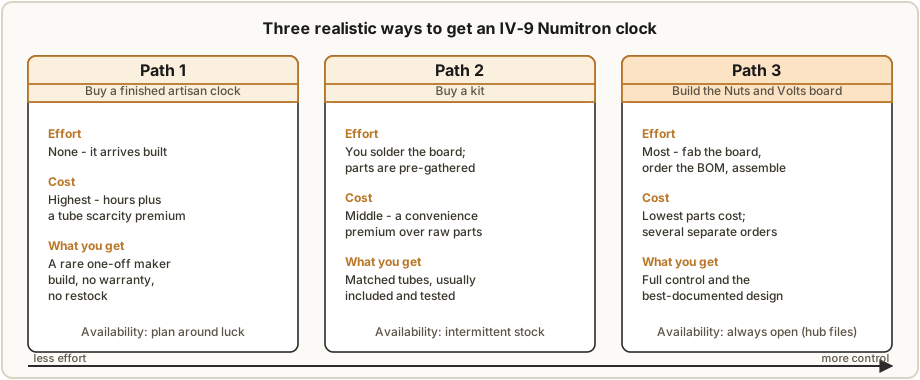
If you have read this far hoping for a list of shops that will sell you a finished Numitron clock, the honest answer of this volume is: there almost isn’t one. The Numitron occupies a much thinner commercial niche than the nixie, and you should set your expectations accordingly before you start shopping. There is no Dalibor Farný of the Numitron world — no boutique manufacturer re-pressing tubes, no catalog of polished turnkey clocks, no thriving aftermarket. What there is amounts to two things: a small, intermittent trickle of artisan one-offs and small-run kits that appear and vanish with the surplus tube supply, and a steady-but-shrinking pool of Soviet cold-war surplus tubes on the open market. The center of gravity of this whole hobby, as Vol 1’s decision tree already made plain, is build it yourself (Vol 5). This volume is therefore mostly about buying the parts — above all the tubes — rather than buying a product.
That is not a disappointment so much as a reframing. A Numitron clock is a parts-sourcing exercise wrapped around a known-good design. Get the tubes, get a board made, get the components from a distributor, and the worked build of Vol 5 is in reach. The rest of this volume walks the four realistic transactions — finding a finished clock (rare), finding a kit (intermittent), sourcing the tubes (the real work), and buying the worked-clock parts (the dependable path) — and ends with an honest comparison and a recap pointing back to Vol 1.
6.1 The reality of the market
Three structural facts shape everything in this volume, and it is worth stating them plainly so the rest reads as guidance rather than complaint.
Finished clocks are artisan one-offs. When a complete Numitron clock surfaces for sale, it is almost always a single maker’s personal build offered on a marketplace like Etsy or a maker forum — not a product with a model number, a warranty, and a restock. Pricing reflects that: a finished clock is priced for the builder’s hours plus a scarcity premium on the tubes, so it sits at the top of the cost spectrum (Path 1, the ”$$$” row in Vol 1’s table). Because each is a one-off, you cannot rely on one being available when you want it, and you cannot assume a second will look like the first. Treat a finished-clock listing as a lucky find, not a shopping option you can plan around.
Kits come and go with the tube supply. A Numitron kit is only viable while its maker has tubes to put in it. Because the tubes are finite surplus (see 6.2), kit runs tend to be small and sporadic — a maker buys a tranche of IV-9s, assembles a batch of kits, sells through them, and then the listing goes dark until the next tranche. The implication for you: if you find a kit you like, in stock, with tubes included, that availability is the perishable part of the deal. The clock design will still exist next year; that kit, in stock may not.
The documented design is the dependable path. The one thing in this hobby that does not go out of stock is the design itself. The hub holds the complete published design for Bill van Dijk’s six-digit IV-9 clock — schematic, Eagle and Gerber board files, BOM with distributor part numbers, and firmware — and those files are as available today as they will be in five years (Vol 5, Vol 8). So while finished clocks and kits are subject to the whims of supply, Path 3 — order the board, order the parts, source the tubes yourself — is always open. That is why this volume spends most of its length there.
6.2 Sourcing the tubes — the real action
Everything else in this volume is logistics; this section is the one that decides whether you get a clock at all. The display tube you want is the IV-9 (ИВ-9), the small Soviet incandescent seven-segment tube described throughout this series — roughly 13 mm digit height, five volts, about 23 mA per segment, fly leads, no socket (Vol 2). Its larger sibling the IV-13 (ИВ-13) is the same idea in a bolder digit at a higher segment current, a good choice if you want presence and can budget the supply (Vol 1, §1.5).
Where they come from. These tubes are cold-war Soviet surplus — decades-old factory and warehouse stock from the ИВ- family of incandescent indicators. They were never made in the West in this form, and they are not being manufactured anywhere now. The practical consequence is that the supply is fixed and dwindling: as the designer of the worked build put it, the tubes are “still available for a reasonable cost on eBay from old Russian cold war stock. As stocks (rapidly) dwindle, their cost increases steadily until they will be gone forever.”1 That is not marketing urgency; it is the actual market. Every tube sold is one fewer in existence.
Where to buy them. In practice the channel is eBay, with the occasional surplus-electronics specialist. Sellers list IV-9s individually and, more economically, in lots of six, ten, or more. Because the worked build needs six tubes for a six-digit clock — and because tubes can fail a lamp test, get damaged in shipping, or die over the years — the single most important sourcing rule in this volume is: buy spares. A lot of ten for a six-digit build is sensible; a lot that gives you two or three spare tubes per clock is not extravagant when the part is irreplaceable and the price only goes up. The designer notes that since you will likely get your tubes on eBay anyway, it is a good place to order other inexpensive parts at the same time — though, as 6.4 covers, the precision parts are better bought from a real distributor.2
Buyer beware. Buying decades-old surplus from a photo means you are buying some risk. Favor sellers with clear, in-focus photos of the actual tubes (not stock images), a return policy, and feedback that mentions working tubes. Expect cosmetic age — these are old parts — but distinguish cosmetic from fatal (6.3). The same “buyer beware” the designer applies to cheap eBay LEDs (“many are junk … don’t buy the ‘1,000 for a dollar’ deal”)3 applies doubly to tubes you cannot easily replace: a slightly higher price from a seller who clearly knows what a good IV-9 looks like is cheap insurance.
6.3 Spotting bad tubes
A Numitron is a sealed vacuum device, and like any vacuum tube it has a small number of failure modes that you can screen for before you commit a tube to a board. Two checks cover the great majority of duds, and both can be done with the tube in your hand.
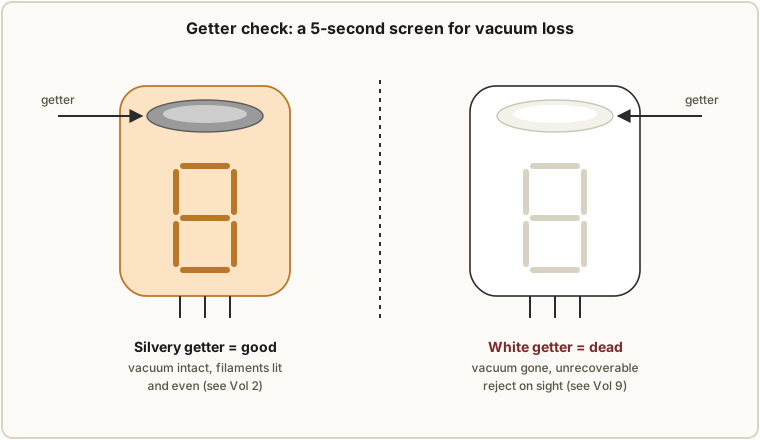
The getter test (look, don’t power). Inside the top of the envelope is the getter — a small patch of reactive metal flashed onto the glass during manufacture to absorb stray gas and maintain the vacuum. On a healthy tube the getter is silvery, a mirror-bright or smoky-grey deposit. When the vacuum is lost — a crack in the glass, a failed seal, age — the getter reacts with the in-rushing air and turns white or milky. A white getter is the unambiguous tombstone of a dead tube: the vacuum is gone, the filaments will burn out almost immediately if powered, and nothing can recover it. This is the single fastest screen you have, it needs no equipment, and it is covered in more depth in Vol 2 (the physics) and Vol 9 (what kills a tube). Reject any tube with a white getter on sight, and be wary of seller photos where the getter region is conveniently out of frame or blown out by glare.
The lamp test (power every segment). A silvery getter tells you the vacuum is intact; it does not tell you that all seven filaments are unbroken. For that, lamp-test the tube before you build with it — light every segment at once and confirm a full, even figure-eight. You can do this on the bench with a current-limited 5 V supply (respecting the ~23 mA-per-segment figure — see Vol 3 for the current math), or, more conveniently, the worked design has a lamp test built in: the CD4511 decoder’s lamp-test input flashes all segments during start-up and reset, which the designer explicitly notes “provid[es] an easy way to test the Numitrons.”4 A good tube shows all seven segments (plus the decimal point) glowing the same warm amber; a tube with a broken filament shows a gap — a missing segment — and should be set aside as a parts donor or a spare-for-nothing. Lamp-testing your whole lot up front, before any soldering, means you discover a dud while it is still trivial to swap, not after it is soldered into the middle of a finished board.
Mechanical screening. Finally, inspect the fly leads — the flexible wires that exit the glass at the base and solder straight to the board. Watch for leads that are kinked, corroded, work-hardened from prior bending, or — worst — already broken off short at the seal. Because the lead passes through a sealed hole in the glass, any stress at that seal can crack the envelope and let the vacuum go, so a tube whose leads have clearly been wrestled with is a tube whose seal you should distrust. Vol 5’s assembly notes and Vol 9’s care discipline both stress the same point the designer makes: “Great care must be taken to ensure no stress (from bending or soldering) is transferred to the glass, which may cause it to crack.”5 Screen for it at purchase, and respect it during the build.
6.4 Buying the worked-clock parts (Path 3)
This is the dependable path, and it has three independent supply lines: the board, the components, and the tubes (already covered in 6.2). None of them depends on anyone selling a finished product, which is exactly why Path 3 is always open.
The board. The hub holds the PCB design in both native Eagle format and Gerber (RS-274X) for board houses that do not accept Eagle (Vol 5, Vol 8). It is a straightforward two-layer board roughly six inches square with, in the designer’s words, “no complicated manufacturing issues for most board houses.”6 Upload the Gerbers to any standard fab, choose a quantity (the per-board price drops steeply with quantity, so ordering two or three is cheap insurance against a ruined board), and you will have bare PCBs in a week or two. One detail worth knowing before you order parts: the CD4511 decoder footprint on this board was deliberately drawn to accept both the wide and the narrow SMD package, because surplus and distributor orders of that chip arrive in either form — so you are not locked to one package variant when sourcing IC5–IC10.7
The components. The Vol 5 BOM reproduces the designer’s full parts list with Mouser part numbers for the parts that matter, and the standing instruction of this series is to order from the Vol 5 BOM rather than re-keying it here — a single source of truth avoids transcription errors on a board this dense. A few sourcing notes specific to buying (the engineering rationale is in Vols 3–5):
- Buy the precision parts from a real distributor. The 32 kHz watch crystal and its matched load capacitors set the clock’s accuracy; the designer is emphatic that this is “a critical part for clock accuracy! Please resist using an unknown or salvaged part here.”8 Order the specified Mouser parts new. The same goes for the PIC, the CD4511 decoders, the regulator, and the shift register — these are the parts where a distributor’s known-good stock is worth the small premium over a surplus gamble.
- Buy the SMD passives in assortment kits — for the spares. The 0805 capacitors and similar small SMD parts are best bought in kits, which is exactly what the designer does: “I usually buy things like the small SMD parts in kits from online providers; it provides lots of spares that way.”9 On a surface-mount board you will launch a few tiny capacitors off the bench with your tweezers; having a sheet of spares turns that from a re-order into a shrug.
- Be a skeptic about ultra-cheap eBay LEDs. The 60-LED ring needs high-output (“ultra-bright”) LEDs or the ring reads as dim; the designer warns that cheap eBay LEDs are “definitely ‘buyer beware’ … many are junk.”10 If you buy the ring LEDs cheaply, buy a few extra and test them; if in doubt, buy known-good ultra-brights from a distributor.
- Salvage is fine for the forgiving parts. The power jack, the bridge rectifier, even the wall wart are explicitly fair game for the junk box — “these are perfect parts to be salvaged from old discarded equipment.”11 Spend your sourcing care where the circuit is fussy, not where it is forgiving.
Static protection when you handle all of it. Several parts on this board — the PIC, the CMOS decoders, the shift register — are static-sensitive, and the designer flags this directly: especially in dry winter air, “static discharges (even so small that you can’t feel them) are guaranteed to destroy or damage many of the parts in this project.”12 Use a grounded wrist strap and an antistatic mat, keep the ICs in their conductive packaging until they go on the board, and treat the tubes gently for mechanical reasons at the same bench. The full ESD and handling discipline is Vol 9’s subject.
6.5 Kit versus scratch build — the trade-offs
When a kit is available, it is a genuine option, and it is worth being clear about what you trade. Compare the two on the four axes that actually differ — the engineering volumes make plain that the circuit is the same either way.
Table 1 — 6.5 Kit versus scratch build — the trade-offs
| Axis | A kit (when available) | Scratch / Path 3 (the documented design) |
|---|---|---|
| BOM sourcing time | Saved — the maker has already assembled the parts | You assemble it from the Vol 5 BOM (board house + Mouser + eBay tubes) |
| Tubes | Usually included and matched — often lamp-tested by the maker | You source and screen them yourself (6.2, 6.3); you choose the spares margin |
| Control & documentation | Limited to what the kit provides; design may be undocumented | Full — complete schematic, board files, BOM, and firmware in the hub (Vol 5, Vol 8) |
| Cost | Convenience premium over raw parts, but you skip shipping from several vendors | Lowest parts cost, but several separate orders (and their shipping) |
| Tube-supply risk | The maker absorbed it — but the kit’s availability is the perishable part | You face it directly at purchase — and you can over-buy spares against it |
| Skill needed | Same soldering as scratch; sometimes a gentler instruction sheet | Same soldering; you also drive the fab and BOM logistics yourself |
The honest summary: a kit buys you time and a set of matched, tested tubes; a scratch / Path 3 build buys you full control and the best-documented design that exists. Neither saves you the soldering — both are the same dense surface-mount assembly. If you find a well-reviewed kit with tubes included and in stock, and you value your sourcing time, take it. If you want to understand and own every part of the clock, or no kit is to be had, build Path 3 from the hub files. There is no wrong answer; there is only which scarcity you would rather manage — the kit’s availability, or the tubes’ supply.
6.6 Skill and time
Be clear-eyed about the effort, because it is the same effort whichever path you choose. The designer rates this build “probably at an advanced skill level, mostly due to the number of surface-mount parts.”13 None of the individual SMDs is exotic — “none … are ridiculously difficult to solder by hand” — but the board is dense, and density is the challenge: it “does require a steady hand, good light, a magnifying glass, and a good soldering iron,”14 plus fine tweezers and thin (≈0.020″) solder for the 0805 passives and the SO-package ICs.
Budget a weekend-plus, not an evening. The two genuine time sinks are not the soldering of any one joint but the fiddly, repetitive work:
- LED ring alignment. The 60 ring LEDs are usually “water-clear” ultra-brights whose aim matters as much as their placement — “placement is very important to provide a visually pleasing result.”15 Getting all sixty sitting at a consistent height and angle so the ring reads evenly is patient, one-at-a-time work, and the construction manual in the hub devotes tips to it (Vol 5, Vol 7).
- Numitron fly-lead dressing. Each of the six tubes solders by its fly leads, and each must be positioned without transmitting bending stress to the glass seal (6.3, Vol 9). Gentle, deliberate lead-bending and placement — six times over — is the other slow part of the build.
Neither is hard; both are slow and reward patience over speed. Plan the build as two or three relaxed sessions, lamp-test your tubes before any of them go on the board, and keep your spares within reach.
6.7 Decision recap
To close where Vol 1 opened, the buy-versus-build choice for a Numitron clock comes down to this:
- A finished clock (Path 1) is a rare artisan find — grab it if you happen on one and want zero soldering, but you cannot plan a project around it.
- A kit (Path 2) is the middle road when one exists in stock with tubes included: it saves BOM sourcing and hands you matched, tested tubes, at a convenience premium — and its availability is the perishable thing.
- The documented build (Path 3) is the dependable, fullest-control route: order the board from the hub’s Gerbers, the components from the Vol 5 BOM, and the tubes from surplus — buying spares, screening every getter and filament, and protecting against static throughout.
- Designing from scratch (Path 4) lives in Vols 2–5 for those who want their own board and firmware.
Whichever path, the tubes are the gating resource and the irreplaceable one: source them first, buy more than you need, test them before you trust them, and read Vol 9 before the first power-up. The full decision tree is in Vol 1, §1.4; this volume has simply walked the buying side of it.
6.8 References (Vol 6)
- Bill van Dijk, “Build the Numitron — A Six-Digit Clock,” Nuts & Volts, September 2016 — construction manual, user manual, full schematic, Eagle/Gerber board files, IV-9 datasheet, MPASM firmware + production HEX, parts list with Mouser part numbers. Held in
02-inputs/TheNumetron/. - Vol 5 (Build It Yourself) — the full BOM with Mouser part numbers, board fabrication, and SMD assembly; the single source of truth for the parts order this volume points to.
_shared/comparison.md(cross-technology decision matrix) and_shared/deep_dive_protocol.md.
Footnotes
-
Bill van Dijk, “Build the Numitron — A Six-Digit Clock,” Nuts & Volts, September 2016: the tubes are “still available for a reasonable cost on eBay from old Russian cold war stock. As stocks (rapidly) dwindle, their cost increases steadily until they will be gone forever.” Held in
02-inputs/TheNumetron/. ↩ -
Van Dijk, Nuts & Volts (Sept. 2016): “eBay is a good source for inexpensive parts if you are not in a rush. Since you will probably get your Numitrons there, other parts can be ordered at the same time.” ↩
-
Van Dijk, Nuts & Volts (Sept. 2016): on cheap eBay LEDs, “it’s definitely ‘buyer beware’ in my experience; many are junk. Don’t buy the ‘1,000 for a dollar’ deal because you will be disappointed.” ↩
-
Van Dijk, Nuts & Volts (Sept. 2016): the CD4511 “also has a ‘lamp test’ function which is used to flash all segments during startup and for reset of the clock, also providing an easy way to test the Numitrons.” Engineering detail in Vol 3. ↩
-
Van Dijk, Nuts & Volts (Sept. 2016): “Great care must be taken to ensure no stress (from bending or soldering) is transferred to the glass, which may cause it to crack.” Handling discipline in Vol 9. ↩
-
Van Dijk, Nuts & Volts (Sept. 2016): the PCB “is a standard two-layer version, and has no complicated manufacturing issues for most board houses … the Eagle files as well as Gerber (RS274x) files … are at the article link.” Board ≈ 6″ square. Files held in
02-inputs/TheNumetron/. ↩ -
Van Dijk, Nuts & Volts (Sept. 2016): the CD4511 footprint was drawn to accept both wide and narrow SMD packages because “in the past I have received either or both mixed in my orders.” See the Vol 5 BOM (IC5–IC10). ↩
-
Van Dijk, Nuts & Volts (Sept. 2016): the 32 kHz watch crystal is “a critical part for clock accuracy! Please resist using an unknown or salvaged part here.” Timebase detail in Vol 4. ↩
-
Van Dijk, Nuts & Volts (Sept. 2016): “I usually buy things like the small SMD parts in kits from online providers; it provides lots of spares that way.” See also the loss-a-cap-off-the-bench note in the same article. ↩
-
Van Dijk, Nuts & Volts (Sept. 2016): “It is important to use high output (also referred to as ultra-bright) LEDs for this design since regular LEDs will appear too dim,” and cheap eBay LEDs are “buyer beware … many are junk.” ↩
-
Van Dijk, Nuts & Volts (Sept. 2016): of the power jack and bridge rectifier, “these are perfect parts to be salvaged from old discarded equipment.” ↩
-
Van Dijk, Nuts & Volts (Sept. 2016): “static protection — especially in the winter when houses become dry, and static discharges (even so small that you can’t feel them) are guaranteed to destroy or damage many of the parts in this project.” Full ESD discipline in Vol 9. ↩
-
Van Dijk, Nuts & Volts (Sept. 2016): “Building this project is probably at an advanced skill level, mostly due to the number of surface-mount parts.” ↩
-
Van Dijk, Nuts & Volts (Sept. 2016): none of the SMDs “are ridiculously difficult to solder by hand, but it does require a steady hand, good light, a magnifying glass, and a good soldering iron.” Plus fine tweezers and ≈0.020″ solder per the same article. ↩
-
Van Dijk, Nuts & Volts (Sept. 2016): the water-clear LEDs’ “placement is very important to provide a visually pleasing result”; the construction manual gives alignment tips. Enclosure/aesthetics in Vol 7. ↩
Comments (0)