Numitron · Volume 2
How a Numitron Works
Filament incandescence, the IV-9's anatomy and vacuum, lifetime, and how it differs from a nixie, an LED, and a VFD
A Numitron looks like a vacuum tube and it is one — a small evacuated glass envelope with wire leads passing through a sealed press — but it works on a principle that has nothing to do with what makes a nixie or a conventional valve glow. There is no electron emission inside a Numitron: no heated cathode boiling off electrons, no anode collecting them, no high voltage to accelerate them across a gap. The device’s designer puts it plainly: the Numitron “is not a traditional tube (valve) in that there is no electron emission involved; it only has filaments, and as such is more analogous to the light bulb than any other electrical device.”1 That one sentence is the whole physics of the part. Each lit segment is a tiny tungsten filament that glows because current heats it white-hot — exactly the mechanism of an incandescent lamp — and the glass envelope is evacuated for exactly the same reason a light bulb is: so the filament does not oxidize and burn up in air.
This volume takes the tube apart. It explains incandescence as the light source and what follows from it (warm color, thermal inertia, inrush, and near-total indifference to ambient temperature); it explains the one electrical property that most shapes the rest of this series — polarity freedom, the fact that a filament does not care which way the current flows; it lays out the anatomy of the IV-9, the Soviet seven-segment tube used throughout this hub, including its pinout, segment map, and the silvery getter that reports the state of the vacuum; it does the current and power arithmetic for a full display; it weighs the article’s striking lifetime claim; it gives a one-section history; and it closes with a four-way comparison of the Numitron against the nixie, the seven-segment LED, and the vacuum fluorescent display. Where this volume says how the tube behaves, Vol 3 turns that behavior into a driver, so read this one first if you are designing your own board.
2.1 The core principle — incandescence, not glow discharge
Three families of “glowing-numeral” display look superficially alike and work completely differently. It is worth stating all three side by side, because the Numitron’s identity is defined by contrast.
- A nixie is a cold-cathode glow-discharge tube. Each numeral is a shaped wire cathode in a low-pressure neon-argon gas mixture. Raise the voltage between that cathode and a mesh anode past the gas’s striking voltage (on the order of 170 V for a typical small nixie) and the gas near the chosen cathode ionizes and emits the familiar orange neon glow. The light comes from excited gas, not from anything getting hot; the cathode stays cold.
- A seven-segment LED is a semiconductor device. Each segment is a light-emitting diode — a forward-biased p-n junction — that converts a few milliamps at roughly 1.6 V to 3.5 V (color-dependent) directly into photons by electroluminescence. No gas, no heat, no vacuum.
- A Numitron is incandescent. Each segment is a tungsten filament — a plain resistor — and when current heats it to something on the order of a couple of thousand kelvin it radiates a broadband (blackbody-like) glow. The light comes from a hot solid, the same way a flashlight bulb or a toaster element glows.
So the Numitron is the odd one out: it is the only one of the three whose light is thermal. It is a vacuum tube by construction — sealed glass, leads through a press, an evacuated interior — but it is a light bulb by operation. Everything practical about driving it, dimming it, powering it, and judging its lifetime falls out of that single fact.
2.2 Filament physics — why the glow is warm, steady, and slow
A tungsten filament is a resistive element. Push current through it and it dissipates power as heat (P = I²R); the filament temperature climbs until the power it radiates and conducts away balances the electrical power going in. At the segment’s operating point the filament settles at incandescent temperature and radiates as an approximate blackbody, which is why a Numitron’s color is a warm amber-white rather than the saturated orange of neon or the pure spectral hue of an LED. It is the color of a slightly under-run lamp — a filament held a little below the brilliant white of a full-power bulb, which is part of the Numitron’s gentle, vintage look.
Three consequences of the filament-as-heater model matter for the rest of this series.
Thermal inertia (you cannot multiplex it). A filament has real thermal mass. It takes a few to several milliseconds to heat to full brightness and a similar time to cool, so a filament cannot be flashed on and off quickly without losing brightness. If you pulse it at a low duty cycle — the trick that lets you multiplex an LED display — the filament never reaches full temperature and you have simply built a dimmer. The build article states the rule directly: the Numitrons “are essentially just little multi-filament incandescent light bulbs from an electrical perspective, and as such, multiplexing them will simply act as a light dimmer.”2 This is the defining drive constraint, and Vol 3 is built around it: every Numitron digit needs its own continuous driver. (The flip side — that the same thermal inertia makes the filament easy to dim smoothly with PWM or a series voltage drop — is also a Vol 3 topic; the design in this hub even includes an optional diode drop, D2/JP2, to trim brightness.)
Cold-vs-hot resistance and turn-on inrush. Tungsten is a positive-temperature- coefficient material: its resistance rises strongly with temperature. A tungsten filament’s resistance when cold can be on the order of a tenth of its hot, operating resistance — the same effect that makes ordinary light bulbs fail at the instant of switch-on. So at the moment a Numitron segment is energized it presents a low resistance and draws a brief inrush current spike well above its steady ~23 mA, until the filament heats and its resistance rises to the operating value. The spike is short (it lasts only the few milliseconds the filament takes to warm) and modest in this low-voltage part, but a driver and supply must tolerate it. It is one more reason the worked build’s 5 V supply is sized with headroom (Vol 3 and Vol 5).
Near-zero temperature dependence (the early advantage). Because the segment makes its own heat and runs far hotter than any room it will ever sit in, ambient temperature barely affects how it looks or works. This was the Numitron’s genuine edge in its day. As the build article notes, Numitrons “did not have a great dependence on ambient temperature,” whereas “Nixies, Panaplex displays, and later LCDs required heating elements when used outdoors in colder regions.”3 A cold nixie is harder to strike; a cold LCD goes sluggish; a cold Numitron does not notice. That ruggedness put Numitrons in gasoline-pump displays (where the article notes they are “still regularly found working”), scientific instruments, and avionics — places that run hot, cold, or outdoors.
2.3 Polarity freedom — the filament does not care which way current flows
Here is the behavioral property that, more than any other, separates a Numitron from a nixie at the driver. A nixie is a diode-like device: it has a defined cathode and anode, current flows one way only, and you must respect that polarity or it will not light. A Numitron segment is just a resistor — a length of tungsten wire. A resistor heats the same whether current flows left-to-right, right-to-left, or reverses sixty or fifty times a second. The build article makes the point on the very pinout figure: “since the Numitron uses filaments, the common can be positive, negative, or even power via AC voltage.”4
Three practical freedoms follow:
- The common pin can be the positive rail or ground. You may drive each segment from a sourcing output with the common returned to ground, or from a sinking output with the common tied to the positive rail. The filament lights either way, so the driver topology can be chosen for convenience rather than forced by the display’s polarity. (The worked build uses a CD4511 BCD-to-seven- segment decoder sourcing current into each segment — see Vol 3.)
- AC drive is legitimate. You could run the filaments straight off a low-voltage AC source; the filament’s thermal mass averages the alternating current into a steady glow with no visible flicker. Almost no modern design does this — DC from a logic-level decoder is simpler — but it is a real option and a vivid illustration of how unlike a nixie the part is.
- No wrong-way-round failure. Reverse the leads on a nixie digit and nothing lights; reverse them on a Numitron segment and it lights exactly the same. The only orientation that matters on a Numitron is which lead is which segment (the pinout), not the polarity of the drive.
The single sentence to carry into Vol 3 is this: a Numitron behaves electrically like a seven-element incandescent lamp, not like an array of diodes. Design the driver as you would for tiny resistive lamps.
2.4 Anatomy of the IV-9
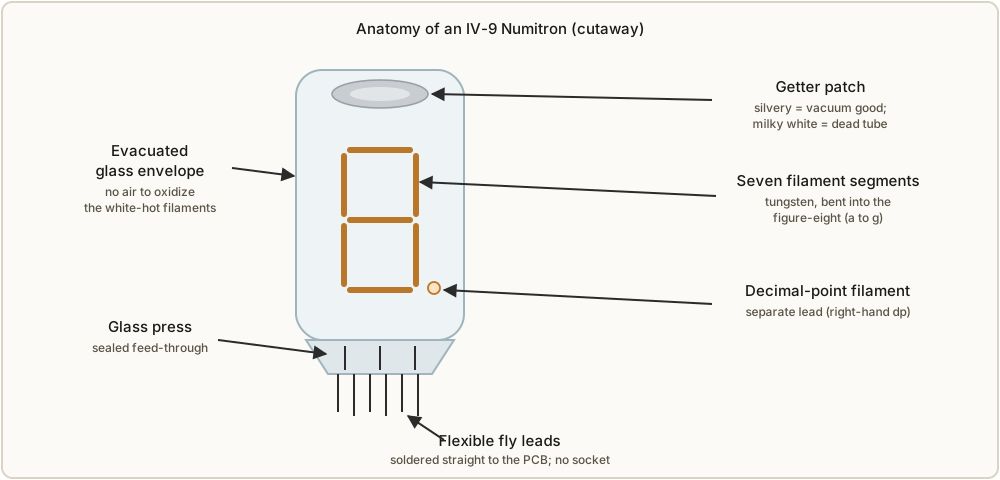
The tube used throughout this hub is the Soviet IV-9 (ИВ-9), a small seven-segment incandescent indicator with a digit height of roughly 13 mm. Its construction is simple, which is much of its charm.
- Seven filament segments are bent into the standard seven-segment figure- eight — the same a-through-g layout used by every seven-segment LED display, so the IV-9 forms any digit 0–9 (and a handful of letters) in the familiar way.
- A decimal-point filament sits to the lower right of the digit, a separate segment with its own lead. On the IV-9 it is a right-hand decimal point.
- An evacuated glass envelope seals the filaments away from air. Because the filaments run white-hot, the vacuum is not optional — in air the tungsten would oxidize and burn through in moments, exactly as a broken light bulb does.
- Flexible “fly leads” exit the bottom of the tube through a sealed glass press. There is no socket: the leads are bent to a footprint and soldered straight to a PCB, which is how the worked build mounts each tube directly atop its decoder chip.5 The leads are also the tube’s chief vulnerability — any bending or soldering stress travels down the lead to the glass seal and can crack it, so the leads are straightened and formed with great care and zero force into the glass (Vol 5 and Vol 9).
- The getter is the silvery patch deposited inside the top of the envelope. A getter is a reactive metal film that absorbs stray gas molecules and so maintains the vacuum over the tube’s life; it also indicates the vacuum’s health. While the getter stays bright and silvery the vacuum is good. When the getter turns milky white, air has leaked in and the tube is dead — the construction manual is explicit: “When the silvery top turns white, it cannot be used anymore; air has somehow leaked in.”6 A white getter is the Numitron’s single most important failure flag, and Vol 9 returns to it as the go/no-go test for any surplus tube.
2.4.1 The seven-segment letter map
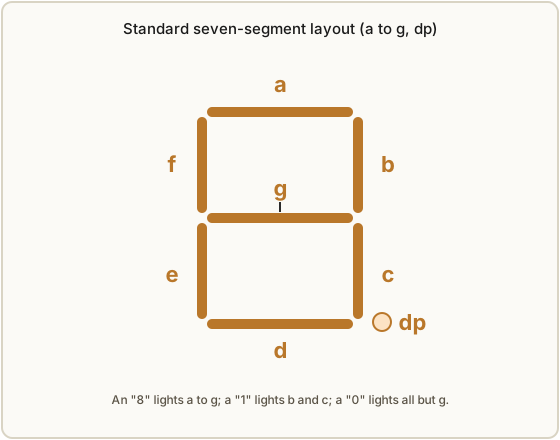
Seven-segment numerals are described by a standard set of single-letter segment names, and the IV-9 follows it exactly. Reading a digit with the decimal point at the lower right:
- a — top horizontal bar.
- b — upper-right vertical bar.
- c — lower-right vertical bar.
- d — bottom horizontal bar.
- e — lower-left vertical bar.
- f — upper-left vertical bar.
- g — center horizontal bar.
- dp — the decimal point (right-hand, on the IV-9).
A “1,” for example, lights b and c; a “7” lights a, b, and c; an “8” lights all seven (a–g); a “0” lights everything but g. This is the universal seven-segment convention, so any BCD-to-seven-segment decoder built for LED displays already speaks the IV-9’s language — the basis for the direct-drive approach in Vol 3.
2.4.2 The IV-9 pinout
The IV-9’s nine leads map to the common, the decimal point, and the seven segments as follows, reproduced from the construction manual.6 Segment notation is the standard seven-segment convention described above.
Table 1 — 2.4.2 The IV-9 pinout
| Pin # | Function |
|---|---|
| 1 | Common |
| 2 | RH decimal point |
| 3 | Segment b |
| 4 | Segment c |
| 5 | Segment a |
| 6 | Segment f |
| 7 | Segment g |
| 8 | Segment d |
| 9 | Segment e |
Two things are worth flagging for the bench. First, the pin order is not a tidy a-b-c-d-e-f-g run — note that pin 5 is segment a while pins 3 and 4 are segments b and c — so the wiring to a decoder must follow this table, not intuition; the worked build’s PCB footprint already encodes it (Vol 5). Second, because of the polarity freedom in section 2.3, pin 1 (common) may be tied to either supply rail; the table tells you which lead is which segment, but it does not dictate the direction of drive.
2.5 Electrical ratings and the arithmetic of a full display
The IV-9 operates at about 5 V with roughly 23 mA per segment lit.5 That low voltage is the entire reason a Numitron clock is the gentle cousin of a nixie clock — there is no high-voltage rail anywhere — and the per-segment current is what sizes the driver and the power supply. Do the arithmetic, because it drives several design choices downstream.
-
One full “8” with decimal point lights all seven segments plus the dp — 8 filaments:
8 filaments x 23 mA = 184 mA for a single tube showing “8.” at full brightness.
-
Power in that tube: 5 V x 0.184 A = 0.92 W for one fully lit digit.
-
A full six-digit display of “8”s without decimal points lights 7 segments on each of 6 tubes — 42 filaments. The build article works exactly this case for the start-up “lamp test” flash, where every tube briefly shows an 8:
7 segments x 6 tubes x 23 mA = 966 mA ≈ 1 A.7
The article notes this start-up flash is the peak current the whole clock ever draws — “Maximum current required for the project peaks therefore very close to the one amp limit when all Numitron segments are lit when first plugged in” — which is why its 5 V buck converter is sized for it and why the recommended wall-wart is rated 1.5 A. (Power and supply design are Vol 3 and Vol 5; the figure is reproduced here to show where the per-segment current leads.)
The takeaway: a Numitron’s appetite is modest (each segment is a fraction of a fifth-watt lamp), but it is continuous — every lit segment draws its 23 mA the whole time it is lit, because you cannot multiplex the load away. A six-digit clock therefore budgets for the worst-case all-eights instant near one amp.
2.6 Lifetime, reliability, and the one failure mode
The build article makes a strong reliability claim for the Numitron, and it is worth quoting precisely and attributing as the article’s claim: Numitrons “are typically rated for over 100,000 hours (~11.5 years) of operation compared to some Nixies that are rated for only 5,000 hours (~200 days!).”8 Treat the headline numbers as the article’s figures rather than as a measured guarantee for any specific surplus tube — real lifetime depends on the drive current and the individual tube — but the direction of the comparison is sound and follows from the physics.
The reason a Numitron can last so long is that its failure mode is benign. The things that kill a nixie do not exist in a Numitron:
- No sputtering. A nixie’s cathodes slowly erode and re-deposit metal on the inside of the glass, darkening it and obscuring the display over thousands of hours. A Numitron has no cathode and no glow discharge, so nothing sputters.
- No cathode poisoning. Unevenly used nixie cathodes develop poisoned, hard-to-light patches, which is why nixie clocks run “slot-machine” anti- poisoning routines that cycle every digit periodically. A Numitron has no cathodes to poison and needs no such routine.9
A Numitron’s eventual end comes one of two ways, both tied to the same physical parts. A filament can simply burn open like any lamp element after enough hours hot — an open segment that no longer lights. More commonly for a surplus tube, the vacuum is lost: a cracked seal or a stressed lead lets air in, the getter turns from silvery to white, and the next time the filaments are energized in the presence of air they oxidize and fail. The white getter (section 2.4) is the visible signature of this, and because the leads transmit handling stress straight to the glass, mechanical care in forming the fly leads is the single biggest thing a builder does to protect tube life (Vol 5 and Vol 9). The short version: a Numitron does not wear out from use the way a nixie does — it dies from a lost vacuum, usually from handling, not from running.
2.7 A short history
The seven-segment numeric format predates every electronic display that uses it: it was patented in 1908 by F. W. Wood.10 The Numitron itself was introduced by RCA around 1970 — the DR2000 / DR2010 series and kin — as a low-cost, low-voltage incandescent readout, and a March 1970 Popular Electronics feature put the new “Numitron” in front of hobbyists.10 For a few years it had a genuine edge over the alternatives of the day: an incandescent segment was slightly brighter than the LEDs of that era and, unlike a nixie, a Panaplex panel, or an LCD, it had almost no temperature dependence, so it went into gas pumps, instruments, and avionics (section 2.2).
The Soviet electronics industry built its own prolific family of incandescent indicators, the ИВ- (“IV-”) series — including the small IV-9 used here and its larger sibling the IV-13 — and it is this Cold-War stock that makes up almost all the Numitrons on the surplus market today. The build article frames the whole project around them: the tubes “are still available for a reasonable cost on eBay from old Russian cold war stock,” and “as stocks (rapidly) dwindle, their cost increases steadily until they will be gone forever.”11 The technology was overtaken by the seven-segment LED through the 1970s — LEDs drew less power, shrank without limit, and matched the Numitron’s brightness and then surpassed it — and mass Numitron production wound down accordingly. What survives is surplus, and the warm filament glow has made the Numitron a quiet favorite of clock builders who want the nixie aesthetic without the high voltage.
2.8 Numitron vs nixie vs seven-segment LED vs VFD
The Numitron sits in a small field of “retro glowing digit” technologies. The table below places it against the three it is most often confused with or compared to — the nixie (its closest aesthetic cousin), the seven-segment LED (the technology that replaced it), and the vacuum fluorescent display (another evacuated glass device with a very different mechanism). Voltages and currents are typical small-display figures; the Numitron column reflects the IV-9.
Table 2 — 2.8 Numitron vs nixie vs seven-segment LED vs VFD
| Property | Numitron (IV-9) | Nixie | 7-seg LED | VFD |
|---|---|---|---|---|
| Light mechanism | Incandescent tungsten filament (thermal) | Cold-cathode neon glow discharge | Semiconductor electroluminescence | Phosphor excited by low-energy electrons |
| Segment / drive voltage | ~5 V | ~170 V to strike, ~120–150 V sustain | ~1.6–3.5 V (color-dependent) | ~12–50 V anode/grid; plus a heated-filament supply |
| Current draw | ~23 mA per segment, continuous | ~1–3 mA per digit | a few mA per segment | low mA per segment |
| Drive complexity | Low — direct from a 25 mA BCD-to-7-seg LED decoder (CD4511); one driver per digit | High — needs a high-voltage supply and HV-rated drivers | Low — standard logic; can be multiplexed | Moderate — needs a small HV-ish supply, a filament supply, and grid/anode drive |
| Multiplexable? | No — thermal inertia turns multiplexing into dimming | Yes (commonly) | Yes (the usual approach) | Yes |
| Polarity | Polarity-free (filament is resistive; common can be +, −, or AC) | Polarity-sensitive (diode-like cathode/anode) | Polarity-sensitive (diode) | Polarity-sensitive |
| Brightness | Good; warm and even | Good; bright neon glow | Very good to very high | Very good; bright |
| Color / look | Warm amber-white filament glow | Saturated neon orange | Any single LED color | Characteristic blue-green (phosphor) |
| Temperature dependence | Negligible (runs far above ambient) | Significant (cold tubes strike poorly) | Low | Low–moderate |
| Lifetime (per the build article) | >100,000 h claimed (~11.5 yr) | as low as ~5,000 h for some types | very long | long |
| Typical failure mode | Lost vacuum (white getter) or open filament | Sputtering / cathode poisoning | LED dimming / junction failure | Filament or phosphor aging |
| Safety | Safe low voltage (5 V) | High voltage — insulation and care required | Safe low voltage | Modest voltages; generally safe |
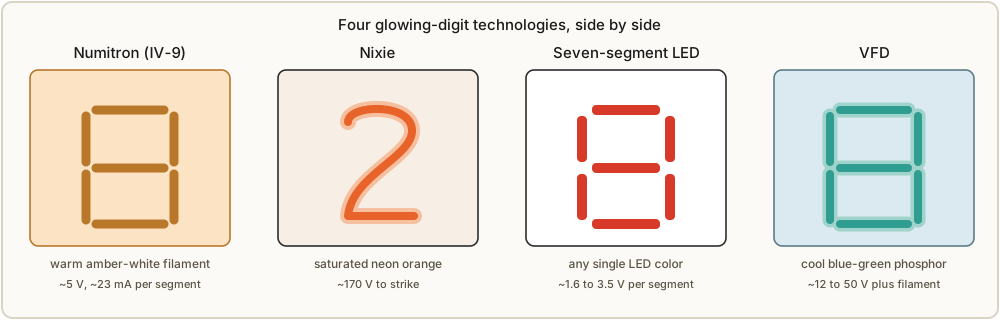
The pattern in the table is the through-line of this whole series. The Numitron trades the nixie’s drama and depth for low-voltage simplicity and ruggedness: same warm glass-tube charm, but it runs at 5 V, it cannot shock you, it does not poison or sputter, and you drive it with the same humble CD4511 decoder you would use for an LED display. The costs are equally clear — it draws far more current per segment than any of the others, and that current must flow continuously because the one thing you cannot do to a filament is multiplex it. Vol 3 takes that constraint and that current figure and turns them into a driver.
2.9 References (Vol 2)
- Bill van Dijk, “Build the Numitron — A Six-Digit Clock,” Nuts & Volts, September 2016 — build article, construction manual (IV-9 pinout chart), user manual, full schematic, Eagle/Gerber board files, IV-9 datasheet, MPASM firmware + production HEX. Held in
02-inputs/TheNumetron/. _shared/comparison.md(cross-technology decision matrix) and_shared/deep_dive_protocol.md.
Footnotes
-
Bill van Dijk, “Build the Numitron — A Six-Digit Clock,” Nuts & Volts, September 2016 (build article). The Numitron “is not a traditional tube (valve) in that there is no electron emission involved; it only has filaments, and as such is more analogous to the light bulb than any other electrical device.” Held in
02-inputs/TheNumetron/_extracted/build_article.txt. ↩ -
Nuts & Volts build article: the Numitrons “are essentially just little multi-filament incandescent light bulbs from an electrical perspective, and as such, multiplexing them will simply act as a light dimmer.”
02-inputs/TheNumetron/_extracted/build_article.txt. ↩ -
Nuts & Volts build article, history/advantages: Numitrons “did not have a great dependence on ambient temperature,” whereas “Nixies, Panaplex displays, and later LCDs required heating elements when used outdoors in colder regions,” and “Even today, the Numitron is still regularly found working in older gasoline pumps.”
02-inputs/TheNumetron/_extracted/build_article.txt. ↩ -
Nuts & Volts build article, Figure 2b caption: “since the Numitron uses filaments, the common can be positive, negative, or even power via AC voltage.”
02-inputs/TheNumetron/_extracted/build_article.txt. ↩ -
Nuts & Volts build article: the IV-9 “operates on five volts at about 23 mA per segment. It has ‘fly leads’ and as such does not require a difficult socket.”
02-inputs/TheNumetron/_extracted/build_article.txt. IV-9 datasheet held in02-inputs/TheNumetron/IV-9 (Numitron).pdf. ↩ ↩2 -
Numitron Clock Construction Manual (Bill van Dijk), IV-9 pin/function chart and getter note (“When the silvery top turns white, it cannot be used anymore; air has somehow leaked in”). Pinout: 1 = common, 2 = RH decimal point, 3 = segment b, 4 = segment c, 5 = segment a, 6 = segment f, 7 = segment g, 8 = segment d, 9 = segment e. Held in
02-inputs/TheNumetron/_extracted/construction_manual.txt. ↩ ↩2 -
Nuts & Volts build article, power supply section: “the start-up flash cycle, where all six Numitrons are lit for a second at the time; 7x6 segments at about 23 mA = 966 mA total. Maximum current required for the project peaks therefore very close to the one amp limit.”
02-inputs/TheNumetron/_extracted/build_article.txt. ↩ -
Nuts & Volts build article, “Numitron vs. Nixie?” section: “In many cases, Numitrons will outlast Nixie tubes as they are typically rated for over 100,000 hours (~11.5 years) of operation compared to some Nixies that are rated for only 5,000 hours (~200 days!).” Attributed as the article’s claim.
02-inputs/TheNumetron/_extracted/build_article.txt. ↩ -
Nuts & Volts build article, “Numitron vs. Nixie?” section: Numitrons “do not suffer from failure states such as ‘sputtering’ where electrode metal collects on the inside of the glass tube” and “don’t encounter cathode poisoning that requires a potentially distracting anti-cathode poisoning software routine.”
02-inputs/TheNumetron/_extracted/build_article.txt. ↩ -
Nuts & Volts build article, history section: first Numitron attributed to RCA (per Wikipedia and a March 1970 Popular Electronics article), built on the seven-segment format “first patented in 1908 by someone called F.W. Wood.” RCA DR-series (DR2000/DR2010) background.
02-inputs/TheNumetron/_extracted/build_article.txt. ↩ ↩2 -
Nuts & Volts build article, introduction: the tubes “are still available for a reasonable cost on eBay from old Russian cold war stock,” and “As stocks (rapidly) dwindle, their cost increases steadily until they will be gone forever.”
02-inputs/TheNumetron/_extracted/build_article.txt. ↩
Comments (0)