Numitron · Volume 10
Cheatsheet & Glossary
The laminate-ready quick-reference card: IV-9 pinout, CD4511 truth table, the worked-clock IC roster, supply math, source URLs, and an A–Z of Numitron terms
This volume distills the nine that precede it into a single dense card. Nothing here is new — every value is carried forward from the IV-9 tube data (Vol 2), the driver and timebase chapters (Vols 3–4), the worked Nuts & Volts six-digit clock (Vols 5 and 8), and the build article’s parts list and Resources section. Where a number could be mistaken, the source volume is named in prose. Print it, laminate it, keep it by the iron.
10.1 IV-9 quick spec
Table 1 — 10.1 IV-9 quick spec
| Parameter | Value | Note |
|---|---|---|
| Technology | Incandescent (tungsten filament) | Not neon, not LED — a vacuum tube with no electron emission |
| Operating voltage | ~5 V | Same rail as the logic; no high-voltage supply anywhere |
| Segment current | ~23 mA per segment | At ~5 V |
| Digit height | ~13 mm | Small Soviet tube |
| Elements | 7 segments + 1 decimal point (DP) | Standard seven-segment layout |
| Connection | Fly leads (flexible wires) | Solders straight to the board — no socket |
| Common polarity | Positive, negative, or AC | A filament is purely resistive — direction-agnostic |
| Getter | Silvery patch at the top of the envelope | A vacuum indicator: white = vacuum lost = dead tube |
| Origin / family | Soviet ИВ- (“IV-”) series; IV-9 (ИВ-9) | Larger sibling: IV-13 |
Full-digit current. A complete “8” lights every element: 7 segments + the decimal point = 8 elements at ~23 mA each ≈ 184 mA per tube. (Without the DP, the seven segments alone draw ~161 mA.) The build article uses the seven-segment figure for its worst-case supply math — see 10.6.
10.2 IV-9 pinout
Pin numbering and segment assignments per the construction manual (notation is the same a–g standard used for seven-segment LED displays).
Table 2 — 10.2 IV-9 pinout
| Pin | Function |
|---|---|
| 1 | Common |
| 2 | RH decimal point (DP) |
| 3 | Segment b |
| 4 | Segment c |
| 5 | Segment a |
| 6 | Segment f |
| 7 | Segment g |
| 8 | Segment d |
| 9 | Segment e |
Standard seven-segment layout (a–g). The seven segments form a figure-eight: a is
the top bar, g the middle bar, d the bottom bar; f and b are the upper-left and
upper-right verticals; e and c are the lower-left and lower-right verticals. The DP
sits at the lower right.
     aaaa
    f    b
    f    b
     gggg
    e    c
    e    c
     dddd  . (DP)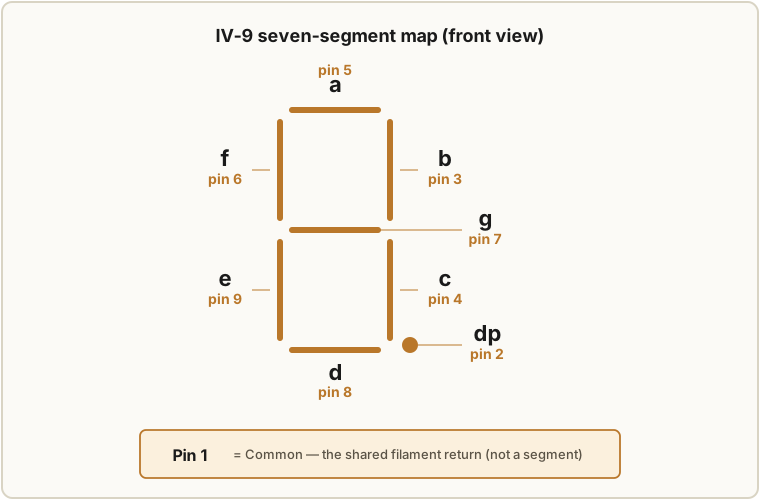
10.3 The “can’t multiplex” rule
A Numitron cannot be meaningfully multiplexed: a filament has thermal mass, so a low duty cycle just dims it — every digit needs its own continuous driver. By contrast, the worked clock’s 60-LED ring is heavily multiplexed (never more than 8 lit at once, fused by persistence of vision).
The two display technologies in the same clock therefore demand opposite drive strategies — the instructive heart of the build (Vol 3).
10.4 CD4511 quick reference
The CD4511 is a BCD-to-seven-segment decoder/driver with a built-in latch, designed for LED displays but driving the IV-9 directly because its ~25 mA output rating covers the tube’s ~23 mA per segment at ~5 V. One per tube (six total in the worked build).
10.4.1 BCD → segment truth table (0–9)
Active-high outputs; 1 = segment ON. (CD4511 blanks for input codes 10–15.)
Table 3 — 10.4.1 BCD → segment truth table (0–9)
| Digit | a | b | c | d | e | f | g |
|---|---|---|---|---|---|---|---|
| 0 | 1 | 1 | 1 | 1 | 1 | 1 | 0 |
| 1 | 0 | 1 | 1 | 0 | 0 | 0 | 0 |
| 2 | 1 | 1 | 0 | 1 | 1 | 0 | 1 |
| 3 | 1 | 1 | 1 | 1 | 0 | 0 | 1 |
| 4 | 0 | 1 | 1 | 0 | 0 | 1 | 1 |
| 5 | 1 | 0 | 1 | 1 | 0 | 1 | 1 |
| 6 | 1 | 0 | 1 | 1 | 1 | 1 | 1 |
| 7 | 1 | 1 | 1 | 0 | 0 | 0 | 0 |
| 8 | 1 | 1 | 1 | 1 | 1 | 1 | 1 |
| 9 | 1 | 1 | 1 | 1 | 0 | 1 | 1 |
10.4.2 Control inputs
Table 4 — 10.4.2 Control inputs
| Pin | Name | Active | Effect |
|---|---|---|---|
| LE | Latch Enable | LOW = transparent | LOW: outputs follow the BCD input. HIGH: latch holds the last value (lets the worked clock fan one data bus out to six decoders, latching only the selected one) |
| LT | Lamp Test | LOW | All seven segments ON regardless of BCD — used for the startup/reset flash and to test the tubes |
| BI | Blanking Input | LOW | All seven segments OFF (ripple-blanking / display blanking) |
Priority in the part: BI overrides LT, which overrides the decoded data.
10.5 Worked-clock IC roster
The Nuts & Volts six-digit clock (Bill van Dijk, September 2016), one-line roles.
Table 5 — 10.5 Worked-clock IC roster
| Ref | Part | Role |
|---|---|---|
| IC1 | PIC16F876A-I/SO | 8-bit MCU — runs everything (time, display scan, UI, EEPROM) at 4 MHz |
| IC5–IC10 | CD4511 (×6) | BCD-to-7-seg decoder/latch, one per Numitron tube |
| IC4 | SN74HC164N | 8-bit shift register — selects which CD4511 latch to update |
| IC2 | CD4017BE | Decade counter — selects the active LED row of the 60-LED ring |
| IC11 | ULN2803A | Darlington array — sinks the full LED-row current (beyond the CD4017’s rating) |
| IC3 | LM2575T-5 | Switch-mode buck regulator — provides the single 5 V rail |
(The part list prints a typo — IC11’s Mouser line reads a CD4511 number — but the device named is the ULN2803A Darlington array, IC11 in the schematic.)
10.6 Power & timebase quick facts
Table 6 — 10.6 Power & timebase quick facts
| Item | Value | Note |
|---|---|---|
| Wall wart | ≥1.5 A at ≥9 V, AC or DC | Bridge rectifier accepts either; parts list suggests 12 V or 15 V |
| Peak current | ~966 mA | Startup flash: all six tubes lit (7 segments × 6 = 42 × ~23 mA) — close to 1 A |
| Rail | 5 V from LM2575T-5 buck | Behind a bridge rectifier + 1000 µF tank cap |
| System crystal | 4 MHz | Runs the PIC program |
| Timebase crystal | 32.768 kHz watch crystal | Critical for accuracy — do not salvage/substitute blind |
| Load caps | 2 × 12 pF (0805), matched to the crystal | Set frequency accuracy; change them if you change the crystal |
| Accuracy | ~1 s/day or better | When crystal and load caps are properly matched |
10.7 LED pattern codes
The 60-LED ring’s selectable patterns (user manual). Mode is saved in EEPROM and survives power loss.
Table 7 — 10.7 LED pattern codes
| Code | Pattern |
|---|---|
| 0 | Cycle — randomly changes patterns 1–7 every hour (default) |
| 1 | Single LED clockwise, ring fills as the minute progresses |
| 2 | As 1, but counter-clockwise |
| 3 | Single LED running clockwise (no fill) |
| 4 | Counter-clockwise running LED, ring fills as the minute progresses |
| 5 | As 4, reversed |
| 6 | Pendulum |
| 7 | Newton |
| 8 | Rain |
10.8 Supply & current formulas
- Segment series/limit resistance —
R = V / I. For a ~5 V drive at ~23 mA, the per-segment current path works out to roughly5 V / 0.023 A ≈ 217 Ωof total path resistance (largely the hot filament itself; the CD4511 drives the IV-9 directly, with the optional dimming diode below). - Full-clock peak current (startup flash) —
7 segments × 6 tubes × 23 mA = 42 × 23 mA = 966 mA(≈ 1 A). This is the worst case the supply must meet. - Per-tube full-”8” current (with DP) —
8 elements × 23 mA = 184 mA. - Dimming-diode drop — placing a series diode (D2, a 1N4001) in the common path and
shorting it with jumper JP2 trades brightness for current. With the jumper off, the
segments see roughly
5 V − 0.7 V = 4.3 V(one diode forward drop), dimming the tubes slightly and shaving the current draw. With JP2 on (or the diode replaced by a wire), the tubes run at the full ~5 V.
10.9 Source URLs and in-hub file locations
10.9.1 External resources (from the build article)
Table 8 — 10.9.1 External resources (from the build article)
| Topic | URL |
|---|---|
| The build article | Nuts & Volts, “Build the Numitron — A Six-Digit Clock,” September 2016 (Bill van Dijk) |
| Switch debouncing discussion | www.eng.utah.edu/~cs5780/debouncing.pdf |
| Free EagleCAD | https://cadsoft.io |
| Microchip MPLAB / PICkit3 IDE | www.microchip.com/pagehandler/en-us/family/mplabx/home.html |
| Numitron lifespan (RCA DR2010) | www.rfcafe.com/references/popular-electronics/images2/rca-dr2010-numitron.pdf |
| Numitron history (March 1970 Popular Electronics) | www.rfcafe.com/references/popular-electronics/numitron-readout-march-1970-popular-electronics.htm |
| Cathode poisoning (nixie contrast) | www.tube-tester.com/sites/nixie/different/cathode%20poisoning/cathode-poisoning.htm |
10.9.2 In-hub files (02-inputs/TheNumetron/)
Table 9 — 10.9.2 In-hub files (02-inputs/TheNumetron/)
| File | What it is |
|---|---|
_extracted/build_article.txt | The article text: parts list, Resources, ratings |
_extracted/construction_manual.txt | Assembly tips and the IV-9 pinout chart |
_extracted/user_manual.txt | Pattern list, accuracy, operating instructions |
IV-9 (Numitron).pdf | The IV-9 datasheet |
| Schematic / Eagle + Gerber board files | Full design files (201609-Dijk.zip) |
Firmware (60L-Numitron.asm + HEX) | MPASM source + production HEX |
| Pattern video | The LED-ring patterns in motion |
10.10 A–Z glossary
BCD (binary-coded decimal) — a digit 0–9 encoded in four bits; the value the PIC sends to a CD4511 to select which numeral to display.
Blanking (BI) — the CD4511’s active-low Blanking Input; when low, all segments are off.
Buck converter — a switch-mode step-down regulator. Here the LM2575T-5 drops the rectified wall-wart voltage to the single 5 V rail; chosen over a linear regulator because it runs cooler and tolerates more wall-wart options.
Darlington array (ULN2803) — eight Darlington transistor pairs in one package; used to sink the full LED-row current the CD4017 cannot.
Decimal point (DP) — the eighth illuminable element of the IV-9, at the lower right (pin 2). Not used for timekeeping in the worked clock.
Decoder/driver — a chip that turns a coded input (BCD) into segment drive signals; the CD4511 is a decoder/driver with a latch.
Dimming diode — the optional series diode (D2) whose ~0.7 V forward drop slightly dims the tubes and trims current when its bypass jumper (JP2) is open.
EEPROM — non-volatile memory inside the PIC; stores the 12/24-hour mode and chosen LED pattern so they survive power loss.
Filament — the tungsten wire that forms one segment; passing current heats it until it glows. The Numitron’s defining element — it behaves like a tiny light bulb.
Fly lead — a flexible wire emerging from the tube envelope (the IV-9 has them), letting the tube solder straight to a board with no socket. Bending stress on a fly lead can crack the glass seal.
Getter — the silvery deposit at the top of the envelope that absorbs stray gas and indicates vacuum integrity. It turns white when the vacuum is lost — a white getter means a dead tube.
Incandescence — light produced by heating a material until it glows; the Numitron’s operating principle (vs. the nixie’s gas glow discharge or an LED’s electroluminescence).
Inrush current — the brief peak draw at power-up; here the ~966 mA startup flash when all tubes light at once, which sizes the supply.
Lamp test (LT) — the CD4511’s active-low Lamp Test input; when low, all segments light regardless of BCD — used for the startup flash and to verify tubes.
Latch (LE) — Latch Enable; when transparent (low) the outputs follow the input, when latched (high) they hold. Lets one BCD bus feed six decoders, updating only the selected one.
Multiplexing — rapidly switching among displays so persistence of vision fuses them into a steady image. Works for the LED ring; does not work for Numitron filaments (it just dims them).
Numitron — an incandescent seven-segment indicator tube (RCA, ~1970; Soviet ИВ- series). Runs at low voltage; segments are filaments, not gas or LEDs.
Persistence of vision (POV) — the eye’s retention of an image after the light stops, which makes a fast-multiplexed LED ring look continuously lit.
Seven-segment — the a–g segment layout (top, two upper verticals, middle, two lower verticals, bottom) used to form digits; standardized from F.W. Wood’s 1908 patent.
Shift register (SN74HC164) — a chip that clocks serial data into parallel outputs; here it generates the digit-select signals that pick which CD4511 to latch.
Watch crystal (32.768 kHz) — the low-frequency quartz crystal used as the accurate timebase. The single most accuracy-critical part — do not substitute an unknown or salvaged one, and match its load capacitors.
10.11 References (Vol 10)
- Bill van Dijk, “Build the Numitron — A Six-Digit Clock,” Nuts & Volts, September 2016.
Held in
02-inputs/TheNumetron/(build article, construction manual, user manual, full schematic, Eagle/Gerber board files, IV-9 datasheet, MPASM firmware + HEX, pattern video). - IV-9 (ИВ-9) Numitron datasheet —
02-inputs/TheNumetron/IV-9 (Numitron).pdf. - Extracted source text —
02-inputs/TheNumetron/_extracted/{build_article,construction_manual,user_manual}.txt. - Cross-references: Vol 2 (tube physics & anatomy), Vol 3 (driving Numitrons / CD4511), Vol 4 (timebase, PIC, LED-ring multiplex), Vols 5 & 8 (the worked build).
Comments (0)