Meter Movement · Volume 7
Buy a Kit or Finished Clock
The buy-instead-of-build path: finished voltmeter clocks, single-board kits, the collected design's controller kit, and sourcing the meters
Vol 6 is the worked build — perfboard, a flashed PIC, a calibration ritual, and a CNC-carved case. This volume is the other half of the hub’s DIY-plus-Buy duality: the path where someone else has already done some or all of that work, and you trade money for effort. It is not a lesser path. A meter-movement clock exists for one reason — the slow, smooth analog sweep of three needles across re-faced instrument dials — and that charm arrives identically whether you soldered the board yourself or unboxed a finished clock from an Etsy seller. What changes across the buy spectrum is only how much of the assembly, calibration, and dial craft you inherit versus do yourself.
The honest framing to carry through the whole volume, and the one this hub repeats without apology: none of these clocks is bought for accuracy. A moving-coil needle settling against a hairspring is a beautiful way to show a number and a mediocre way to keep time; any $15 quartz movement holds time far better than the best of them. You are buying — or building — the instrument aesthetic and the sweep, not the timekeeping. Keep that straight and every trade-off below reads clearly.
7.1 The buy spectrum
Vol 1 laid out four first-class paths to a meter-movement clock; this volume owns three of them (everything except “build the collected design,” which is Vol 6). Read left to right, the spectrum runs from zero effort, most money per clock to most effort, least money and most soul:
Table 1 — most soul
| Option | What you get | What you do | Effort | Cost | Section |
|---|---|---|---|---|---|
| Finished clock | A complete, calibrated artisan/novelty “voltmeter clock,” meters and case included | Unbox it, set the time | none | $$ | §7.4 |
| Single-board kit | A generic voltmeter-clock PCB (often ATmega/Arduino), sometimes with meters | Light soldering, mount meters, calibrate | low | $–$$ | §7.3 |
| Controller kit | The Multimeter Clock Kit — the controller board for the collected design, with a pre-programmed PIC | Solder the board, add 3 meters + a case, calibrate | medium | $ | §7.2 |
| Source the parts | Nothing assembled — meters, MCU, board, faces, enclosure bought separately | Design and build all of it | high | $ | §7.5, Vols 3–5 |
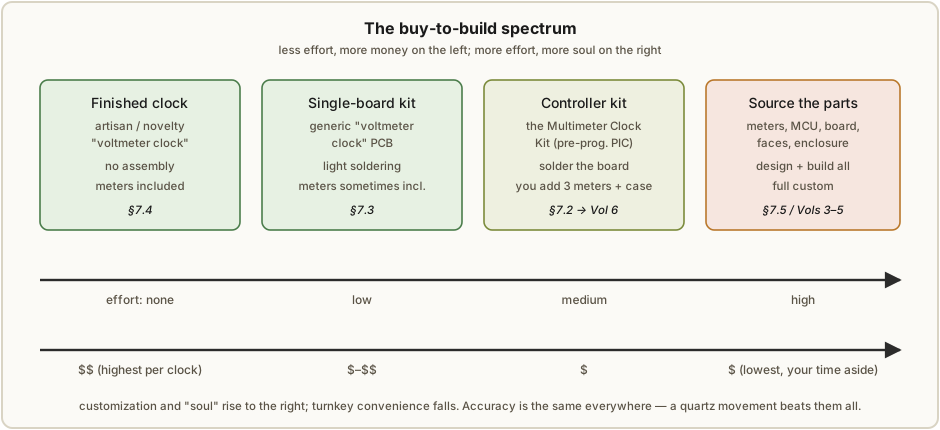
Two things about the cost column are worth saying plainly. First, the dollar signs are per finished clock: a finished unit costs the most because you are paying for someone’s labor, their meters, and their case, while “source the parts” is cheapest in cash precisely because it spends your time instead. Second, the controller kit is the sweet spot for a maker who wants the collected design — it hands you the one genuinely fiddly part (a correctly programmed PIC and a known-good circuit) and leaves you the satisfying, low-risk parts (mounting meters, re-facing dials, building a case). The rest of this volume walks each option in turn, then closes (§7.6) with the buy-vs-build table that weighs them against actually building Vol 6 from scratch.
7.2 The Multimeter Clock Kit — turnkey path to the collected design
The collected build of this entire series is abbtech’s Multimeter Clock (Vols 1, 6, 9): three analog meters on their 0.5 mA range, a PIC16F628A at 20 MHz, each meter driven from a PIC pin through a 4.7 kΩ resistor, with a scale-adjust calibration mode and custom MeterBasic dial faces. The author (Alan Parekh, of Hacked Gadgets) sold a matching Multimeter Clock Kit — and this kit is the single most direct way to end up with the exact clock Vol 6 builds, without etching a board or flashing a chip.1
7.2.1 What is in the kit
The kit is the controller, not the whole clock. It supplies the electronics that turn a crystal into three calibrated meter currents, built on a small perfboard. As documented, the kit contains:2
- A pre-programmed PIC16F628A — flashed with the Multimeter Clock firmware (PICBasic Pro), so you never touch a PIC programmer. This is the part that makes it “turnkey”: the firmware, the tenth-of-a-second timebase, and the calibration mode are already in the chip.
- An 18-pin DIP socket for the PIC (so the chip is never soldered directly and can be re-flashed later if you want to hack the ~20 % of free code space).
- A 2 × 3 inch perfboard, a 2-position terminal block (power in), a 20 MHz crystal, the voltage regulator (5 V), diodes and capacitors, the current-limiting resistors and the three tactile time-set buttons, pin headers with shorting jumpers, and a blue status LED.
In other words: everything in the schematic except the meters and the box.
7.2.2 What you still supply
Three things, and they are deliberately the things that make the clock yours:2
- Three analog panel meters with a 0.5 mA range — the kit firmware and the 4.7 kΩ resistors assume a 0.5 mA full-scale drive (Vol 4). Cheap plastic-bezel meters, surplus multimeters used on their 0.5 mA DC setting, or a matched set work; meter sourcing is §7.5 and the full treatment is Vol 3.
- An enclosure — the canonical build is layered ½-inch MDF, CNC v-carved with Simpson 260 details (Vol 8), but the kit imposes nothing here.
- A 9–12 V DC supply — any small wall adapter; the on-board regulator drops it to 5 V.
7.2.3 Why this is the recommended buy path for the collected build
If you want this clock — the documented one, with the article, schematic, faces, and case files all in hand (Vol 6, Vol 9) — the controller kit removes the two steps most likely to stop a build cold: getting a PIC correctly programmed, and wiring a known-good timebase. What remains is soldering a small through-hole board (an evening), then the genuinely enjoyable craft of choosing and re-facing meters (Vol 8) and building a case. You still run the scale-adjust calibration yourself (Vol 4 / Vol 6) — that is intrinsic to the meters you chose and cannot be pre-done at the factory. Availability of the kit has come and gone over the years (it was sold through the author’s small storefront, not a mainstream distributor), so if it is out of stock, the generic single-board kits of §7.3 cover the same need with different firmware.
7.3 The generic “voltmeter clock” kit genre
Beyond abbtech’s specific design there is a whole small genre of voltmeter clock kits and boards — the search terms are “voltmeter clock” and “panel meter clock” — sold on AliExpress, Tindie, Etsy, and Amazon. The recipe is always the same: a small controller drives three analog voltmeters as hours / minutes / seconds. What varies is the brain and what is in the box.
7.3.1 The common architectures
- Arduino / ATmega boards. The most common hobbyist pattern is an Arduino Nano (or a bare ATmega328) plus a DS1307/DS3231 RTC module, driving three meters through PWM pins and RC filters (or directly through resistors). Many published designs — and several kits derived from them — follow this exact shape.3
- A fully-assembled controller with no soldering. The best-known commercial example is Wicked Device’s Angular Clock Kit: three voltmeter-style panel meters plus a pre-assembled Arduino-based controller, advertised as no soldering required and user-reprogrammable. The three meters are included; you mount them and set the time.4
- Dedicated driver boards. Some cheaper AliExpress listings use a small dedicated time-and-driver IC or a programmed micro with onboard trimmers, sold as a bare board you wire to your own meters.
7.3.2 What to check before buying
The genre is uneven, and a cheap board can leave you with meters that never reach noon or a seconds needle that jumps instead of sweeps. Check, in rough order of importance:
- Meter full-scale vs. the driver. This is the §7.5 and Vol 4 trap in kit form. The driver puts out a fixed maximum (a PWM-filtered voltage, or a current through a set resistor); the meter must read full scale at exactly that level so “twelve o’clock” lands at the dial’s end. A 0.5 mA driver into a 1 mA meter only reaches half-scale. If the kit includes the meters, this is solved for you — strongly prefer those.
- Calibration — trimmers or firmware. A good kit gives you a way to trim each meter to true full scale: either onboard trim potentiometers (one per meter) or a software calibration mode. Without one, unit-to-unit meter spread leaves the needles reading visibly wrong at the top of the scale.
- Are the meters included? Many AliExpress/Tindie listings sell only the board. Sourcing three meters that match the driver is the hard part (§7.5); a kit that bundles matched meters is worth a premium.
- 12 / 24-hour selection. Confirm the firmware (and the dial it ships with, if any) supports the format and dial range you want — a 0–12 vs 0–24 hour face is not interchangeable.
- RTC and battery backup. A kit with a DS3231 RTC and a coin-cell holds time across a power blip and drifts far less than a bare crystal counted in firmware. For a clock whose only weak point is timekeeping, this is the one accuracy upgrade worth caring about.
7.4 Finished meter clocks — no assembly at all
At the zero-effort end are finished panel-meter and voltmeter clocks: complete, calibrated, cased units you set the time on and put on a shelf. They come from two overlapping sources — small artisan/maker shops (Etsy, Tindie, and dedicated storefronts) and the occasional novelty brand.
The look is the whole product. Sellers lean into the laboratory-instrument aesthetic: vintage or vintage-styled meters in a wooden or metal frame, dials re-lettered HOURS / MINUTES / SECONDS, often with the smooth seconds sweep as the headline feature. A representative finished example is Awkward Engineer’s Analog Voltmeter Clock (model AWK-105): a two-meter design (an ATtiny CPU driving a pair of analog meters), with a mode knob that includes per-meter calibrate positions and AA-battery operation. As of the mid-2020s it listed at roughly $169 — a useful anchor for the finished tier.5 Three-meter artisan builds on Etsy/Tindie span a wide band: roughly $100 to $400+ as of the mid-2020s depending on whether the meters are genuine vintage instruments (a real Simpson or Weston commands a premium) or new panel meters, and on the case work.6 Treat every figure here as approximate and date-sensitive — these are small-batch handmade goods and prices move.
The trade you make for zero effort is the obvious one: you pay the most per clock, and you give up customization — the dial style, the case, the meter choice are the seller’s, not yours. If the point is to own a meter clock rather than to build one, this is the right tier; if any part of the appeal is the making, drop down the spectrum.
7.5 Sourcing the meters by themselves
This overlaps Vol 3 (the full meter-selection and sourcing treatment) and §7.2.2; here it is only the buyer’s-eye summary, because for several options above “buy the meters” is the missing piece. Three broad sources:
- Cheap new panel meters. New plastic-bezel moving-coil meters in the 0.5–1 mA full-scale range are a few dollars each from the same AliExpress/Amazon channels as the kits. These are the natural match for the collected design (0.5 mA) and the easiest to re-face (Vol 8). The risk is unit-to-unit spread — which is exactly why every driver in this hub has a per-meter calibration trim.
- Vintage instruments — Simpson 260, Weston. A genuine Simpson 260 VOM or a Weston panel meter is the real-instrument look the collected build deliberately imitates (the case is CNC-carved with Simpson 260 details, Vol 8). They are larger, pricier, and worth preserving — drive them within their range and never past full scale (Vol 4). Surplus units are plentiful on eBay and at hamfests.
- Matched sets. For three needles that look alike and track alike, the cleanest buy is a matched set of three identical meters — same model, same full-scale current, ideally same production batch. Some sellers list meters specifically in sets of three for exactly this clock use. A matched set also makes calibration converge faster, since all three start near the same point.
The single rule that ties §7.5 back to the whole volume: whatever drives the meters must be able to reach their full-scale current. Buy the meters and the driver as a system — either a kit that includes matched meters, or a driver chosen (or trimmed) for the meters you sourced. Mismatched, the needles simply never reach the top of the dial.
7.6 Buy vs. build — the trade-off
Putting the buy options beside actually building Vol 6 from scratch, weighed on the axes that matter for this clock:
Table 2 — matter for this clock
| Finished clock (§7.4) | Single-board kit (§7.3) | Controller kit (§7.2) | Build from scratch (Vol 6) | |
|---|---|---|---|---|
| Cash cost | Highest ($$, ~$100–400+) | Low–medium | Low (kit + your meters) | Lowest in cash; highest in time |
| Effort / skill | None — unbox | Light soldering | Solder a board + add meters/case | Full: board, flashing, faces, case |
| Time to a working clock | Minutes | An evening | A weekend | Several sessions |
| Customization (faces, case, meters) | None — seller’s design | Some (your meters/case) | High — your meters, faces, case | Total |
| ”Soul” / satisfaction | Low (a purchase) | Medium | High | Highest |
| Accuracy | Same — sweep, not timekeeping | Same | Same | Same |
The customization and “soul” columns climb steadily right; the cost-and-effort columns trade off against each other; and the accuracy column is deliberately flat. That last point is the volume’s thesis restated as a table: it does not matter which of these you pick — finished, kitted, or hand-built — because none of them is for keeping time. A meter-movement clock is bought or built for the instrument look and the analog sweep of three needles, and on those terms every tier delivers. If you genuinely need to know what time it is, a quartz wall clock or your phone wins by orders of magnitude and costs less than the cheapest meter here. Choose your tier by how much of the making you want to own — and let the calibration craft of Vol 4 and the dial-face craft of Vol 8 be what makes the needles, whichever path produced them, tell the truth across the whole dial.
7.7 References (Vol 7)
- Cross-references: Vol 1 §1.3 (the four paths) and §1.4 (decision tree); Vol 3 (meter selection and sourcing — the full treatment §7.5 summarizes); Vol 4 (driving, the 0.5 mA / full-scale match, and calibration); Vol 6 (the worked build the controller kit shortcuts); Vol 8 (dial faces and the instrument-panel enclosure); Vol 9 (the collected project walk-through).
Footnotes
-
Multimeter Clock by abbtech (Alan Parekh, Hacked Gadgets), Instructables, 2010 — three analog meters (H/M/S), PIC16F628A at 20 MHz, meters on 0.5 mA DC driven through 4.7 kΩ resistors, PICBasic Pro firmware with a scale-adjust calibration mode. The matching kit was sold through the author’s storefront. Source: https://www.instructables.com/Multimeter-Clock/; build log: http://hackedgadgets.com/2010/07/22/multimeter-clock-build-log/. See Vols 1, 6, 9. ↩
-
Multimeter Clock Kit contents (pre-programmed 16F628A, 18-pin socket, 2×3 inch perfboard, 2-position terminal block, crystal, 5 V regulator, diodes/capacitors, resistors, tactile buttons, pin headers + shorting jumpers, blue LED) and buyer-supplied items (3× analog meters on a 0.5 mA range, enclosure, 9–12 V DC supply), as documented in the project write-up. Source: https://pic-microcontroller.com/multimeter-clock/ (mirror of the abbtech build), accessed 2026. ↩ ↩2
-
Representative Arduino/ATmega voltmeter-clock designs driving three analog voltmeters as H/M/S, several with a DS1307/DS3231 RTC: https://projecthub.arduino.cc/markbennettuk/voltmeter-clock-8eb334, https://www.instructables.com/Arduino-Voltmeter-Clock/, and https://blog.arduino.cc/2018/07/11/tell-time-on-a-three-module-voltmeter-clock/ (accessed 2026). ↩
-
Wicked Device Angular Clock Kit (ANGCLKV1) — three voltmeter-style panel meters with a pre-assembled Arduino-based controller, advertised “no soldering required,” user-programmable; meters included. Listings: https://shop.wickeddevice.com/product/angular-clock-kit/ and https://www.jameco.com/z/ANGCLKV1-Wicked-Device-Angular-Clock-Kit-No-Soldering-Required-User-Programmable_2207831.html (accessed 2026). Factory firmware: https://github.com/WickedDevice/AngularClock. ↩
-
Awkward Engineer Analog Voltmeter Clock, model AWK-105 — a finished two-meter clock (ATtiny44 CPU, dual analog meters, mode knob with per-meter calibrate positions, single-AA operation); listed at approximately $169 as of the mid-2020s (approximate and date-sensitive). Source: https://www.awkwardengineer.com/products/model-awk-105-analog-voltmeter-clock (accessed 2026). ↩
-
Price band for finished three-meter artisan voltmeter/panel-meter clocks on Etsy and Tindie, roughly $100–$400+ as of the mid-2020s, varying with whether the meters are genuine vintage instruments (Simpson/Weston command a premium) or new panel meters, and with the case work. Approximate, handmade-market, and date-sensitive; verify against current listings before quoting. ↩
Comments (0)