Meter Movement · Volume 10
Cheatsheet & Glossary
A laminate-ready synthesis: the equations, the meter-selection and BOM quick-refs, the PIC and LM7805 pinouts, the calibration drill, source URLs, and an A–Z of terms
This is the one volume meant to be printed, trimmed, and laminated for the bench. It collects the working equations from Vols 2–5, the meter-selection and bill-of-materials quick-refs from Vols 3 and 6, the PIC16F628A and LM7805 pinouts, and the calibration drill from Vols 4 and 6 — all condensed to tables and one-liners, with the worked build’s exact numbers. Nothing here is new; everything here is cross-referenced back to the volume that derives it. Where a formula has a worked example, the units are carried all the way through, and where a number is an assumption rather than a measured value, it says so.
10.1 Formulas at a glance
10.1.1 The moving-coil movement
The d’Arsonval movement turns coil current into needle angle. Deflection is proportional to current because the magnetic torque on the coil is balanced by the linear restoring torque of the hairspring (Vol 2):
- Deflection: θ ∝ I, and in full form θ = N·B·A·I / k
- N = number of coil turns; B = air-gap flux density (T); A = coil area (m²); I = coil current (A); k = hairspring torsional stiffness (N·m/rad). θ is in radians.
- Full-scale current Ifs — the coil current that drives the needle to the end of the dial (full-scale deflection). For the worked build, Ifs = 0.5 mA.
- Internal resistance Rm — the DC resistance of the coil (plus any internal multiplier). For a bare 0.5 mA movement this is typically tens to a few hundred ohms; this volume assumes Rm ≈ 200 Ω where a number is needed (state it on the actual meter — measure it).
Because θ tracks I linearly, mapping time onto the dial is just mapping a fraction onto Ifs (§10.1.4).
10.1.2 Turning a movement into a voltmeter or ammeter
A “voltmeter” is the bare movement with a series multiplier; an “ammeter” is the bare movement with a parallel shunt (Vol 2–3):
- Voltmeter series multiplier: Rs = Vfs/Ifs − Rm
- Example: a 0.5 mA, Rm = 200 Ω movement to read full scale at Vfs = 5 V → Rs = 5 V / 0.0005 A − 200 Ω = 10 000 Ω − 200 Ω = 9.8 kΩ.
- Ammeter shunt: Rsh = Rm·Ifs / (Ifull − Ifs)
- Example: the same movement to read full scale at Ifull = 1 A → Rsh = 200 Ω · 0.0005 A / (1 A − 0.0005 A) = 0.1 / 0.9995 ≈ 0.10 Ω.
For clock work you usually want the bare movement (or a voltmeter you drive inside its range), not a high-current ammeter — see the selection table in §10.2.
10.1.3 Driving the meter from the microcontroller
The PIC produces a PWM waveform; the meter’s own slow mechanical response (or an optional RC filter) averages it into a steady deflection (Vol 4):
- PWM average voltage: Vavg = D·Vcc, where D is the duty cycle (0–1) and Vcc the logic-high level (≈5 V). At D = 1 the output sits at Vcc; at D = 0.5, Vavg = 2.5 V.
- Current-limiting resistor to reach full scale: R = (Vcc − Ifs·Rm) / Ifs
- Worked at Vcc = 5 V, Ifs = 0.5 mA, Rm ≈ 200 Ω (Rm assumed) → R = (5 V − 0.0005 A · 200 Ω) / 0.0005 A = (5 − 0.1) / 0.0005 = 4.9 / 0.0005 = 9.8 kΩ.
- The worked build uses 4.7 kΩ instead. The two are reconciled by the firmware: the resistor sets the maximum current the pin can push, and the firmware trims the duty cycle per meter (stored in EEPROM, §10.5) so the needle lands on full scale below 100% duty. A smaller resistor leaves headroom for that trim; pick R so that full-scale current is reachable at a duty comfortably under 100%, then calibrate the rest away.
- RC low-pass cutoff (optional explicit filter): fc = 1 / (2π·R·C)
- Choose fc well below the PWM frequency (so the ripple is filtered) but above the needle’s mechanical bandwidth (so the pointer can still move at the speed time changes).
- Example: R = 10 kΩ, C = 10 µF → fc = 1 / (2π · 10 000 · 10×10⁻⁶) ≈ 1.6 Hz — far below a multi-kHz PWM, and a meter needle’s bandwidth is itself only ~1 Hz, so in the worked build the meter’s own mechanical lag is the filter and no RC is fitted.
10.1.4 Timebase accuracy and time-to-deflection
- Crystal accuracy: 1 ppm ≈ 0.0864 s/day (1×10⁻⁶ × 86 400 s/day = 0.0864 s). A bare 20 MHz crystal of, say, ±30 ppm drifts on the order of a few seconds a day; trim expectations accordingly. Note the bare-crystal build has no battery-backed RTC and no power-loss holdover — pull the plug and the time is lost, to be re-entered by the buttons (Vol 5).
- Time → deflection: the duty is the value as a fraction of that meter’s full-scale units:
duty = value / full-scale-units.
- Seconds 0–59 → 0–100 %: e.g. 30 s → 30/60 = 50 % (the dial is lettered 0–60, so the full-scale unit count is 60).
- Minutes 0–59 → 0–100 % the same way.
- Hours use fractional hours on a 12-hour dial: 7:30 → 7.5 h / 12 h = 62.5 %; 3:00 → 3/12 = 25 %. A 24-hour dial divides by 24 instead.
10.2 Meter selection quick-ref
The single gating question is full-scale current vs. what the PIC pin can source. The PIC output sources about 25 mA per pin, so every common panel-meter movement is driven directly from the pin through a resistor; only an above-25-mA meter needs a buffer.
Table 1 — 10.2 Meter selection quick-ref
| Full-scale current | Drive method | Series R to full scale¹ | Notes |
|---|---|---|---|
| 50 µA | Direct from pin through R | ≈ 100 kΩ | Most sensitive; friendliest to drive, but delicate — easy to slam past full scale. |
| 100 µA | Direct from pin through R | ≈ 50 kΩ | Common microammeter; very easy on the pin. |
| 0.5 mA | Direct from pin through R | ≈ 9.8 kΩ (build uses 4.7 kΩ, trimmed) | The worked build’s range. Sweet spot of sensitivity vs. robustness. |
| 1 mA | Direct from pin through R | ≈ 4.8 kΩ | Still trivial for the pin; sturdier needle. |
| > ~25 mA | Transistor / current-source buffer | — | Exceeds the pin’s ~25 mA source; needs a transistor switch or a voltage-to-current source (Howland pump, §10.7). Avoid for a simple build. |
¹ Series R from R = (Vcc − Ifs·Rm)/Ifs at Vcc = 5 V, Rm ≈ 200 Ω assumed (§10.1.3); the firmware then trims duty to land exactly on full scale, so treat these as starting values and calibrate (§10.5).
The rule of thumb from Vol 3: lower full-scale current is friendlier to drive but more fragile; 0.5 mA to 1 mA is the practical clock sweet spot, and anything you can drive directly through a resistor (i.e. under 25 mA) keeps the circuit at one part per meter.
10.3 The collected build — BOM quick-ref
The complete parts list for the Multimeter Clock (abbtech / Alan Parekh, Hacked Gadgets; Vols 6 and 9), compacted:
Table 2 — Vols 6 and 9), compacted
| Qty | Part | Value / spec | Role |
|---|---|---|---|
| 1 | PIC microcontroller | 16F628A, pre-programmed | Timekeeping + per-meter PWM |
| 1 | DIP socket | 18-pin | Holds the PIC |
| 1 | Perfboard | 2 × 3 in | Controller substrate |
| 1 | Terminal block | 2-position | DC power in |
| 5 | Diode | 1N4401 | Supply protection / steering |
| 1 | Filter capacitor | 100 µF / 12 V | Bulk on the 9–12 V input |
| 1 | Filter capacitor | 47 µF / 5 V | Bulk on the 5 V rail |
| 1 | Decoupling capacitor | 0.01 µF | PIC supply decouple |
| 2 | Crystal capacitor | 22 pF | 20 MHz crystal load caps |
| 1 | Regulator | LM7805 | 9–12 V → 5 V |
| 1 | Crystal | 20 MHz | PIC timebase |
| 4 | Resistor | 4.7 kΩ | Three meter current-limiters + 1 |
| 1 | Resistor | 1 kΩ | LED / pull |
| 3 | Tactile button | — | hour+ / min+ / sec-reset |
| 2 | Pin header | 0.1 in, 2-position | Scale-adjust + option jumpers |
| 2 | Shorting jumper | 0.1 in | For the headers above |
| 1 | LED | blue | Heartbeat (steady on power-up, 1 s on/1 s off running) |
| 1 | Power supply | 9–12 V DC | Wall adapter |
| 3 | Analog meter | moving-coil, 0.5 mA range | HOURS / MINUTES / SECONDS |
Each meter: negative lead grounded, positive lead from a PIC output through 4.7 kΩ. There is no RTC — the timebase is the crystal alone.
10.4 Pinouts & key parts
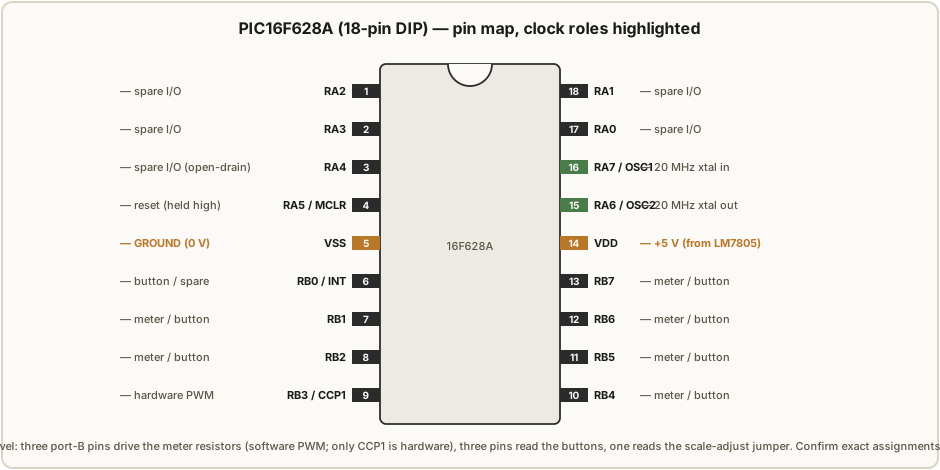
10.4.1 PIC16F628A (18-pin DIP) — summary pin roles
Table 3 — 10.4.1 PIC16F628A (18-pin DIP) — summary pin roles
| Function | Pin(s) | Notes |
|---|---|---|
| +5 V (VDD) | 14 | From the LM7805 output |
| Ground (VSS) | 5 | Common 0 V |
| Crystal (OSC1 / OSC2) | 16 / 15 | 20 MHz crystal, 22 pF to ground on each |
| Reset (MCLR) | 4 | RA5/MCLR, held high in normal run |
| Hardware PWM (CCP1) | 9 | RB3 — the one hardware PWM channel |
| Meter outputs | three port-B/port-A pins | One per meter, each → 4.7 kΩ → meter (+). Because only CCP1 is hardware PWM, the other meter channels are software (firmware) PWM timed off the 1/10 s interrupt. |
| Buttons | three pins | hour+ / min+ / sec-reset (also the calibration controls, §10.5) |
| Scale-adjust jumper | one pin (header) | Reads the calibration-mode jumper |
| Heartbeat LED | one pin (via 1 kΩ) | Blue LED status |
Exact pin-to-meter and pin-to-button assignments are summary-level here; confirm them against the PICBasic Pro firmware before probing (Vol 5).
10.4.2 LM7805 (TO-220) — pinout
Table 4 — 10.4.2 LM7805 (TO-220) — pinout
| Pin | Name | Connection |
|---|---|---|
| 1 | IN | 9–12 V DC from the terminal block (100 µF bulk) |
| 2 | GND | Common ground (tab is also GND) |
| 3 | OUT | +5 V rail (47 µF bulk, feeds VDD) |
Pin order viewing the labelled face, leads down, is 1-IN, 2-GND, 3-OUT left to right; the metal tab is internally tied to GND.
10.5 Calibration quick-procedure
The firmware boots all three PWM outputs to about 50 % of full output, so the meters must be trimmed to exactly full scale once, then saved (Vol 4, Vol 6). The drill:
- Insert the scale-adjust jumper across its pin header → the clock enters scale-adjust mode. In this mode only the meter being adjusted is powered.
- Button 1 (hour+) selects which meter is being adjusted.
- Button 2 (min+) decreases the selected meter’s full-scale setting.
- Button 3 (sec-reset) increases the selected meter’s full-scale setting.
- Trim all three so each needle sits on exactly full scale (the “12 / 60 / 60” end of each dial).
- Remove the scale-adjust jumper to return to normal clock mode — the settings are written to non-volatile (EEPROM) memory at this point, so they survive power-down.
- Set the time with the same three buttons: hour+ advances the hour, min+ advances the minute, sec-reset zeroes the seconds.
The two delicacy rules (carry these everywhere):
- Never exceed a meter’s full-scale current — driving past full scale slams the needle against its stop and can overheat the fine coil wire. A bent pointer or broken hairspring is hard to repair (Vol 2).
- Power up gently — ramp the drive rather than slamming it; the meter is a delicate electromechanical movement, not a logic load.
10.6 Source URLs & where the files live
Table 5 — 10.6 Source URLs & where the files live
| Resource | Where |
|---|---|
| Multimeter Clock construction article (abbtech / Alan Parekh) | http://www.instructables.com/id/Multimeter-Clock/ |
| Author’s blog (Hacked Gadgets) | http://hackedgadgets.com |
| Author’s personal site | http://alan-parekh.com |
| MeterBasic dial-face software (Tonne Software) | Tonne Software — used to draw the HOURS / MINUTES / SECONDS faces (Vol 8) |
| Multimeter Clock Kit (the controller, ready to solder) | Linked from the Instructables article and the project page (Vol 7) |
| Collected files in this hub | 02-inputs/Simpson/ — article, parts list, schematic, dial faces, build photos, and the two-meter “So Analog” parts |
Misfiled reference: a
UTixClock.pdfalso sits in this subproject’s inputs. It is not a meter-movement clock — it is a TIX LED-grid clock (Arduino Nano + DS1302 RTC + 74HC595 shift registers) and belongs to the TIX subproject. Relocate it; it is excluded from this deep dive (Vol 1, §1.7).
10.7 Glossary A–Z
Air-vane vs. eddy-current damping — two ways to slow a needle’s swing so it settles without overshoot. An air vane drags a paddle through air; eddy-current damping uses currents induced in the moving coil’s metal former (or an aluminium vane in a magnetic field) to oppose motion. See critically damped.
Ballistic response — the transient swing of the needle after the current changes: it accelerates, overshoots, and rings down to its final deflection. The meter’s mechanical lag that makes this transient also low-pass-filters the PWM drive (§10.1.3).
Critically damped — the damping that brings the needle to rest in the shortest time with no overshoot. Under-damped needles ring; over-damped needles crawl. Panel meters aim near critical.
Current-limiting resistor — the series resistor between the PIC pin and the meter (4.7 kΩ in the worked build) that sets the maximum current into the movement; sized from R = (Vcc − Ifs·Rm)/Ifs (§10.1.3).
DAC (digital-to-analog converter) — a circuit that turns a digital number into an analog voltage or current. A PWM output plus a filter is a poor-man’s DAC; a dedicated DAC chip is the higher-fidelity alternative for driving a meter (Vol 4).
d’Arsonval movement — the pivoted moving-coil meter movement (Jacques-Arsène d’Arsonval with Marcel Deprez, 1880s) in which a coil swings in a permanent-magnet field against a hairspring. The basis of every meter in this series (Vol 2).
Duty cycle (D) — the fraction of each PWM period the output is high (0–1, or 0–100 %). Sets the average drive voltage, Vavg = D·Vcc, and hence the deflection (§10.1.3).
Edgewise meter — a panel meter whose scale is read along a narrow edge rather than a broad face; a packaging variant, electrically the same moving-coil movement.
Full-scale current (Ifs) — the coil current that produces full-scale deflection; 0.5 mA in the worked build. The number the driver must be able to reach (§10.1.1).
Full-scale deflection (FSD) — the needle at the very end of the dial, i.e. the maximum reading. “Calibrate to full scale” means trim the drive so the needle lands exactly here (§10.5).
Galvanometer — a sensitive current-detecting moving-coil instrument; the ancestor of the panel meter, made rugged and portable by Weston (1888).
Hairspring — the fine spiral spring that provides the linear restoring torque against which the coil’s magnetic torque balances; its stiffness k appears in θ = N·B·A·I/k (§10.1.1).
Howland current pump — an op-amp circuit that forces a programmed current through a load regardless of the load’s resistance; one way to build a precise voltage-to-current source for a meter that needs more current or better linearity than a resistor gives (Vol 4).
Internal resistance (Rm) — the DC resistance of the meter’s coil (plus any built-in multiplier); needed to size the series resistor and shunt. Assumed ≈ 200 Ω here where a number is required — measure the real meter (§10.1.1).
MeterBasic — Tonne Software’s program for drawing custom meter dial faces from the meter’s dimensions and scale; used to make the HOURS / MINUTES / SECONDS faces (Vol 8).
Moving coil — the current-carrying coil pivoted in the magnet’s field whose deflection is the meter reading; synonymous in this series with the d’Arsonval movement.
Multiplier — a resistor in series with the movement that turns a current meter into a voltmeter; Rs = Vfs/Ifs − Rm (§10.1.2).
Pivot-and-jewel — the traditional bearing in which the coil’s hardened pivots turn in jewel (sapphire) cups; the lower-friction, more fragile alternative is taut-band.
PWM (pulse-width modulation) — switching the output fully on and off at a fixed frequency and varying the on-fraction (duty) to set an average level; the worked build’s meter-drive method (§10.1.3).
RTC (real-time clock) — a dedicated timekeeping chip, usually with a battery so the time survives power loss. The worked build has no RTC — it keeps time on the bare crystal and loses the time on power-down (Vol 5).
Shunt — a resistor in parallel with the movement that turns a current meter into a higher-range ammeter; Rsh = Rm·Ifs/(Ifull − Ifs) (§10.1.2).
Simpson 260 — the archetypal analog volt-ohm-milliammeter (1936); the look the worked build imitates, down to a CNC-engraved Simpson 260 face on the enclosure (Vols 1, 8).
Taut-band — a suspension in which the coil hangs on two thin tensioned metal ribbons instead of pivots and jewels; lower friction, no pivot wear, but more shock-sensitive.
Voltage-to-current converter — a circuit (e.g. a Howland pump) that outputs a current proportional to an input voltage, independent of load resistance; the high-fidelity way to drive a meter when a resistor’s load-dependence matters (Vol 4).
VU meter — a moving-coil meter with a standardized ballistic response for showing audio levels; mechanically a close cousin of the meters used here.
Weston meter — Edward Weston’s rugged, temperature-compensated portable moving-coil instrument (1888) that established the taut-hairspring, knife-edge-pointer construction every later panel meter (and the Simpson 260) inherits (Vol 1).
10.8 References (Vol 10)
- Multimeter Clock by abbtech (Alan Parekh, Hacked Gadgets), Instructables, 2010 — three
analog meters (H/M/S), PIC16F628A at 20 MHz, meters on 0.5 mA DC driven through 4.7 kΩ
resistors, PICBasic Pro firmware with a scale-adjust calibration mode, custom MeterBasic dial
faces, layered ½-inch MDF CNC case with v-carved Simpson 260 details. Source:
http://www.instructables.com/id/Multimeter-Clock/; author blog: http://hackedgadgets.com;
personal site: http://alan-parekh.com. Article, parts list, schematic, faces, and build
photos held in
02-inputs/Simpson/. - MeterBasic, Tonne Software — meter-face design program used for the dial faces (Vol 8).
- Equations and worked numbers condensed from Vols 2 (moving-coil physics), 3 (meter selection), 4 (drive electronics and calibration), and 5 (timebase and counting logic) of this series.
- PIC16F628A pinout and the LM7805 pinout: Microchip and standard regulator pin conventions;
clock-role annotations from the collected build files in
02-inputs/Simpson/. - Vol 1 of this series for the project provenance, the two-meter “So Analog” parts, and the
note on the misfiled
UTixClock.pdf(TIX subproject).
Comments (0)