LED · Volume 8
Buy a Kit or Finished Clock
The KABtronics kit as the realistic buy, why finished discrete-logic clocks are rare and pricey, the visible-logic genre and its cousins, and a skill/time/cost trade-off you can act on
There is an honest answer to “how do I get one of these” that the rest of this series has been circling, and it is short: you buy a kit and you build it. The discrete-logic LED clock is, almost by definition, a build-it proposition — its entire value is the visible logic, the thousand-plus parts laid out where you can see and probe them, and that value only exists because a human placed every one of those parts. A finished, assembled unit defeats half the purpose and, where it exists at all, is rare and dear precisely because someone already spent the ten-to-fifteen hours you would otherwise spend yourself. This volume lays out the realistic ways to acquire the clock, what each costs you in money, skill, and time, and how the “visible logic” genre extends to a few cousins worth knowing about before you commit.
The anchor throughout, as in the rest of this series, is the KABtronics Transistor Wall Clock Kit (transistorclock.com): a six-digit HH:MM:SS clock whose every flip-flop, counter, and decoder is built from discrete 2N3904/2N3906 transistors and diodes — roughly 1,256 parts and over 2,700 solder joints.1 Vol 7 is the build itself, section by section; this volume is the decision before the build — what’s in the box, who it suits, and what it costs.
A standing caution on prices and availability. Specific prices, sellers, and stock status change, and this series is grounded in a manual copyrighted 2011, not in a live storefront. Every dollar figure below is an order-of-magnitude guide, explicitly hedged. Verify current price and availability directly with the vendor (http://www.transistorclock.com) before you plan a purchase. This volume does not assert that the kit is — or is not — currently for sale.
8.1 The realistic buy: the KABtronics kit
For practical purposes, the kit is the product. It is sold specifically so that a hobbyist can build, see, and understand a digital system one transistor at a time, and it is the path this whole series documents to component level (Path 2 in the Vol 1 decision tree).
8.1.1 What’s in the box
The kit is a complete build-everything package, not a bag of loose parts. As supplied it includes:1
- the assembly manual (theory of operation, circuit description, parts identification, troubleshooting, and specifications);
- the full schematic (the 15-page set this series leans on in Vols 7 and 9);
- the printed-circuit board — a single large board, roughly 10 × 11.3 inches;
- all the parts — the transistors, diodes, resistors, capacitors, and the seven-segment LED displays;
- solder and de-solder braid (the braid is a quiet signal that the vendor expects you to make and fix mistakes across 2,700 joints);
- a wall transformer (the 9–12 V AC supply that powers the board); and
- a mounting kit for hanging it on the wall.
In other words, everything needed to go from box to running clock is in the box — you supply the soldering iron, a multimeter, time, and patience. Note one stocking detail to plan around: the kit ships with spares for the small parts (resistors, diodes, transistors — the things easy to cook or lose), but not spare seven-segment displays. Treat the displays as the irreplaceable parts on the board and handle them accordingly during the build (Vol 7).
8.1.2 Skill and time: who this is for
This is not a beginner’s first soldering project. The manual’s own figures set the bar: the build is on the order of 10 to 15 hours, across ~2,700 solder joints, with over a thousand parts that must each be the correct value, oriented correctly, and soldered cleanly — and the clock only works when all of them are right.1 The realistic candidate is a knowledgeable hobbyist: someone comfortable with a soldering iron and a multimeter, who can read a schematic, who will not rush, and who treats a long methodical build as the reward rather than the obstacle. If that describes you, the kit is well within reach; if you have never soldered, this is a steep place to start.
The good news on the risk side is that the build is electrically gentle — the whole board runs at low voltage from the wall transformer, with nothing on it at line voltage (Vol 1 §1.11). The difficulty is entirely scale and discipline, not danger.
8.1.3 Documentation and support
A kit of this size lives or dies by its paperwork, and here the kit is strong. The included manual covers theory of operation, a section-by-section circuit description, parts identification, troubleshooting, and specifications, and the full schematic is supplied so that every node is traceable — which is exactly why this series can document the build and the troubleshooting to component level (Vols 7, 9). For an experienced builder, schematic-level documentation is the single most valuable thing a kit can ship, because it turns a dead board into a solvable problem rather than a mystery.
On support and warranty, set expectations honestly: per the kit’s terms there is no warranty, but email support is available from the vendor. For a hand-assembled kit with 2,700 joints that is a reasonable bargain — a warranty on a board you soldered would mean little, whereas a knowledgeable person on the other end of an email is what actually helps when a digit miscounts. (Vol 9’s troubleshooting method is built around reasoning from the symptom yourself; vendor email is the backstop.)
8.1.4 The price, hedged
The kit’s price has historically been in the neighborhood of $199 — call it the ~$200 order of magnitude, and read that as a planning figure, not a current quote. Verify the current price and availability with the vendor before ordering. What that money buys is worth stating plainly, because it is the crux of this whole hub: you are paying more for a clock that does less than a $10 digital clock. The premium is the education, the object, and the visible logic — it costs more and does less, deliberately, and that is the entire point (Vol 1).
8.2 Why a finished clock is rare and pricey
It is natural to ask whether you can simply buy one already built. You sometimes can — assembled units turn up occasionally — but they are rare, and where they exist they are expensive, for a reason that follows directly from what the clock is.
The cost of a discrete-logic clock is not in its parts. The transistors, diodes, resistors, and displays are commodity components; the bill of materials is modest. The cost is in the labor — the 10-to-15 hours of careful hand-assembly and the testing that follows. When you build the kit yourself, that labor is free (it is, in fact, the thing you are buying the kit for). When you buy a finished unit, you are paying someone else for those same hours, plus a margin, on top of the kit — so a finished clock is essentially the kit price plus a skilled person’s day of bench time. That is why assembled units are uncommon and dear: there is little market for them, because the people who want a visible-logic clock are overwhelmingly the people who want to build it.
So the honest framing is: the point is the build, not the time-telling. If you only want a clock on the wall, this is the wrong object at any price (Vol 1’s decision tree sends you elsewhere on the very first branch). If you want the finished object without the build, a finished unit is a legitimate but pricey and hard-to-find choice — and you will have skipped the part that gives the thing its meaning.
8.3 The genre and its cousins
The discrete-logic LED clock belongs to a small family of “visible logic” or retro-logic builds — projects whose whole appeal is that the working machinery is on display rather than hidden in a chip. If the KABtronics clock appeals to you, these cousins appeal for the same reasons, and are worth knowing about as alternatives in the same spirit. A standing caveat for this whole section: the genre is framed generally below. This series does not assert specific vendors, model names, prices, or stock for any of these — verify current availability and details yourself before treating any as a concrete buy.
8.3.1 Other discrete-transistor kits
The same maker behind the clock has historically offered other discrete-transistor kits in the same build-the-logic-from-bare-transistors spirit — for example a discrete-transistor calculator / “computer”-style kit. These scratch exactly the same itch as the clock (watching arithmetic and logic happen in visible, individual transistors) at a larger scale. Treat them as relatives of the clock, not the same product; verify what is currently offered and at what price.
8.3.2 Relay clocks
Where the transistor clock makes logic visible, a relay clock makes it visible and audible — the counters and decoders are built from electromechanical relays, so every state change is a physical click you can hear and a contact you can watch. Relay logic is the most tangible form of “visible logic” there is: slower, larger, noisier, and even more of a spectacle than the transistor version. It is a distinct genre with its own builds and kits; this series does not name specific ones — verify availability if it tempts you.
8.3.3 Discrete-555 (“Three Fives”-style) kits
A neat sibling at a smaller scale is the discrete-transistor 555 timer — a kit in the “Three Fives” style that rebuilds the ubiquitous 555 timer IC out of individual transistors and resistors on a board, so you can see the comparators, flip-flop, and output stage that are normally hidden inside the eight-pin package. It is not a clock, but it is the same idea — integration undone for the sake of understanding — and a much shorter build, so it makes a good “try the genre before the big one” project. Again, framed generally; verify current options.
8.3.4 Tube / Nixie clocks of the same logic era
Finally, the Nixie and other tube clocks of the 1960s are cousins by logic lineage rather than by display. Those early digital clocks used exactly the same divide-by-ten transistor counter logic this clock is built from — the counting was identical; only the display differed (a glow-discharge tube instead of a seven-segment LED) (Vol 1 §1.3). A modern Nixie-clock build therefore shares much of this clock’s DNA on the logic side, even though the display is a different deep dive (the Nixie hub covers those). If the counting logic is what fascinates you, the Nixie clocks are kin; if the visible discrete logic is the draw, the transistor and relay clocks are the closer relatives.
8.4 A buyer’s checklist
If you decide to buy the kit, walk this checklist before ordering — most of it is “confirm the box is complete and the documentation is deep,” because for a build this large those are what determine whether you succeed.
Kit completeness
- Board version. Confirm the PC board version you are buying (this series is grounded in version 4); a later revision is fine, but match the manual/schematic you will work from to the board you receive.
- Spares. Confirm the kit includes spares for the small parts (resistors, diodes, transistors). Remember the seven-segment displays are not spared — plan to be careful with them, or ask the vendor about ordering a spare display separately.
- Transformer. Confirm the wall transformer is included and is the right type (a 9–12 V AC supply) and right for your mains (plug type and voltage for your country).
- Manual + full schematic. Confirm both the assembly manual and the complete schematic are included — for a 2,700-joint board, the schematic is what makes troubleshooting tractable (Vol 9). Do not buy a board-only deal without the schematic.
- Consumables. Confirm solder and de-solder braid are included (they are in the standard kit) so you are not stalled on the first evening.
The clock itself
- Display colour and size. Confirm the seven-segment display colour (commonly red on these kits) and digit size suit where the clock will hang — a wall clock wants digits readable across the room.
- 12- vs 24-hour. Confirm whether the clock runs 12-hour or 24-hour (and whether that is selectable). The hours stage divides by 12; a 24-hour variant is a design change, so if 24-hour matters to you, verify it is offered rather than assuming.
Documentation and support
- Documentation depth. Beyond the schematic, confirm the manual includes the theory of operation, parts identification, and troubleshooting sections — the difference between a kit you can finish and one you can’t.
- Support. Note there is no warranty but email support is available; confirm a working support contact before ordering, since that email is your backstop when a digit misbehaves.
8.5 The skill / time / cost trade-off
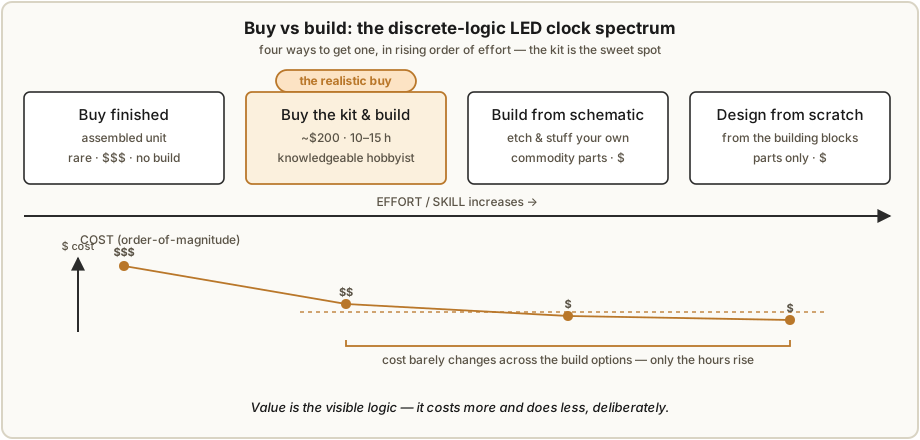
Tying the four acquisition paths from the Vol 1 decision tree to the realities above, the trade-off looks like this. Read it alongside Vol 1 §1.4 — this is the same four paths, costed.
Table 1 — 8.5 The skill / time / cost trade-off
| Path | Skill required | Time / effort | Cost (order of magnitude) | The catch |
|---|---|---|---|---|
| Buy a finished clock | none | none | $$$ — kit price plus a skilled day of assembly; rare to find at all | You skip the build — the part that gives the object its meaning. (§8.2) |
| Buy the kit and build it | knowledgeable hobbyist (solder + multimeter + read a schematic) | 10–15 h of methodical assembly + testing | $$ — historically ~$200 order of magnitude; verify current price | The realistic path; the build is the value. (§8.1; Vol 7) |
| Build the collected design from the schematic | board fabrication + populating from a schematic | very high — etch/source/stuff your own board | $ — commodity parts only | No kit hand-holding, no curated parts/spares; you own every sourcing decision. (Vol 9) |
| Design your own from the building blocks | digital-logic design from first principles | extreme — design, lay out, fabricate, debug | $ — parts only | You must understand every block as a circuit (Vols 3–6) before you can design it. |
The center of gravity is unambiguous: buy the kit and build it. Buying finished is rare and pricey and skips the point; building from the schematic or designing from scratch are real and rewarding paths, but they are the engineering project, not the acquisition — and this series documents them in Vols 9 and 3–6 respectively. For the overwhelming majority of people who want a discrete-logic LED clock, the kit is the answer, and Vol 7 is how you build it.
8.6 References (Vol 8)
- KABtronics Transistor Wall Clock Kit — vendor and ordering: http://www.transistorclock.com. Confirm current price, availability, board version, display options, and support contact directly with the vendor; this series asserts none of those as current fact.
- Genre and cousins (§8.3) are described generally and intentionally name no specific vendors, models, or prices for other discrete-transistor kits, relay clocks, discrete-555 (“Three Fives”-style) kits, or Nixie/tube clocks. Verify current availability and details independently. The Nixie clocks of the same logic era are covered as a display in the Nixie deep dive elsewhere in this hub.
- Cross-references: Vol 1 (overview, the four-path decision tree §1.4–1.5, safety §1.11) and Vol 7 (the build itself).
Footnotes
-
Transistor Clock Assembly Manual, KABtronics (transistorclock.com), document version 1.4 for PC board version 4, copyright 2011. Source for the kit contents (manual, full schematic, board, parts, solder, de-solder braid, wall transformer, mounting kit; spares for small parts but not the seven-segment displays; no warranty but email support), the ~1,256-component / 2,700-joint scale, the 10–15-hour build estimate, the 9–12 V AC supply, and the 60 Hz line-derived timebase. The ~$199 / ~$200 figure is an order-of-magnitude planning guide drawn from the kit’s historical pricing, not a current quote — verify current price and availability with the vendor before ordering. Full manual + 15-page schematic held in
02-inputs/LED_Transistor_Clock/. ↩ ↩2 ↩3
Comments (0)