LED · Volume 1
Overview & Decision Tree
What a discrete-logic LED clock is, how it builds digital logic from bare transistors, and which path fits your bench
A discrete-logic LED clock keeps and shows the time using no integrated circuits at all — no microcontroller, no counter chip, not even a logic gate in a package. Every flip-flop, every gate, every counter and decoder is built up from individual transistors, diodes, resistors, and capacitors soldered onto one large board, and the result drives a row of ordinary seven-segment LED digits. It is the only clock in this hub whose entire brain is laid out in front of you, component by component: you can put a finger on the one transistor that holds the “8” bit of the seconds counter, or watch on a scope the single edge-triggered pulse that advances the minutes. Where the other clocks here hide their logic inside a chip or a vacuum tube, this one is the logic, made visible.
The interest is entirely pedagogical and aesthetic. There is nothing a discrete-transistor clock does that a 50-cent microcontroller could not do a thousand times over — but watching digital logic assembled from first principles, from the bipolar transistor as a switch up through gates, a bistable latch, a toggle flip-flop, a decade counter, a one-of-ten decoder, and a seven-segment decoder, is a genuine education and a striking object. The canonical example, and the build this series is anchored on, is the KABtronics Transistor Wall Clock Kit: roughly 1,256 components and over 2,700 solder joints on a board about 10 by 11 inches, every one of them a piece of logic you placed yourself.1
Note — this is the discrete-logic LED technology overview. Specific discrete-logic LED clocks Jeff owns or builds — their design, construction, and operation — are documented as their own deep dives in this technology’s
clocks/folder, one folder per clock, each avol*.mdseries with a Design → Building → Running spine. This volume series covers the technology in general; the per-clock dives go deep on individual units.
This ten-volume reference covers the discrete-logic LED clock at depth: the seven-segment display and how it is driven; the transistor-level building blocks (switch, gates, bistable, edge trigger, comparator); the counters and frequency dividers that turn a steady tick into seconds, minutes, and hours; the decoders that turn a count into lit segments; the mains-derived 60 Hz timebase and the clever noise-rejecting circuit that cleans it up; the complete worked build; the buy-a-kit options; a full walk-through and troubleshooting guide for the collected design; and a laminate-ready cheatsheet. It is written for an experienced hobbyist with a soldering iron, a multimeter, and the patience for a long build; the whole clock runs at a safe low voltage from a wall transformer.
1.1 What a discrete-logic LED clock actually is
Strip away the sheer parts count and the clock is the same four subsystems every clock in this hub has — except that the logic is realized in raw transistors rather than a chip, and the timebase is the power line itself:
- The timebase. Instead of a crystal, this clock counts cycles of the 60 Hz AC mains (50 Hz elsewhere). The power-supply section rectifies the wall transformer’s low-voltage AC and, in the same breath, extracts a clean 60 Hz square wave from it through a small comparator-and-pulser circuit that doubles as a brick-wall noise filter (Vol 6). The mains frequency is held very accurately over the long term by the utility, so the clock keeps excellent time over days and weeks without a crystal.
- The counting logic. A chain of toggle flip-flops divides that 60 Hz down: a prescaler divides by 60 to make a 1 Hz tick, then cascaded counters count seconds (÷10), tens of seconds (÷6), minutes (÷10), tens of minutes (÷6), and hours (÷12). Each flip-flop is a cross-coupled pair of transistors; each counter is four flip-flops plus a little steering logic to make it divide by ten instead of sixteen (Vols 3–4).
- The decoding. A counter’s output is a four-bit binary number; two ranks of diode logic turn it into a lit digit — a one-of-ten decoder (a diode AND matrix) selects which numeral is active, and a seven-segment decoder (a second diode matrix) lights the right segments for that numeral (Vol 5).
- The display. Six seven-segment LED digits show HH:MM:SS, with single LEDs as the colons. Each segment is driven through its own current-limiting resistor — the display is statically driven, every lit segment on continuously, not scanned (Vol 2).
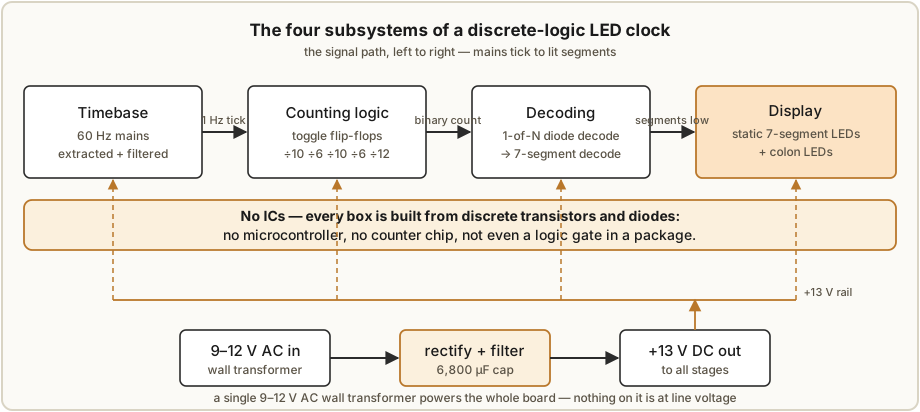
What makes this a project rather than a purchase is not that any one subsystem is hard — each is a textbook circuit — but the scale and the discipline: over a thousand parts, each of which must be the right value, the right way around, and soldered well, with the whole only working when all 2,700-odd joints are good. The reward is a working, visible computer-of-sorts that tells the time.
1.2 The signal chain, in one line
The spine of the whole clock, which every later volume hangs off, is this divide-and-decode chain:
60 Hz mains → extract + filter → ÷10 → ÷6 → 1 Hz → [÷10 seconds] → [÷6 tens] → [÷10 minutes] → [÷6 tens] → [÷12 hours], and at each digit: counter → one-of-N decode → seven-segment decode → LED.
Read left to right that is the timebase (Vol 6), the prescaler and counters (Vol 4), and the decode-and-display at every stage (Vols 5 and 2). The transistor circuits that implement each box are Vol 3.
1.3 A one-paragraph history
Counting and displaying time with discrete logic is how it was actually done before calculator chips: early digital clocks of the 1960s used discrete transistors or small-scale logic, and the Nixie clocks of that era were driven by exactly this kind of divide-by-ten transistor counter (the display differed; the logic did not). Integrated counters and the single-chip clock IC swept all of it away in the 1970s, and discrete logic became a teaching curiosity. The modern discrete-transistor clock is a deliberate revival in that spirit — most famously the KABtronics Transistor Wall Clock Kit (and its relatives, the discrete-transistor “calculator” and “computer” kits), sold specifically so a hobbyist can build, see, and understand a digital system one transistor at a time.1 It belongs to the same family of “build the logic yourself” projects as relay clocks and the discrete Three Fives-style 555 kits — slow, large, power-hungry, and entirely the point.
1.4 The ways to get a discrete-logic LED clock
Because the engineering is a large, exacting assembly rather than a design problem, the center of gravity here is build a kit. This hub recognizes four paths, and the series is organized so that whichever you choose, a volume goes deep on it.
Table 1 — 1.4 The ways to get a discrete-logic LED clock
| # | Path | Effort | Cost | Covered in |
|---|---|---|---|---|
| 1 | Buy a finished discrete-logic clock (rare; occasional assembled units) | none | $$$ | Vol 8 |
| 2 | Buy the kit and build it — the KABtronics Transistor Wall Clock | high (10–15 h) | $$ | Vols 7, 8 |
| 3 | Build the collected design from the schematic — etch/populate your own board | very high | $ | Vols 7, 9 |
| 4 | Design your own discrete-logic clock from the building blocks | extreme | $ | Vols 3–6 |
Path 2 is the worked example throughout this series: the hub holds the complete KABtronics manual and full 15-page schematic, so the build, the theory, and the troubleshooting are all documented to component level (Vols 7, 9). Path 4 — designing your own — is what Vols 3 through 6 actually teach, because to design one you must understand each block as a circuit.
1.5 Decision tree — which path is right for this build
Work top-down; stop at the first “yes.”
- Do you just want a striking digital clock on the wall and don’t care how it’s built? → Buy any clock; this is the wrong hub. The discrete-logic clock costs more and does less — its whole value is the visible logic.
- Do you want to build and understand a digital system one transistor at a time, and enjoy a long, methodical solder? → Path 2, the KABtronics kit. Vol 7 is the build; Vols 2–6 are the theory behind every section you populate.
- Do you have the schematic skills and want to etch and stuff your own board (or change the design — 12/24-hour, different display)? → Path 3. Vol 9 walks the collected schematic; Vols 3–6 are the design reference.
- Do you want to design a discrete-logic clock from scratch? → Path 4. Live in Vols 3–6: the transistor gates and flip-flop (Vol 3), the counters (Vol 4), the decoders (Vol 5), and the timebase (Vol 6).
Whatever the path, Vol 9’s troubleshooting methodology is what gets a built board working — with 2,700 solder joints, the build almost never works the first time, and knowing how to reason from a symptom (which digit, miscounting vs wrong glyph) to a cause is the real skill.
1.6 The building blocks — a first orientation
You cannot follow the clock without the handful of circuits it is made from, so here is the orientation the rest of the series builds on (Vol 3 is the full treatment).
- The transistor as a switch. A bipolar transistor (the kit uses 2N3904 NPN and 2N3906 PNP, current gain β ≈ 50) is used as an on/off switch: enough base current pulls the collector down to ground; no base current lets it float up. Every gate and flip-flop is built from this one behavior.
- Gates from diodes and a resistor. An AND gate is two diodes and a pull-up; an OR gate is two diodes and a pull-down; an And-Or gate combines them. These steer the counters.
- The flip-flop. Two transistors cross-coupled form a bistable latch — it holds a 0 or a 1. Add a small edge-trigger network (a 220 pF capacitor and a 100 kΩ resistor) and it becomes a toggle flip-flop that flips state on each falling clock edge. Four of these in a row count to sixteen; with steering logic they count to ten.
- The comparator. A long-tailed differential pair with a little feedback snaps cleanly between states — used in the timebase to turn the soft rectified mains into a crisp 60 Hz square wave.
1.7 Discrete logic vs the chip it replaces (the one clarification)
It is worth stating plainly what is and is not different here. A discrete-logic clock and an ordinary 1970s digital clock IC do exactly the same logic — the same binary counters, the same BCD-to-seven-segment decode. The only difference is integration: the chip packs thousands of these transistors onto silicon; this clock spreads a thousand of them across a board you can probe. So everything you learn here (counters, decoders, the divide chain) is real digital-design knowledge, not a curiosity — it is simply drawn at a scale you can see and fix. When a clock counts with visible, individual transistors it belongs in this volume; when it counts inside a package (a 4026, a microcontroller, a clock chip) it is a different, smaller build and a different hub conversation.
1.8 What the owner already has collected
One published design anchors the series, documented to the component:
- KABtronics Transistor Wall Clock Kit (transistorclock.com; designer K. A. B.; manual copyright 2011, PC board version 4). A six-digit HH:MM:SS wall clock built entirely from discrete parts: 2N3904/2N3906 transistors, small-signal and rectifier diodes, resistors (680 Ω, 1 K, 10 K, 100 K, 1 M), capacitors (220 pF, 0.001, 0.01, 0.1 µF and one 6,800 µF electrolytic), and LSD8161-11 seven-segment LED displays, on a 10 × 11.3 inch board. It runs from a 9–12 V AC wall transformer (about 13 V DC on the main cap), draws ~5.7 W, and keeps time from the 60 Hz line. The hub holds the full assembly manual (theory of operation, circuit description, parts ID, troubleshooting, specifications) and the complete 15-page schematic and board views. This is the worked build of Vol 7 and the subject of the walk-through in Vol 9.
- Supporting material: the kit’s FAQ, a Nuts & Volts article reference, and the kit /
article links, all in
02-inputs/LED_Transistor_Clock/.
1.9 How this series is organized
The series moves from display to building blocks to system to project to polish:
- Building blocks & system (Vols 2–6) — the LED display and its drive; the transistor gates and flip-flop; the counters and the divide chain; the decoders; and the mains timebase. Read these to understand any discrete-logic clock.
- Project (Vols 7, 9) — the worked KABtronics build start to finish, and a full decision-by-decision walk-through plus the troubleshooting methodology.
- Buy & polish (Vols 8, 10) — the buy-a-kit and finished options; and the laminate-ready cheatsheet and glossary.
1.9.1 Volume-by-volume index
Table 2 — 1.9.1 Volume-by-volume index
| Vol | Title | Read it for |
|---|---|---|
| 1 | Overview & Decision Tree | (this volume) — the map, the signal chain, the path choice |
| 2 | The LED Display | seven-segment LEDs, the colon LEDs, static (un-scanned) drive, current-limiting resistors, brightness and Vf |
| 3 | Transistor-Level Building Blocks | the transistor as a switch, diode AND/OR/And-Or gates, the cross-coupled bistable, the edge-trigger toggle flip-flop, the comparator |
| 4 | Counters & Frequency Division | toggle-flip-flop chains, ÷2/÷4/÷8/÷16, building ÷10 / ÷6 / ÷12 with steering logic, the count tables, the full divide chain |
| 5 | Decoders & Seven-Segment Drive | the one-of-N diode decoder, the seven-segment diode decoder, worked digits, how the decode drives the segments |
| 6 | The Timebase — Mains 60 Hz | the power supply, rectification, the 60 Hz extractor and its brick-wall noise filter, mains-frequency accuracy vs a crystal |
| 7 | Build It Yourself | the KABtronics kit: parts, soldering 2,700 joints, the section build order, the per-section power-up tests |
| 8 | Buy a Kit or Finished Clock | the KABtronics kit, the discrete-logic/relay/tube-clock genre, pricing, skill/time, trade-offs |
| 9 | The Collected Project & Troubleshooting | a full walk-through of the KABtronics design, the “use your brain” troubleshooting method, longevity |
| 10 | Cheatsheet & Glossary | the divide chain, count tables, gate/flip-flop reference, BOM quick-ref, transistor pinouts, source URLs, A–Z terms |
1.10 What this series is — and is not
It is a build-and-understand reference for clocks whose digital logic is realized in discrete transistors and diodes and displayed on seven-segment LEDs, grounded in a complete published design held in this hub and in the textbook circuits it is made from.
It is not a guide to clocks built from logic ICs or a microcontroller (same logic, but packaged and invisible — §1.7), nor a numeral-display reference for other technologies (the nixie, Numitron, and scope deep dives cover those displays), nor the TIX count-the-cells LED clock (its own subproject). Where the logic or display overlaps another hub deep dive, this series cross-links to it.
1.11 Safety, stated once up front
This is one of the safest builds in the hub. The clock runs from a 9–12 V AC wall
transformer into a low-voltage board; the mains stays inside the sealed wall-wart, and
nothing on the board you touch is at line voltage — it is the same gentle tier as the
Numitron, Meter-Movement, and TIX clocks, and nothing like the nixie (~170 V) or scope/CRT
(kV) builds elsewhere in this hub. The only cautions are ordinary ones: observe the polarity
of the one large 6,800 µF electrolytic capacitor (mounted backwards it can overheat and
vent) and the rectifier diodes (backwards, they can short and overheat the transformer);
handle the transistors and diodes with a little care against heat while soldering; and use
the usual sense around a hot iron and the mains plug of the wall transformer. There are no
high-voltage warnings in this deep dive because there is no high voltage — see
../../_shared/safety.md for the hub’s baseline.
1.12 Photo policy
Photographs in this series are credited in every caption, from three sources: the owner’s own build photos; license-clean images from Wikimedia Commons / Openverse fetched through the project’s Photo Helper (with the full attribution line reproduced verbatim); and, for diagrams, hand-authored SVG in the paper-background house style. Figures that have not yet been sourced are simply absent. No images are scraped from arbitrary copyrighted web pages; the KABtronics manual’s own photographs and schematics belong to KABtronics and are referenced, not reproduced.
1.13 References (Vol 1)
- KABtronics Transistor Wall Clock Kit — assembly manual (theory of operation, circuit description, parts identification, troubleshooting, specifications), 15-page schematic, and board views, in
02-inputs/LED_Transistor_Clock/(trans-clock-manual.pdf,trans-clock-FAQ.pdf,Schematics/). Vendor: http://www.transistorclock.com. _shared/comparison.md(cross-technology decision matrix) and_shared/deep_dive_protocol.md.
Footnotes
-
Transistor Clock Assembly Manual, KABtronics (transistorclock.com), document version 1.4 for PC board version 4, copyright 2011. States ~1,256 components, “over 2,700 good solder joints,” a 10 × 11.3 inch board, ~5.7 W consumption (0.6 A at 9.5 V AC), 2N3904/2N3906 transistors, LSD8161-11 seven-segment displays, and a 60 Hz line-derived timebase. Full manual + 15-page schematic held in
02-inputs/LED_Transistor_Clock/. ↩ ↩2
Comments (0)