Steampunk · Volume 8
Sourcing & Cheatsheet
Where the parts actually come from, a laminate-ready reference card, and an A-Z of the vocabulary
The last volume answers the question that every preceding one raises and none of them settles: where does this material actually come from? Steampunk has a sourcing problem that most electronics projects do not, because a large part of its vocabulary is not manufactured for the purpose. Nobody sells a Victorian bezel. What exists instead is a set of channels — salvage, plumbing supply, general metal stock, surplus, and the small trade in genuine antique instruments — and knowing which channel yields which part is most of the skill. This volume maps those channels, then condenses the series into a reference card and a glossary.
A note on what follows: the channels are named, and the few specific suppliers named are only those documented in the collected build write-ups or identifiable in the collected material. Prices are not quoted, because they date badly and because the salvage half of this list has no price at all.
8.1 The display, the board, and the tubes
Not this series’ subject, and covered properly elsewhere: the Nixie series’ buy-a-kit volume surveys the tube sources, the kit houses, and the finished-clock makers, and the Scope/CRT series does the same for CRTs and controller boards. Two sourcing notes belong here anyway because they are treatment decisions rather than electronics ones.
Buy the board, build the case. Every documented build in this subproject did exactly this. The collected lantern build used a bought nixie prototyper board — the write-up recommends a particular eBay seller trading as petes_kits, praised specifically for a prototyping board offering screw terminals, solder pads, and nixie-patterned lead mounts — and the copper build used another maker’s published design. For a styling project this is the right division: the interesting work is the case, and a proven board removes the variable that would otherwise dominate debugging.
Let the tube choice lead the case. Vol 4 § 4.1: pitch and viewing direction set the proportions. Source the tubes first, measure them, and design around what arrived, not around a datasheet.
8.2 Metal stock
Brass and copper sheet, rod, and tube come from general metal suppliers and from the model-engineering and hobby trade, which is the more useful channel at small quantities because it stocks thin sheet and small-diameter rod in short lengths. Useful sheet thicknesses run from about 0.5 mm for wrapped skins up to about 1 mm for panels; plate much thicker than that is hard to work by hand.
Steel for brackets and structure comes from anywhere; the relevant point is Vol 3 § 3.1’s — use it where the work happens and keep brass for what is seen.
Offcuts and remnant bins are worth more here than in most hobbies, because the parts are small and because variety matters more than quantity.
8.3 Plumbing fittings
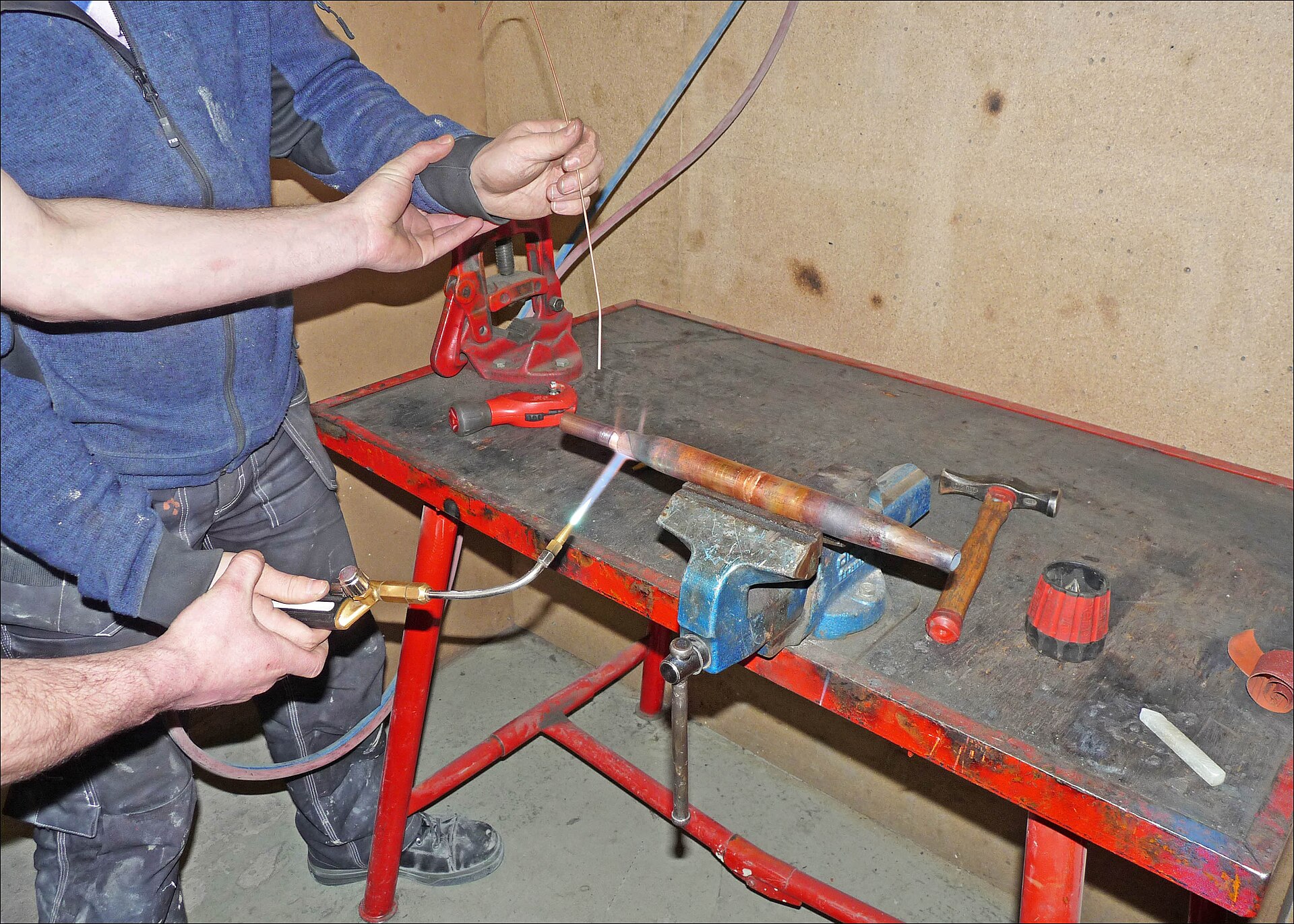
The channel that makes the pipe-frame archetype practical. Copper tube, elbows, tees, couplings, reducers, end caps, and flanges are stocked by every plumbing and hardware supplier in standard sizes, designed to be soldered into rigid joints, and cheap. Brass compression fittings, unions, and small valves come from the same shelf.
Two cautions. Modern fittings are dimensionally consistent but visually modern — clean, uniform, and sometimes stamped with markings that want removing or turning inward. And the aesthetic’s favourite items, valves and handwheels, are the ones most likely to end up as the glued-on gear of Vol 2 § 2.4; a valve that opens nothing is decoration.
8.4 Bezels, gauges, and instrument hardware
The hardest category, because it is almost entirely salvage.
Gauge bezels — the single most valuable item, and the collected lantern build needed four per fixture, which is the sourcing reality nobody mentions. They come from dead pressure gauges, from instrument repair leftovers, from clock-movement suppliers, and from the surplus trade. Buy more than the design needs.
Dead instruments are the richest source of everything at once: bezel, glass, needle, dial, case, knobs, and legend plate in one purchase. A broken pressure gauge, a scrap barometer, a dead panel meter, or an unrepairable aircraft instrument is worth more as parts than as an object, and is the guilt-free version of the conversion argument in Vol 4 § 4.7.
Knobs, toggle switches, and indicator jewels come from electronic surplus, from vintage-radio parts dealers, and from stripping dead equipment. The vintage-radio trade is the specific channel worth knowing, because it exists precisely to supply period-correct small hardware.
Clock and camera parts — clock bezels, lens rings, and filter rings — are a frequently overlooked source of accurately turned metal rings in useful diameters.
Turning your own is the answer when salvage fails, and is the reason a lathe changes what is possible in this hobby more than any other machine.
8.5 Fasteners
Brass fasteners in period styles — slotted, pan-head, button-head, and thumbscrews — come from model-engineering suppliers, from restoration-hardware dealers, and from specialist fastener houses. The collected lantern build used 4-40 brass pan-heads as its visible fastener throughout.
Threaded rod and all-thread for the laminated-slab method of Vol 4 § 4.3.1 is ordinary hardware stock.
Insulating standoffs in nylon or PTFE — the ones Vol 6 § 6.3 makes non-negotiable for the high-voltage board — come from electronic component distributors, not from the hardware shop. Order them at the same time as the board, not at assembly, because the temptation to substitute a metal standoff at the last minute is exactly the failure that section exists to prevent.
8.6 Wood, glass, and acrylic
Hardwood in the species of Vol 3 § 3.2 comes from timber merchants, from the luthier and furniture trade in small quantities, and — as in the collected lantern build, which sourced both its walnut and its maple that way — from online auction listings of slabs. Small quantities are the norm: a plinth is a few board feet.
Glass domes and bell jars come from the taxidermy and display trade, from clock suppliers as replacement anniversary-clock domes, and from antique dealers. Measure the base rebate to the dome, not the other way round.
Acrylic in sheet, tube, and rod comes from plastics suppliers, and the collected lantern build’s 2 in diameter, 0.125 in wall clear tube is a representative stock item. Smoked and bronze tints are worth ordering as samples first, because the tint’s effect on a lit display is impossible to judge from a colour swatch.
8.7 Finishing materials
Liver of sulphur is a jewellery-supply item, which is the channel to search. Gun blue is a firearms-maintenance product. Ammonia is a household product for the fuming method of Vol 5 § 5.2. Catalysed lacquer and the spray equipment for it come from the wood-finishing trade; the collected build used an inexpensive HVLP gun and reported it worked as well as a professional one.
Etching supplies — ferric chloride and toner-transfer film — come from the same suppliers that serve home PCB etching. The collected lantern build names an electronics supplier for both its etchant and its transfer film, having etched its own tube-holder boards; the Scope/CRT series’ Vol 11 names the transfer-film manufacturer.
Abrasives and polishes through 1500 grit, plus automotive polishing compounds, come from the automotive refinishing trade, which is where the collected build’s finishing schedule got them.
8.8 The cheatsheet
A laminate-ready condensation of the series.
Before designing
- Source and measure the tubes first; pitch and viewing direction set the proportions.
- Decide the archetype: plinth, bell jar, pipe frame, instrument, or conversion.
- Decide the safety philosophy now: bonded conductive case, or fully insulated case. Never a mix.
Design rules
- One focal point (the lit display), one quiet field around it, one cool accent, one fastener family, one legend.
- Every visible element does a job: structure, mounting, adjustment, sealing, legend, or handling.
- Would it have been finished this way when new? Age is a layer over good work, not a substitute for it.
Construction
- Lock laminations with all-thread and machine the stack as one piece; disassemble to wire.
- Derive the compartment from the board: board + spacers + tallest component + margin.
- Bezels should be mounts, not trim.
- Nothing hard touches display glass without a gasket; nothing that cures by shrinking touches it at all.
- Deburr every hole and edge — cosmetic outside, field-concentration inside.
Finishing order
- All machining and trial assembly. 2. Mask the bonding points. 3. Etch and engrave plates. 4. Prepare and degrease metal. 5. Patinate. 6. Selectively polish the high points. 7. Clear-coat or wax. 8. Colour the wood (test on offcuts). 9. Lacquer schedule.
- Assemble and measure bonding continuity. 11. Distress only what proves to be handled.
Irreversible, so do it first: cutting, drilling, etching, engraving, staining, dyeing. Reversible, so do it last: wax, polish, and — with care — patina and clear coat.
Safety, every time ⚠
- The shell inherits the hazard tier of the display: nixie ~150–200 V DC; CRT to several kV, plus implosion; both hold charge after power-off.
- HV board on nylon or PTFE standoffs, never metal.
- Anode lead on its own routed, clamped path.
- Every touchable metal part bonded to earth, or guaranteed unreachable. Never neither.
- Patina and lacquer are insulators: mask bonding points, use star washers, measure continuity after finishing.
- Convection venting, low in and high out, with no straight-line path to a live node.
- Opening the case must not present a charged capacitor to a reaching hand.
- Read the display’s own safety volume. This series does not replace it.
Glossary
All-thread — fully threaded rod; the registration and clamping method of the laminated plinth.
Archetype — one of the five recurring enclosure forms: plinth, bell jar, pipe frame, instrument, conversion.
Bezel — the ring that trims and retains the aperture a display is viewed through; structurally a mount in good builds.
Bonding — connecting all touchable metalwork together and to protective earth.
Cloche / bell jar — a glass dome over a movement, presented as a specimen.
Cog fallacy — decorative gears that mesh with nothing; the commonest failure of the commercial style.
Creepage — the shortest path across an insulator’s surface between two conductors.
Clearance — the shortest path through air between two conductors.
Crackle / wrinkle finish — the granular paint texture of mid-century instrument cases.
Dekatron — a cold-cathode counting tube that displays a rotating glow rather than a digit.
Diffuser — a translucent layer softening a display’s glow and hiding its internal structure.
Gun blue — a chemical blackening for steel; the traditional fill for an etched plate’s recessed field.
Knurling — a machined grip texture; functional ornament.
Liver of sulphur — potassium sulphide, the standard darkening agent for copper alloys.
Magic eye — a tuning-indicator tube showing a fan or wedge of green light.
Nixie — a cold-cathode neon glow tube with stacked numeral cathodes, ~150–200 V.
Numitron — an incandescent filament seven-segment display; low voltage, low hazard.
Patina — a deliberately induced corrosion layer imitating age.
Pitch — the centre-to-centre spacing of display tubes.
Rubbed-through — darkening the whole part then polishing the high points back to bright.
Standoff — a threaded spacer holding a board off a surface; insulating standoffs are mandatory for a high-voltage board.
Steampunk — here, a treatment: enclosure, materials, finish and hardware chosen to present a modern electronic display as a Victorian or early industrial instrument.
Toner transfer — the heat-transfer method of applying an etch resist to metal or board.
Underglow — low-level light washing up around the display, usually from an edge-lit acrylic plate or a hidden LED.
VFD — vacuum fluorescent display; blue-green, low voltage.
Verdigris — the blue-green corrosion product of copper alloys.
8.9 References (Vol 8)
Lantern-Clock.pdf,02-inputs/— the named nixie prototyping-board seller and the named electronics supplier for etchant and toner-transfer film (§ 8.1, § 8.7); the four-bezels-per-fixture requirement (§ 8.4); walnut and maple slabs bought at online auction and the 2 in, 0.125 in wall clear acrylic tube (§ 8.6); the inexpensive HVLP gun and the 400–1500 grit and automotive-polish finishing materials (§ 8.7).Steampunk Nixie Tube Clock(Instructables),02-inputs/— copper tube and standard fittings as structure, and brass candle-holder hardware (§ 8.3).- Nixie Vol 7 (Buy a Kit or Finished Clock) and Scope/CRT Vol 9 (Buy a Kit or Finished Unit) — the display, tube, kit, and controller-board sourcing this volume deliberately does not duplicate.
- Scope/CRT Vol 11 § 11.3.2 — the named toner-transfer film manufacturer and the full brass-etching process.
- Hub-wide safety baseline,
Clocks/_shared/safety.md, and the display dives’ safety volumes — the source of the safety block in § 8.8. - Figure photograph credits are recorded verbatim in
photo_credits.txt.
Comments (0)