Steampunk · Volume 7
The Collected Builds
An audit of the reference gallery, two documented builds, a donor chassis, and what the best work does that the rest does not
This subproject holds more collected visual material than any other in the hub — roughly 550 images, plus two complete build write-ups, a photographed teardown, and a small inspiration board. This volume is the survey of all of it: what is actually there, what each item is good for, and, because it changes how every one of those images should be used, what fraction of the gallery turns out not to be a photograph at all. The audit comes first, because it determines the standing of everything after it.
7.1 How the survey was done
Every one of the 35 gallery themes was assembled into contact sheets and examined visually, rather than judged from filenames or from the manifest. That distinction matters: the manifest records a theme, a search query, a title, a source page, and an image URL for all 513 gallery images, and every one of those fields can be present and correct for an image that is a synthetic render. A manifest row is a record of where a file came from, not evidence of what it depicts.
The two build write-ups and the donor photograph set were read and examined in full. Where this volume states something about construction, it comes from those sources.
7.2 The gallery audit ⚠
The headline finding, stated plainly: a substantial fraction of the reference gallery is not photographs of real objects. Three distinct categories are present.
Synthetic (AI-generated) imagery. Present in most themes and dominant in several.
The markers are visible in the filenames — stable_diffusi, lexica_,
premium_ai_image_, premium_photo_, free_…_image_st — and confirmed on inspection
of the images themselves: pipework that connects to nothing, gear trains whose teeth
cannot mesh, gauge faces with unreadable or impossible graduations, bilaterally
symmetric “clockwork” that is wallpaper rather than machinery, and an overall density
no fabricated object has ever had.
Watermarked stock-photo comps. Alamy, Dreamstime, Adobe Stock, and VectorStock marks are all visible in the gallery at full size.
Commercial 3-D model renders. Files carrying cgtrader are product visualisations
of models for sale, not builds.
A theme-by-theme reading:
Table 1 — A theme-by-theme reading
| Theme group | Standing | Notes |
|---|---|---|
nixie_steampunk, wood_brass_base, enclosures_wood, desk_clocks, diy_builds, exposed_pcb | Largely genuine | Real commercial and DIY builds. The most useful part of the gallery. |
glass_dome | Largely genuine | Real bell-jar builds; the strongest single archetype visually. |
vfd_tube, numitron_steampunk, dekatron, magic_eye | Largely genuine | Real tubes and real builds, though the dekatron folder mixes dekatron and ordinary nixie clocks. |
scope_crt_steampunk | Mixed | Genuine acrylic-cased scope clocks and bare CRTs, alongside several clearly synthetic “retro laboratory” images and one watermarked stock frame. |
famous_art, colossus_iconic | Mixed but valuable | Contains the real, identifiable work of named makers (§ 7.6) among generic material. |
radio_conversion | Genuine, off-period | A good set of real mid-century clock radios — useful as donor candidates, but 1950s rather than Victorian. |
finishing_patina | Mostly synthetic, with a valuable core | The metal-finish and patina swatch charts are genuinely useful reference; most of the rest is AI gear-texture wallpaper, and two frames carry visible Alamy watermarks. |
enclosures_brass, gears_mechanism, kinetic_sculpture | Heavily synthetic | Fantasy clock objects; use for mood only, never for construction. |
pipes_valves, raw_industrial, wall_industrial | Heavily synthetic, and off-subject | Much of it is mass-produced “industrial” wall-clock product rather than anything relevant to a tube clock. |
gauges_bezels, instruments_compass, aviation_nautical, nautical_telescope, victorian_instrument | Mixed | Real brass instruments, barometers, sundials and carriage clocks are present and useful; interleaved with synthetic “steampunk gauge” renders and printable-gauge product sheets. |
figurine_robot, mixed_media, art_deco, tesla_coil, lantern_lamp, leather_rivets | Weak | Drifted off-subject — robot ornaments, skull clocks, Edison-bulb lamps that are not clocks, and stock leather goods. |
The practical rule that follows, and it is the reason this audit is in the volume series rather than in a note: a synthetic image cannot be used as evidence about how anything is made. It has no joint, no fastener, no fit, and no finish, because nothing in it was ever fabricated. It can suggest a silhouette or a mood. It cannot tell a builder how deep a rebate should be. Every construction claim in Vols 3 to 6 is therefore grounded in the documented builds below, never in the gallery.
The second rule is about method rather than about this gallery: an image set gathered by keyword search will drift, and will drift furthest in exactly the themes where real photographs are rarest. The themes here with the least genuine material — industrial pipework, decorative gears, patina texture — are precisely the abstract ones, where a search engine has the most synthetic material to offer and the fewest real objects to find. Categories and named sources do not fail this way; keywords do.
7.3 The lantern clock — a laminated hardwood and brass build
The most useful single document in the subproject. A complete, illustrated, step-by-step write-up of a nixie lantern clock in walnut, maple, brass and acrylic, built largely from found components, and unusually candid about method.
What it is. Two nixie tubes per fixture inside a 2 in clear acrylic tube, the tubes carried on a custom-etched circuit board that both holds them mechanically and presents solder terminals; nickel-plated gauge bezels clamping the acrylic tube; brass gears used as structural clamping elements with a cross-drilled hub carrying a swing pivot, so the fixtures can rock; and all of it on a laminated walnut-and-maple base housing a bought nixie prototyping board.
What it contributes to this series, in order of value:
- The all-thread laminated slab (Vol 4 § 4.3.1) — the registration and work-holding technique that lets a multi-part wooden case be machined as one piece and then taken apart to wire.
- The lacquer schedule (Vol 5 § 5.5) — brushed coats soaked in, then five or six sprayed coats with thorough dry sanding between each, 400 to 1500 grit, finished by hand and machine buffing through automotive polishes, with the two cautions that matter.
- The bezel-as-mount principle (Vol 4 § 4.10) — choosing the acrylic tube diameter to equal the bezel’s gauge-face diameter so the bezels become the structure.
- The underglow method (Vol 3 § 3.6) — one 3 mm blue LED per chamber hidden below the bezel line, with both ends of the acrylic tube painted white to bounce the light evenly; three in series across a 9 V AC supply.
- The compartment-from-the-board rule (Vol 4 § 4.3.2) — depth derived from board plus spacers plus tallest component plus margin, with a flush-fitting cover in a relieved recess.
Where it is honest about difficulty. The builder describes the lacquering as exhausting and days long, records that the wire slot was deliberately not taken all the way through because it would weaken the piece, and notes the continuity-checking and wire-numbering work needed to sort out a 24-conductor harness. That candour is what makes it a better source than any number of finished-object photographs.
What it does not cover. The electronics are a bought board, so there is no design content; the high-voltage discipline is not discussed beyond ordinary care.
7.4 The copper candelabra — a soldered pipe-frame build
The second documented build: a steampunk nixie clock built on a copper main tube with brass candle-holder hardware, using IN-12A tubes, written up as a nine-step diary and built between 2014 and 2017.
What it contributes:
- The tube-seat finding (Vol 4 § 4.6) — the most transferable single result in the subproject. Tube seats were laminated from red fibre and plywood, hole-sawn and then opened with a fretsaw to a printed datasheet outline; and for fixing the tube, a UV-cured resin was found to work best because it hardens without putting tension on the glass, whereas two-part resins and hot glue both build stress as they shrink and as they move thermally.
- Fabricated rather than bought hardware — hooked tube holders cut, expanded, filed to an existing triangular hole and soldered together (Vol 4 § 4.5).
- The PTFE shim-ring lesson — shim rings cut from PTFE scrap had to be pinned with brass M3 screws precisely because the material is too slippery to hold by friction.
- Wiring inside the structure — cathode wires commoned and run down the inside of the pipe, so the finished object shows no cable at all.
- An explicit safety statement — the builder warns that the circuit raises the voltage to a deadly 300 V and that contacts must not be touched while working, and records that the custom tube connector needed careful insulation because there was no space between tube and brass socket.
What it does not cover. The board is another builder’s published design, referenced rather than reproduced, so again there is no original electronics content — which is exactly the division of labour this series assumes.
7.5 The donor chassis — a portable oscilloscope teardown
Eighteen photographs of the interior of a Waterman Pocketscope S-11-A, together with the instrument’s manual obtained from a radio-museum archive. The photographs are a single consistent session on a bench mat, shot from many angles at close range.
What they actually show, and this is the honest reading: a stock vintage instrument opened up, not a steampunk build. Visible are the round CRT in its cylindrical shield can, wax-paper and early electrolytic capacitors, cloth-covered wiring in period colours, octal-based valves, and a folded steel chassis — the interior of an unmodified mid-century portable scope. There is no clock hardware in them and no modification in progress.
So the correct description of this item is a donor-instrument survey: the before-cutting photographic record that Vol 4 § 4.7 argues every conversion should begin with. Read that way it is genuinely valuable, because it is the one thing in the subproject that documents the starting condition of a conversion rather than a finished object, and because it illustrates the specific cautions of that section — the aged cloth and rubber insulation, the wax-paper capacitors, and the period mains arrangement are all visible, and all are reasons a conversion should re-wire rather than inherit.
It also sets an expectation honestly: no finished steampunk build by the owner is documented in this subproject. The figure slots throughout these volumes are where that work belongs when it exists.
7.6 Named makers visible in the collected material
Four identifiable sources are worth separating out of the gallery, because unlike most of it they are real, attributable, and worth studying.
The inspiration board. The Ideas/ folder is a set of named clocks — Centurion,
Double Gordon, Gemini, Pandora, Speedo, TTM — alongside an internet shortcut pointing at
a single British maker’s wooden-clocks page, and the gallery separately contains a file
explicitly named for that maker. The attribution is therefore strongly supported by the
shortcut and the matching names, though it has not been confirmed with the maker
directly. The work itself is the best argument in the subproject for the
instrument archetype: beam-engine and walking-beam motifs in wooden cases,
engraved brass legends such as “Gemini in Tempore” and dial markings like “LOCAL” and
“BROAD”, nixies and panel meters combined on one face, and hardware that is uniformly of
one family.
Frank Buchwald. Present in the colossus_iconic theme, and a case of the search
conflating two things: Buchwald’s Machine Lights are lamps, not clocks. They earn
their place anyway, because they are the clearest demonstration in the whole gallery of
the § 7.8 principle — a machined steel and brass armature where every visible element is
structural, with no applied ornament at all.
Nuvitron. Real, identifiable art-deco and streamline nixie clocks in figured wood cases with fluted sides. They sit at the boundary of the aesthetic — deco rather than Victorian — and are the best illustration of the “machined texture rather than applied ornament” argument of Vol 3 § 3.8.
GRA & AFCH. A kit vendor whose IN-14 and IN-18 acrylic-cased clocks appear repeatedly. Relevant here as the reference point for the exposed sandwich case of Vol 4 § 4.8, and as a reminder that a large share of “steampunk nixie clock” search results are in fact the same handful of commercial kits in different photographs.
7.7 The other displays in the collected material
Worth noting because they widen the choice available to a builder beyond the nixie.
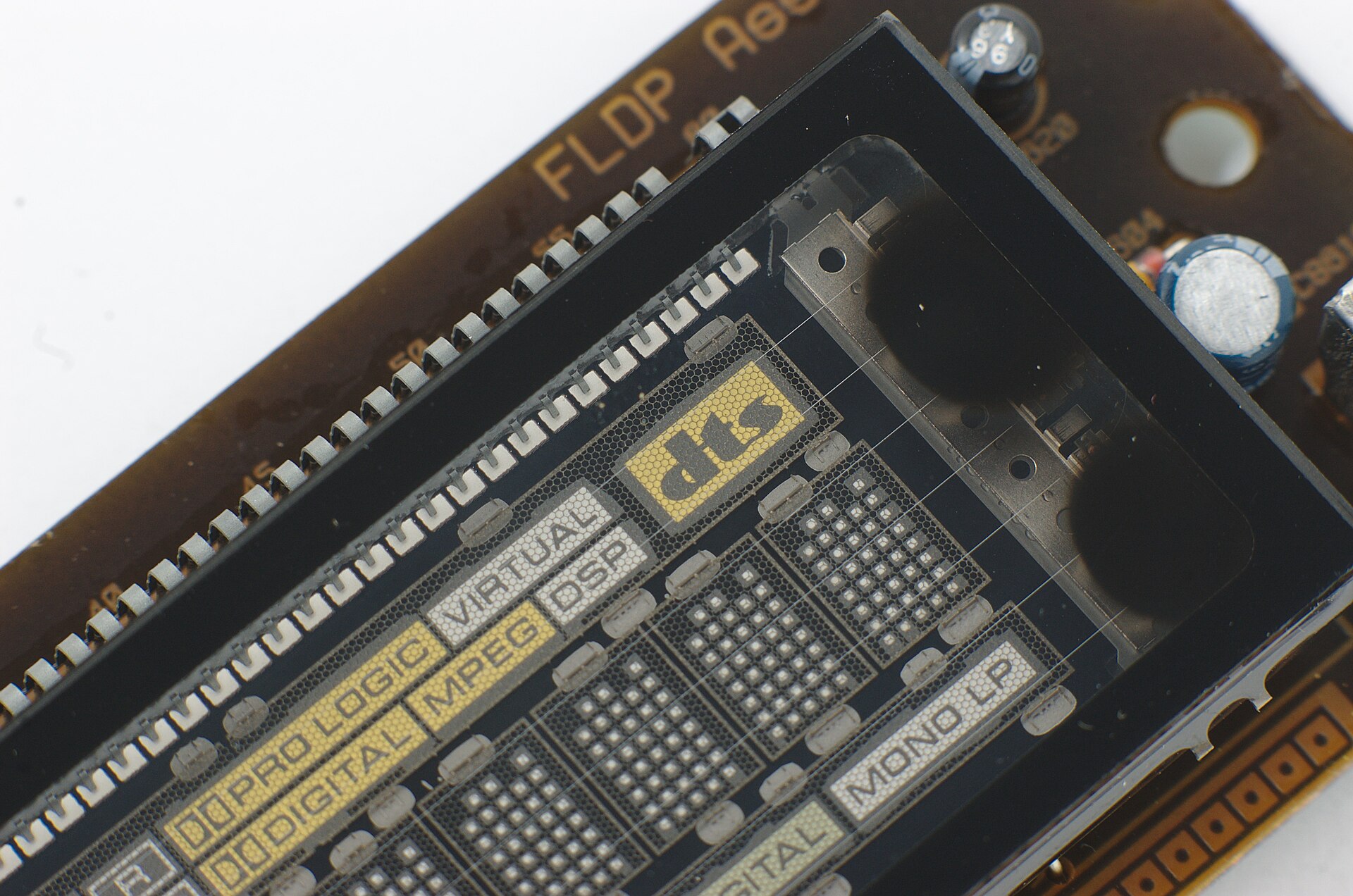
A VFD gives blue-green seven-segment or dot-matrix digits at low voltage, and the collected material shows the IV-11, IV-18, and IV-27 families used in wooden plinths and copper-pipe frames. A numitron is a genuinely low-voltage incandescent display — the IV-16 appears in the gallery — and is the one glow-style display with essentially no electrical hazard, which makes it the sensible choice for a first steampunk build or for anything a child will be near. A dekatron gives a rotating dot rather than a digit and reads as pure laboratory apparatus. A magic-eye tube gives a fan of green light that is not a digit at all and works best as an accent alongside another display. Each has its own engineering dive or, for the dekatron and magic eye, no dive in this hub at all — a gap worth naming rather than papering over.
7.8 What the best builds do that the rest do not
Reading the genuine material against the synthetic, five differences separate the work worth studying from the work worth scrolling past. All five are restatements of principles introduced earlier, which is the point — they converge.
- Every visible element is structural. The bezel is the mount, the pipe is the frame, the gear is the clamp, the plate covers the fastener holes. In the weakest work, nothing is.
- The hardware is one family. One metal, one finish, one head style, one drive.
- There is a quiet field around the display. The best builds are sparser than the aesthetic’s reputation suggests.
- The wiring was considered. Sleeved, dressed, commoned, and either genuinely hidden or genuinely presentable. The bell-jar builds are unforgiving here and the good ones survive it.
- The finish is proportionate to the fit. Ageing over well-made work reads as history; ageing over poor work reads as disguise.
7.9 References (Vol 7)
- Steampunk reference gallery and per-image manifest,
02-inputs/reference_gallery/(README.md,manifest.csv) — the 513-image, 35-theme corpus audited in § 7.2. Lantern-Clock.pdf,02-inputs/— the laminated hardwood and brass lantern build of § 7.3.Steampunk Nixie Tube Clock(Instructables, nine steps),02-inputs/— the copper pipe-frame build of § 7.4, built 2014–2017 on another builder’s published board design.- Donor-chassis photograph set,
02-inputs/Steampunk clock/ScopeInternals/(18 images), withwaterman_s11a_manual.pdf(Waterman Products Company Pocketscope S-11-A, manual obtained from radiomuseum.org) andschematic.pdf— the teardown of § 7.5. - Inspiration board,
02-inputs/Steampunk clock/Ideas/— named clocks and an internet shortcut to a single maker’s wooden-clocks page; the attribution in § 7.6 is inferred from that shortcut and the matching filenames and has not been confirmed with the maker. - Sibling display dives for the engineering of the displays surveyed in § 7.7 — Nixie, Scope/CRT, Numitron, Meter-Movement. The dekatron and magic-eye displays have no dive in this hub.
- Figure photograph credits are recorded verbatim in
photo_credits.txt.
Comments (0)