Mechanical · Volume 8
Enclosure, Dials & Finishing
Three aesthetics, one hub — the visible mechanism, the instrument panel, and the circuit-as-object; designing printed gauge faces; enclosures and FDM/acrylic/brass finishing; lighting with restraint; and the sound a clock makes
Everything before this volume was about making a clock work: the gear train that paces the hands (Vol 3), the motors and coils and drivers that move things (Vol 4), the timebases and counting logic that keep them honest (Vol 5), and the three worked builds (Vol 6). This volume is about making a clock good to live with — the part that is finished by eye and by ear rather than by oscilloscope. It is the volume where the three collected clocks stop being the same four subsystems wearing different mechanisms and become three genuinely different objects, because each one answers the finishing question in a way the other two reject.
A working movement is not yet a clock you want on the shelf. The planetary train must be held between plates at exactly the right gap; the aviation gauges need faces, bezels, a “glass,” and a panel to live in; the fork’s bare etched board has to decide whether to hide or to be the whole point. None of these is a timekeeping decision — the clock keeps the same time however it is dressed — and that is precisely why they are gathered here, away from the engineering volumes, and treated as the craft they are.
8.1 Three aesthetics, one hub
The three collected builds are not three styles of the same clock; they are three philosophies about what a clock is allowed to show. Knowing which one you are building governs every later decision in this volume — what the enclosure is made of, whether there is a dial at all, how much light is appropriate, and even how the clock is meant to sound.
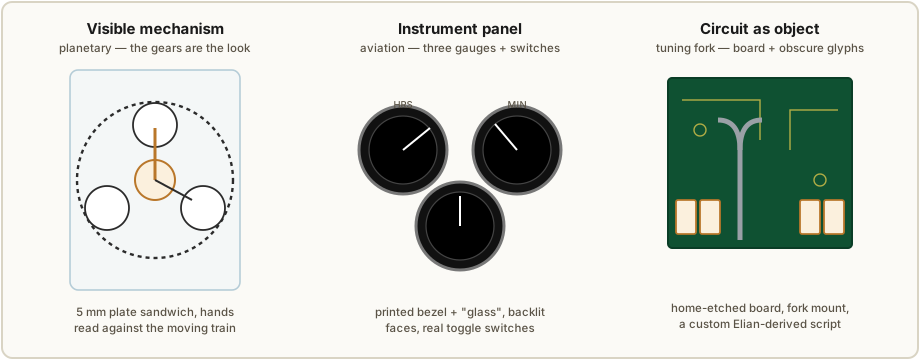
8.1.1 The visible mechanism — the planetary clock
The planetary clock’s design philosophy is honesty: the thing that does the work is the thing you look at. There is no dial in the ordinary sense and no decorative shell — a front and back plate hold the printed epicyclic train in a thin gap, the hands ride the sun axis (Vol 3), and the viewer reads time off the mechanism itself. The aesthetic decision is therefore mostly a material one — make the front plate transparent (clear acrylic) so the gears show, or opaque (wood, painted plate) so only the hands do — and a restraint one: nothing should distract from the rotation. This is the kinetic-sculpture school of clockmaking, and its risk is visual noise; the discipline is to keep the plates clean and let the slow, geared motion be the only ornament.
8.1.2 The instrument panel — the aviation gauge clock
The aviation clock’s philosophy is imitation done convincingly. The goal is that a
glance reads “aircraft instrument panel,” and every finishing choice serves that illusion:
three round gauges with chamfered bezels (NemaBezelChamfer01), a printed lens standing in
for instrument glass (MeterOuterGlass04), black dial faces with white aviation-style
graduations (§8.2), a control panel carrying real toggle switches and labelled functions
(SELECT, BELL, WIFI & TIME STATUS, PIR), and a plinth (PlinthFoot) so the whole
thing sits on a desk like a removed cockpit cluster. Here the mechanism is hidden on
purpose — the steppers, hall sensors, and ESP32 live behind the panel in the Base and
RearCover — because an instrument panel that showed its motors would break the spell.
8.1.3 The circuit as object — the tuning-fork clock
The fork clock’s philosophy is the most uncompromising of the three: the electronics are the ornament, and legibility is partly surrendered for it. The home-etched double-sided board with its silkscreen, the steel fork on its 3D-printed mount sticking up in plain view, and — most pointedly — a display that uses a custom Elian-derived script rather than ordinary digits are all deliberate. An Elian-style glyph set means the time is not casually readable by a stranger; you have to learn the clock. That is the opposite of the aviation clock’s at-a-glance imitation, and it is the point: this is an object for the maker who finds a bare board and an obscure alphabet more beautiful than a finished face. Its finishing is therefore mostly non-finishing — keep the board honest, mount the fork so it can hum freely (§8.5), and let the glyphs be strange.
8.2 Dials & gauge faces
Of the three, only the aviation clock has dials in the classic sense, and they are the most transferable craft in this volume — a clean instrument face is the same problem whether you are making an aircraft clock, a meter-movement clock, or a panel for any gauge. The collected faces (hours, minutes, seconds, all white-on-black) are the worked example.
8.2.1 Mapping the sweep to the time range
The first design decision on any face is what range maps to what arc, and the three collected faces show three different mappings on the same 85 mm circle:
- The seconds and minutes faces run 0–60 around a near-full circle, marked every
5 with a labelled numeral (
00, 05, 10 … 55) and minor ticks between, plus aZEROlegend at top where the needle homes (Vol 4’s hall-sensor zero). - The hours face runs 1–12 (
01 … 12) with aHOURSlegend, the same 5-unit-style spacing repurposed for twelve evenly spaced hours.
The rule is to lay the graduation circle out by angle, not by guesswork: a 60-division
face puts a tick every 360° / 60 = 6°, a 12-hour face every 360° / 12 = 30°, and the
labelled majors fall on whole multiples of that. Because the needle is stepper-driven and
homed (Vol 4), the face and the firmware must agree on where zero sits and which way the
sweep runs — the ZERO mark on the decal is the physical promise the homing routine keeps.
8.2.2 Drawing a clean face
What separates a convincing instrument face from an amateur one is consistency, and the
collected decals are a good model: a single typeface used at two sizes (large for the
5-unit majors, the legend in small caps — ZERO, HOURS, MINUTES, SECONDS), tapered
tick marks (long majors, medium 5-unit marks, short minor ticks) struck radially from a
common centre, and generous black margin so the white reads with high contrast. The
seconds face even reserves a rectangular cut-out for a digital sub-display — a nice touch
that mixes analog sweep with a digital window. Keep the numerals upright at the top and
allowed to rotate around the dial (as the collected faces do) rather than all forced
upright, which is the period-correct aviation convention.
8.2.3 Materials for the face
Three ways to get the artwork onto a physical face, cheapest first:
- Printed paper or self-adhesive vinyl decal. Lay the face out as vector art, print on a good inkjet or laser, and either spray-laminate it or print on adhesive vinyl and burnish it onto a disc. This is what the collected black faces are designed for — print, cut to the 85 mm circle, punch the centre and mounting holes. Cheapest, full-colour, but the surface is only as durable as its lamination.
- Laser-engraved / etched face. Engrave the graduations into painted acrylic or anodised aluminium so the marks are cut in, not printed on — far more durable and with a crisp, permanent edge. Reverse-engrave the back of clear acrylic and back-paint for a face that cannot scuff. This is the upgrade path for a keeper.
- Direct-printed FDM face. Print the disc in black, pause the print, and swap to white for the raised graduations (or vice versa) — a multi-material face with no decal at all, though resolution is limited by nozzle width.
8.2.4 The printed “glass”
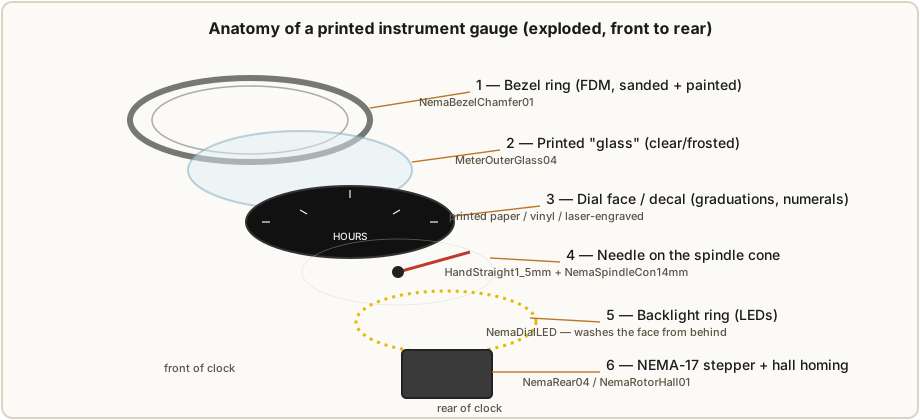
The aviation build prints its own lens, MeterOuterGlass04 — a thin disc in clear or
lightly frosted filament (or PETG, which comes off the bed glossier than PLA) that snaps
under the bezel and stands in for instrument glass. Two finishing notes: a flat, glossy
lens reads as glass where a layer-lined matte one reads as plastic, so either print it very
fine, sand-and-polish it, or — the cheap cheat — drop a laser-cut acrylic or real watch-glass
disc into the bezel recess instead of printing it. A lightly frosted lens has the side
benefit of diffusing the backlight (§8.4) so the LEDs do not show as points.
8.3 Enclosures & materials
The enclosure is where the three philosophies become physical, and the two extremes — the planetary plate sandwich and the aviation case stack — are worth treating as the two patterns most mechanical clocks fall into.
8.3.1 The planetary plate sandwich
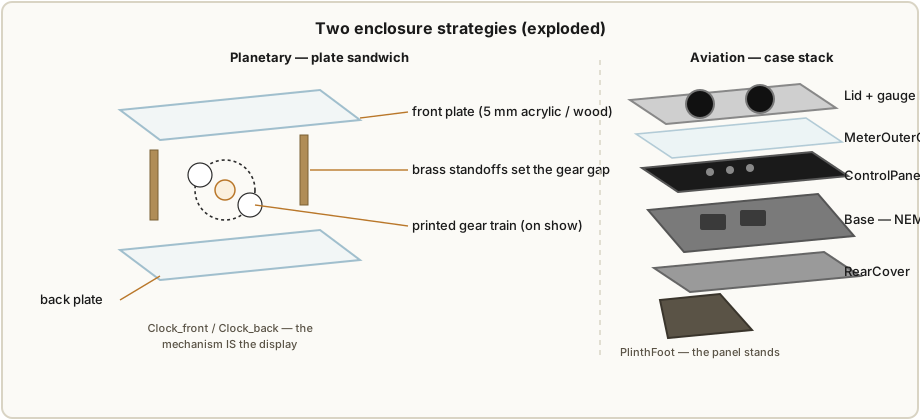
The planetary case is two plates and the air between them. The collected set
(Clock_front, Clock_back) is designed around 5 mm stock — laser-cut acrylic if you
want the gears visible, or wood/MDF if you want them hidden — separated by brass standoffs
whose length sets the gap the gear stack runs in. The whole craft here is the gap: too
tight and the printed gears rub the plates and bind; too loose and they wobble off-axis and
the mesh skips. Standoffs are the adjustment, so buy them in a couple of lengths and a stack
of thin washers and dial the gap in by feel — the train should spin with no axial slop and
no drag. Clear acrylic plates want their edges flame-polished (a quick pass with a
hot-air or small torch turns the frosted laser edge optically clear) and their protective
film left on until the last moment to avoid scratches.
8.3.2 The aviation printed case
The aviation case is a stack of FDM-printed parts rather than a sandwich, and the
collected FreeCAD/STL set is unusually complete: a Base chassis that carries the three
NemaMount/NemaRear04 stepper mounts, the RTC_Holder and SpeakerHolder; a Lid and
LidSpacer; the three NemaBezelChamfer01 bezels and MeterOuterGlass04 lenses; the
ControlPanel04 (with 11x12_4sw and alt variants) drilled for real panel switches;
a RearCover03 with its RearCoverCap/RearCoverFix; and a PlinthFoot (with a Cut
variant) the panel stands on. There are also internal-structure parts — Crossmember,
CrossmemberBracket, HallSwitchBracket, VerosupportFront/Rear — that hold the
hall sensors and a Veroboard at the right places. Building this is an assembly job: print in
a colour you will paint over anyway, dry-fit the stack, then finish (§8.3.3) before final
wiring.
8.3.3 Finishing FDM parts
A raw FDM print never reads as a finished instrument — the layer lines are the giveaway. The standard route, in order:
- Sand the visible faces up through grits (start ~120, finish ~400) to knock down the layer ridges. PLA sands fine dry; do it slow to avoid heat-smearing.
- Filler primer. Two or three coats of high-build filler primer fill the remaining valleys; sand between coats. This is the step that does the most work — it turns a striped surface into a smooth one.
- Colour coat. Light coats of the finish colour (matte or satin black reads most like instrument hardware), then a clear if you want gloss only on the “glass.”
- Brass / metal accents. A real brass bezel ring, knurled brass knobs on the switches, or brass standoffs visible at the corners lift a printed case toward looking machined — and they are the natural bridge to the steampunk treatment (§8.6).
8.3.4 Acrylic and metal
For the planetary clock and any kinetic build, laser-cut acrylic is the material of choice: dimensionally exact, available clear or tinted, and — flame-polished — it reads as glass. Cut plates with the standoff holes in the same file as the bearing bores so everything is concentric. Where a build wants to look machined rather than printed, brass and aluminium accents (a turned bezel, an engraved name-plate, machine screws instead of self-tappers) do most of the work for little money, and aluminium can be laser-engraved for permanent graduations (§8.2.3).
8.4 Lighting
Two of the three clocks invite light; all three are improved by restraint. The governing principle is the same one from §8.1 — light should serve the chosen aesthetic, never overwhelm the mechanism.
8.4.1 Backlit dials and gauges
The aviation build has two dedicated lighting parts: NemaDialLED, a carrier that puts an
LED ring behind each gauge face so the white graduations glow against the black, and
PanelLED, which lights the control panel legends. A backlit instrument face is the single
biggest “this looks real” upgrade — night-flying cockpit lighting is exactly this — but it
lives or dies on diffusion: drive the LEDs gently, bounce them off a white reflector
ring or through the frosted lens (§8.2.4) so the face glows evenly rather than showing six
bright dots. Warm white reads as period instrument lighting; a faint green or red is the
overt cockpit cliché if you want it.
8.4.2 Edge-lit acrylic
For the planetary clock, the elegant lighting trick is edge-lighting the clear acrylic plate: LEDs hidden in the standoff line fire into the edge of the plate, and any engraved mark on its surface lights up while the plate itself stays mostly transparent. Engrave a ring of hour marks into the front plate and edge-light it and you get glowing graduations floating over the visible gears — light that adds to the kinetic aesthetic instead of hiding it.
8.4.3 Restraint
The failure mode in all lighting is washing out the thing you built. On the planetary clock,
too much internal light flattens the gears into a glare and kills the depth that makes the
mechanism worth showing; on the aviation panel, an over-bright backlight blooms past the
graduations and looks like a toy. Keep the LEDs dim, warm, and diffuse, put them on the
clock’s own dimming if the firmware allows, and — a real feature on the aviation build —
let the PIR sensor wake the lighting only when someone is near (Vol 6), so the clock is
dark and calm until you look at it.
8.5 The hum, the tick, the silence
A mechanical clock has a sound, and on these three builds the sound is as much a finishing decision as the paint. It is the one finish you cannot see and the easiest to get wrong.
8.5.1 Three different voices
- The fork hums. The tuning-fork clock’s defining sensory signature is that it does not tick — the 440 Hz fork sings a faint, steady concert-A hum (Vol 5), the audible fingerprint of the Accutron lineage. This is a feature to preserve, not damp: mount the fork so its tines swing freely and the board does not buzz against the case, and the clock has a voice no quartz movement can imitate.
- The stepper can whine. The planetary and aviation clocks are stepper-driven, and a stepper’s natural voice is a whine or chatter at each move — full-step or coarse microstepping on the planetary’s L293D drive is the worst offender. The aviation clock sidesteps this by design: its TMC2208 drivers in StealthChop mode (Vol 4) move the needles in near-silence, which is the right choice for an instrument that should look like it glides.
- Silence as a choice. Cross-link Vol 4: choosing a TMC2208 over an L293D is partly an acoustic finishing decision. If you want the aviation needles to sweep without a sound, StealthChop and gentle acceleration are the finish; if you want the planetary gears to click audibly as a deliberate mechanical voice, a louder driver is a legitimate aesthetic too. Decide which voice the clock should have.
8.5.2 Acoustic finishing
Where noise is unwanted, it is mostly structure-borne — a motor bolted hard to a thin
printed bracket turns the whole case into a speaker. The fixes are cheap: soft mounts (a
rubber washer or a dab of silicone between the NemaMount and the Base), mass and
stiffness in the bracket so it does not resonate, and gentle acceleration ramps in firmware
so the steppers ease rather than snap to each position. For the fork clock the opposite
care applies — do not damp the fork itself; only make sure nothing else in the case is
rattling in sympathy with it.
8.6 Cross-link to Steampunk
There is a fourth aesthetic this hub treats as its own subproject: the moment a mechanical
clock stops imitating an instrument and becomes a steampunk shell — exposed brass gears,
riveted plates, a gauge or Nixie fused into a Victorian-industrial object. Several finishing
choices in this volume are the on-ramp to it: the brass accents of §8.3.3 and §8.3.4, the
visible-mechanism honesty of the planetary clock (§8.1.1), and the real-gauge imitation of
the aviation panel (§8.1.2) all sit one decision away from a steampunk treatment. The
difference is one of intent — steampunk is not trying to look like a real aircraft
instrument or a clean kinetic sculpture; it is trying to look like an imagined Victorian
machine, where brass, patina, exposed mechanism, and gauge/Nixie fusion are the whole
vocabulary. When a build crosses that line, hand it to the dedicated reference: the
Steampunk subproject deep dive in this hub
(../../../Steampunk/) covers the materials, the patination,
and the gauge-and-Nixie fusion that this volume only gestures at.
References
- Cross-references: Vol 3 (gear-train geometry and the plate gap), Vol 4 (TMC2208 StealthChop vs L293D — the acoustic-finishing decision, and hall-sensor homing the
ZEROmark promises), Vol 5 (the 440 Hz fork’s hum as timebase), Vol 6 (build assembly, PIR-woken lighting), Vol 2 (how the gauge sweep reads as time). - Sibling subproject: Steampunk deep dive —
../../../Steampunk/— brass, exposed gears, and gauge/Nixie fusion.
Comments (0)