Mechanical · Volume 7
Buy a Kit or Finished Clock
The buy-instead-of-build path for all three threads — a vintage Accutron, gear-clock kits and files, and finished gauge clocks — with pricing, sourcing, and an honest trade-off table
Volume 6 is the build volume: print the planetary movement, etch the fork board, wire the ESP32 gauge clock. This volume is its mirror image — the buy-instead-of-build path for each of the three threads, plus the one finished-resonator option that has no DIY equivalent you would ever attempt. The hub’s distinguishing convention is that every buildable thing is documented along both paths (Vol 1, §1.4); here is the buy side in full.
A blunt framing first, because it governs everything below. None of these clocks is about keeping time. A $15 quartz movement from any craft store keeps better time than a vintage Accutron, a wooden gear clock, or a stepper-driven gauge clock ever will. You buy — or build — these for the mechanism: the hum of a real steel fork, the slow turn of laser-cut wooden gears, the sweep of an instrument needle behind an aviation dial. Read every price and trade-off in this volume through that lens.
7.1 The buy spectrum
Volume 1 (§1.4) laid out a four-row DIY+Buy table running from buy a vintage finished resonator down to design your own. This volume expands the top two rows — buy finished, buy a kit — across the three threads. The spectrum is wide and the two ends are genuinely different clocks: at one end you own a serviced 1960s wristwatch that needs nothing from you but winding wear; at the other you buy a set of STL files and still print, ream, and assemble every gear yourself.
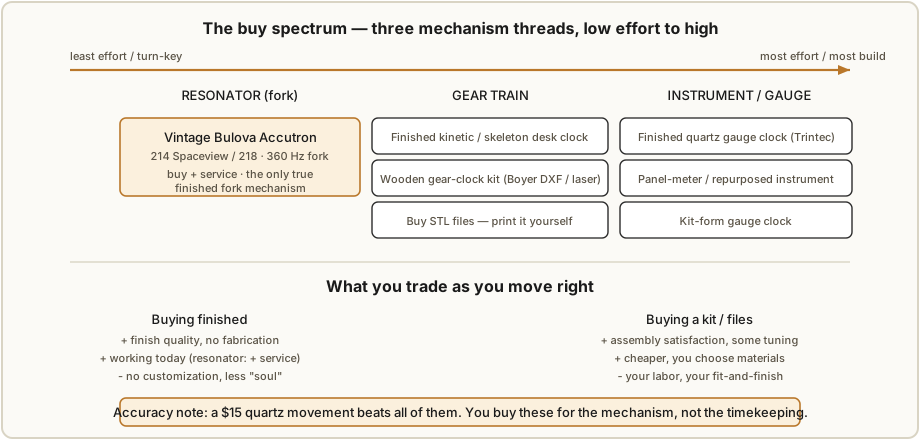
The three threads do not offer the same menu, and that asymmetry is the most useful thing to understand before spending money:
Table 1 — understand before spending money
| Thread | Buy finished? | Buy a kit? | Buy the files? | The honest summary |
|---|---|---|---|---|
| Resonator (fork) | Yes — vintage Accutron | No | No | The only genuine finished electromechanical fork mechanism you can own. There is no fork kit. |
| Gear train | Yes — kinetic/skeleton desk clocks | Yes — wooden gear-clock kits | Yes — 3D-print STL sets | The richest buy menu; spans $30 files to $300+ finished. |
| Instrument / gauge | Yes — quartz “instrument-style” clocks | Some kit forms | N/A (you’d design it) | Finished units are quartz behind an aviation dial — a different animal from the DIY stepper build. |
The sections that follow take the threads in that order: the resonator (§7.2), because it is the unique one; gears (§7.3); gauges (§7.4); then the consolidated trade-off table (§7.5).
7.2 The vintage tuning-fork watch — the resonator you can actually own
This is the standout of the whole volume. The tuning-fork clock the hub anchors on (the NuclearLighthouseStudios 440 Hz build, Vols 5–6, 9) has no finished commercial equivalent — nobody sells a hobby fork clock. But the idea — a steel fork sustained electromagnetically as the timebase — was a mass-market wristwatch for a decade, and those watches survive in quantity. You can buy and wear a genuine, serviceable electromechanical fork mechanism: the Bulova Accutron.
7.2.1 What it is, and why it hums instead of ticks
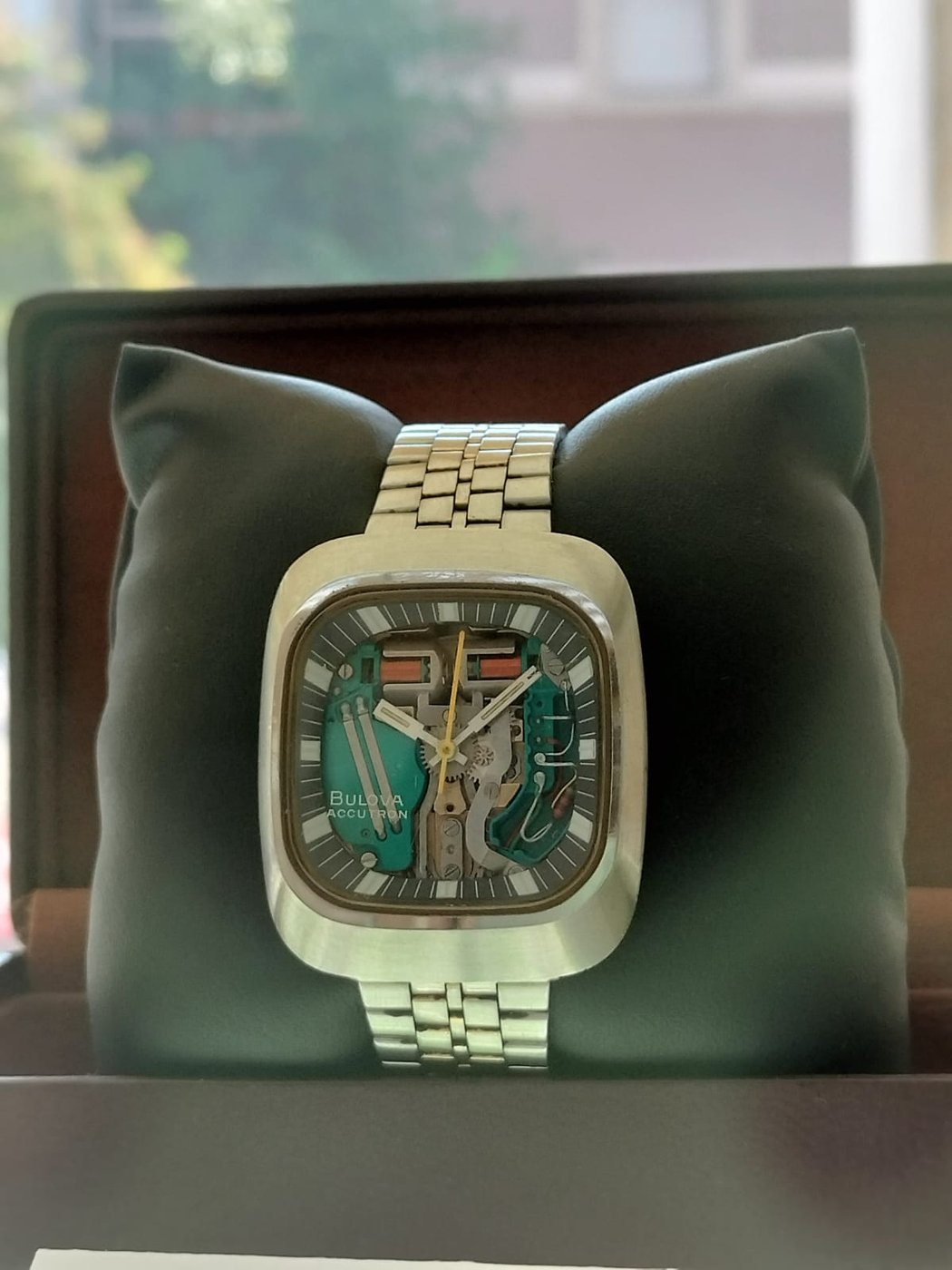
Bulova introduced the Accutron in 1960 (first sales 1961). In place of a balance wheel and hairspring it used a small tuning fork sustained by a single-transistor oscillator and two coils, exactly the architecture Vol 1 (§1.2) names as the direct ancestor of the collected fork clock.1 The fork vibrates at 360 Hz — far faster and far more stable than a balance wheel’s few Hz — which is why a healthy Accutron emits a faint, continuous hum rather than a tick, and why its second hand glides smoothly instead of stepping. That hum is the fork itself, audible against the wrist.
The mechanical translation from a vibrating fork to a turning hand is the clever part. One tine carries an index (pawl) mechanism: a tiny jeweled pawl pushes a 300-tooth index wheel forward one tooth per fork cycle, while a second pawl prevents back-slip. The fork’s 360 vibrations per second thus advance the index wheel and, through a conventional gear train, the hands. It is the only place in horology where a tuning fork’s vibration is ratcheted directly into rotation — the collected DIY clock instead counts its fork’s pulses electronically and drives a digit display, never touching a mechanical index.
7.2.2 The two movements, and the date codes
Two calibres matter to a buyer:
- Cal. 214 (1960–1968). The original. Crown is on the caseback (no side crown), which is a quick authentication tell. The famous “Spaceview” is a 214 whose dial was left off (or is a clear printed crystal) so the green circuit board, coils, and humming fork are visible — see §7.2.3. Over ~400,000 were made.
- Cal. 218 (1967 onward). Replaced the 214 in most lines by the end of the decade; a refined movement with a conventional side-set crown and a date complication on many models. Generally a bit easier to live with day to day.
Bulova stamped a date code on the caseback: a letter for the decade and a digit for the year — M = the 1960s (M0 = 1960, M1 = 1961 … M9 = 1969) and N = the 1970s (N0 = 1970 …). An “M5” caseback is a 1965 watch. The code is the single most reliable way to place a piece and to sanity-check a seller’s “1962” claim against the actual stamp.
7.2.3 What to look for buying one
Accutrons are one of the friendlier vintage niches — plentiful, well-documented, and cheap relative to mechanical watches of the era — but there are specific things to check:2
- Is it actually running, and does it hum? A healthy 214/218 emits the constant 360 Hz buzz and the seconds hand sweeps with no one-second ticks. A ticking or dead Accutron means a service (or worse) is needed — budget for it (§7.2.4).
- Fork and index health. The fork tines and the jeweled index/pawl are the fragile, hard-to-source parts. A movement that won’t hold rate, or that runs fast/slow beyond adjustment, may have an index problem — the most expensive thing to fix.
- Genuine Spaceview, not a converted dial watch. Because Spaceviews command a premium, unscrupulous sellers remove the dial from a common 214 to fake the open look. A factory Spaceview has a specific printed/clear crystal and chapter ring; verify before paying the premium. When in doubt, a standard-dial 214 is the safer, cheaper buy.
- Cell type. The 214/218 were designed for a 1.35 V mercury cell (e.g. Mallory RM-? series), which is banned and no longer made. A modern 1.5 V silver-oxide cell runs ~0.15 V high, which can push the rate and stress the circuit. The standard fixes are a voltage-reducing adapter (a cell-sized carrier with a small dropping diode/regulator to bring 1.5 V down to ~1.35 V) or a watchmaker who adjusts/regulates for the higher voltage. Ask the seller which the watch is set up for. This is a known, solved problem — not a reason to avoid the watch, just a thing to confirm.
7.2.4 Servicing realities and price ranges
An Accutron is not a watch for a generalist watchmaker — the tuning-fork movement is its own discipline, and the index/pawl work in particular needs someone who knows it. Seek out Accutron specialists (the collector community and the NAWCC forums maintain lists of known-good ones). A full clean / oil / adjust on a healthy 214/218 with no coil or index damage runs roughly $285–$350 as of the mid-2020s; budget $250–$400 to be safe, and more if coils or index parts need replacing (those parts are scarce and drive cost).2
Purchase prices, all as of the mid-2020s and date-sensitive — vintage watch prices move:
Table 2 — Purchase prices, all as of the mid-2020s and date-sensitive — vintage watch prices move
| Piece | Rough condition | Ballpark price |
|---|---|---|
| Standard-dial 214 / 218, running, recently serviced | wearable, honest | ~$300–$700 |
| Standard-dial 214 / 218, untested / “for parts” | needs service | ~$100–$250 |
| 214 Spaceview, genuine, running | the collectible | ~$700–$1,500+ |
| Gold-filled / solid-gold cased pieces | premium cases | higher, case-driven |
The reliable-value play is a running, recently-serviced standard-dial 214 or 218 from a seller who can name the servicer — you get the genuine humming fork mechanism for the price of a mid-range modern quartz watch, with none of the index-fork lottery of a “for parts” listing.
7.2.5 The modern “Accutron” reissue — clarify before you buy
The Accutron brand was relaunched, and in 2020 it released the Spaceview 2020, which deliberately echoes the open-dial 1960s look. It is not a tuning-fork watch. Its “electrostatic” movement uses twin turbines spun by wrist motion between electrodes to charge an accumulator, which then powers an electrostatic motor (the gliding seconds hand) and a conventional step motor (hours/minutes).3 It is an interesting modern electromechanical movement in its own right, and a handsome homage — but if your goal is to own a fork mechanism, the Spaceview 2020 is the wrong watch. Only the vintage 214/218 (and the related 2xx-series fork calibres) hums an actual steel fork. Buy the brand-new one because you like it; buy the vintage one because you want the fork.
7.3 Gear-clock kits and finished gear clocks
The gear thread (DIY anchor: the 3D-printed planetary clock, Vol 6) has the richest buy menu of the three — files, kits, and finished clocks, spanning roughly $30 to $300+.
7.3.1 Wooden moving-gear clock kits and plans
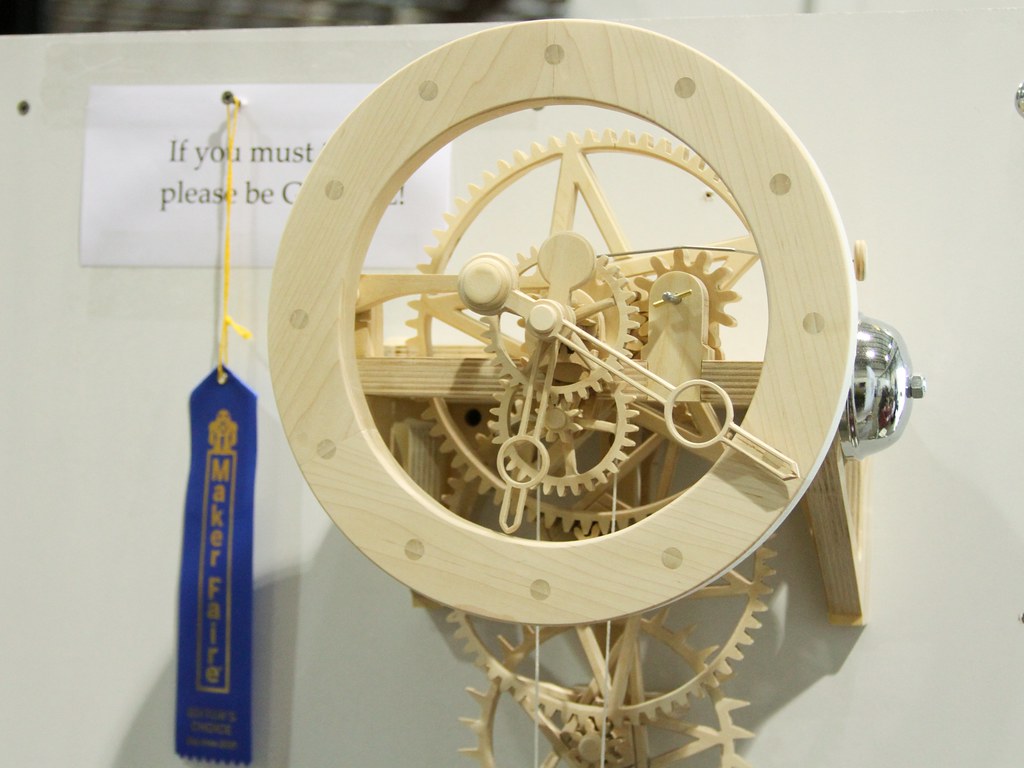
The signature of this category is Clayton Boyer’s wooden gear-clock designs — large, slow-turning, all-wood movements where the gear train is the sculpture. Boyer sells plans, not pre-cut kits: paper patterns and, for most designs, DXF files so you can have the gears laser-cut or CNC-routed from plywood or hardwood. Plans run roughly $37–$60 each as of the mid-2020s (e.g. the beginner-friendly “Genesis” and “Simplicity” designs); the DXF is typically included with the plan.4 You then supply the material, the cutting (your laser, your CNC, or a cutting service), arbors, and a small weight or spring drive. This is the closest analog to the DIY-files path — you buy the design, not the parts — and it sits at the high-effort end of the buy spectrum.
For people who want parts in a box, third parties and clock-supply houses (Clockworks.com and similar) sell mechanical skeleton/wall-clock kits that include the brass movement, hands, and hardware to assemble. These are assembly projects rather than fabrication projects — more turn-key than Boyer plans, less so than a finished clock.
7.3.2 Skeleton mechanical-movement kits
A skeleton clock exposes its movement — no solid dial, openwork plates so the gears, escapement, and (often) pendulum are all visible. Kit forms range from simple beginner assemblies to multi-day spring or weight-driven movements with real escapements. Brass is the usual material. These are genuine mechanical clocks (a wound spring or a weight drives an escapement and pendulum) — distinct from the hub’s electromechanical anchors — and they are the buy-path way to get a classic visible-escapement clock without machining your own wheels. Match the kit to your patience: a time-only kit is an evening; an 8-day striking movement is a weekend of careful fitting.
7.3.3 3D-printable gear-clock designs you buy as files
Directly parallel to the collected PlanetaryGear build, you can buy STL files for gear clocks on Cults3D and Printables (and free designs abound on both, plus Thingiverse). Many are quartz-movement display pieces — decorative non-functional gears around a $5 fit-up quartz module (e.g. designs built around a 56×56×16 mm movement) — while others are functional printed gear trains in the spirit of the planetary clock.5 Paid designs are typically a few dollars to ~$15. This is the lowest-cost buy option in the whole volume, but it is barely “buying” — you still print, deburr, ream bores, and assemble. It is the files-path bridge into the Vol 6 DIY build.
7.3.4 Finished kinetic and gear desk clocks
At the turn-key end, plenty of finished gear/kinetic desk clocks are sold as decor — a quartz movement driving (or merely surrounded by) visible gears. These give you the look of a gear clock with zero assembly, but the gears are usually cosmetic and the timekeeping is quartz. Honest framing: this is buying an object, not a mechanism — fine if you want the aesthetic on a shelf, the wrong buy if the moving gear train is the point.
7.4 Instrument / gauge and “engineering” clocks
The gauge thread (DIY anchor: the ESP32 aviation gauge clock, Vol 6) is where the buy path diverges most from the build path — and you should know that going in.
7.4.1 Finished aviation / instrument-style clocks
The dominant finished product is the aviation instrument-style wall clock, of which Trintec is the best-known brand. These replicate a cockpit instrument — an altimeter, airspeed indicator, or turn coordinator — as the clock face, in sizes around 6.5”, 10”, and 14”, and they sell for roughly $30–$120 as of the mid-2020s depending on size and model.6 The crucial caveat: these are quartz clocks behind an aviation-styled dial. A single AA battery drives an ordinary quartz movement and a pair of hands printed to look like instrument needles. They are handsome and cheap and need nothing — but they share only the aesthetic with the DIY build, not the mechanism.
7.4.2 Panel-meter and repurposed-instrument clocks
A second finished/kit family drives a genuine moving-coil panel meter (or repurposes a real aircraft gauge) so the needle deflection encodes the time — a voltmeter whose 0–10 V scale is relabeled 0–60 minutes, driven by a DAC or PWM. This is a real electromechanical indicator, and it overlaps the hub’s Meter-Movement deep dive, which covers it in depth (Vol 1, §1.3 notes the boundary). The distinction the hub draws: the Meter-Movement clock drives a meter coil by current/voltage deflection, whereas the collected Aviation clock drives its needles with stepper motors through gear reduction — the mechanism is the motor and the gear train, which is why it lives in Mechanical. If a panel-meter-deflection clock is what you want, start in the Meter-Movement deep dive; if a stepper-driven gauge is what you want, the buy options are thin and the DIY build (Vol 6) is the real answer.
7.4.3 Kit-form gauge clocks, and what you give up vs the DIY ESP32 build
Genuine kit-form stepper-gauge clocks are uncommon; most “gauge clock kits” are either the quartz instrument-style clocks above or panel-meter kits. Set against the collected ESP32 aviation build, the trade is stark:
- What you give up by buying finished. Customization (your own dials, decals, number of gauges), the homing/zeroing tuning that makes stepper needles read true (Vol 4), Wi-Fi/NTP time, the chime, the PIR wake — everything that makes the DIY clock yours. A Trintec is the same on every wall.
- What you gain. Finished-product fit and finish, an authentic instrument bezel and lens, no fabrication, no firmware, and it works the moment the battery goes in.
For the gauge thread specifically, the buy path is best understood as buying the look cheaply (Trintec, §7.4.1) while the mechanism — real homed stepper needles — remains a DIY-only proposition in this hub.
7.5 Buy-vs-build trade-offs
The consolidated, honest comparison. Effort/cost are as of the mid-2020s and approximate; treat all prices as ballpark and date-sensitive.
Table 3 — 7.5 Buy-vs-build trade-offs
| Thread → option | Cost (mid-2020s) | Effort | Accuracy | Customization | ”Soul” / satisfaction |
|---|---|---|---|---|---|
| Resonator — vintage Accutron 214/218 | $300–$700 + ~$300 service | none (buy + service) | ~few s/day (period-correct) | none | very high — a real humming fork on the wrist |
| Resonator — Accutron Spaceview 214 | $700–$1,500+ + service | none | ~few s/day | none | very high — and you see the fork |
| Resonator — DIY 440 Hz clock (Vol 6) | ~$40–$80 parts | very high (etch + tune) | tunable, good | total | highest — you sustained the fork yourself |
| Gear — finished kinetic desk clock | $30–$150 | none | quartz (excellent) | none | low — gears often cosmetic |
| Gear — skeleton movement kit | $40–$200 | medium (assembly) | mechanical (modest) | some | high — a real escapement you fitted |
| Gear — Boyer plan + laser-cut | $40–$60 plan + material | high (cut + build) | mechanical (modest) | high (material/finish) | very high — a sculptural wooden train |
| Gear — buy STL files + print | $0–$15 | high (print + assemble) | varies | high | high — the files-to-DIY bridge |
| Gear — DIY planetary (Vol 6) | ~$50–$90 parts | high | RTC (excellent) | total | highest — your printed movement |
| Gauge — Trintec instrument clock | $30–$120 | none | quartz (excellent) | none | low–medium — the look, not the mechanism |
| Gauge — panel-meter / kit | $30–$150 | medium | analog (modest) | some | medium — a real deflecting needle |
| Gauge — DIY ESP32 build (Vol 6) | ~$80–$160 parts | very high | NTP (excellent) | total | highest — homed steppers, your dials |
Two honest conclusions stand out from the table:
-
Accuracy is never the reason to choose any of these. The most accurate options are the quartz finished clocks and the RTC/NTP DIY builds — both timekeeping by an electronic reference, not by the mechanism you’re paying for. A vintage Accutron, for all its engineering romance, keeps roughly period-correct time (a few seconds a day at best when freshly serviced) and a wooden gear clock keeps mechanical-clock time (drifts, needs regulation). As Figure 7.1 puts it: a $15 quartz movement beats all of them on accuracy; you build or buy these for the mechanism, not the timekeeping.
-
The resonator thread is the one place buying wins on “soul.” For gears and gauges, the DIY build (Vol 6) is the most satisfying and the most customizable, and buying is mostly a shortcut to the look. For the fork, the opposite is true at the high end: a serviced Accutron is a genuine, wearable, finished fork mechanism with seventy years of provenance — something no hobby build replicates. The DIY 440 Hz clock and a vintage Accutron are both “real” fork instruments; owning both is the complete picture of the thread.
Where to go next: to build any of these instead, Vol 6 (the three worked builds) and Vol 9 (the collected-design walk-throughs). To understand why the mechanism behaves as it does — the gear math, the fork’s sustaining amplifier, the stepper homing — Vols 3–5. For finishing a bought kit or a built clock, Vol 8.
References
- Cross-references: Vol 1 (the three threads, the DIY+Buy spectrum §1.4, the decision tree §1.5), Vol 3 (gear-train and reduction math behind a printed/wooden movement), Vol 4 (the fork sustaining amplifier, steppers and microstepping, hall-sensor homing), Vol 5 (the 440 Hz fork timebase and pulse counting), Vol 6 (the three worked DIY builds — the build-side mirror of this volume), Vol 8 (enclosure, dials, finishing a bought kit or built clock), Vol 9 (collected-design walk-throughs). Mechanism boundary with the Meter-Movement deep dive noted in §7.4.2.
Footnotes
-
Bulova Accutron history — calibres 214 (1960, crown on caseback, ~400,000 made through 1968) and 218 (1967 on). The 360 Hz tuning fork is sustained by a single-transistor oscillator and two coils; a jeweled index/pawl advances a 300-tooth index wheel one tooth per fork cycle, driving the hands. See Vol 1 §1.2 for the Accutron as the conceptual ancestor of the collected tuning-fork clock. Grail Watch — Accutron 214 movement reference, https://reference.grail-watch.com/movement/accutron-214/; Gear Patrol, “This Space Age Technology Was a Watchmaking Milestone in 1960,” https://www.gearpatrol.com/watches/a664506/watches-you-should-know-bulova-accutron-spaceview/. ↩
-
Accutron buying, authentication, cell, and service guidance — verify factory Spaceview vs. a stripped-dial 214; healthy pieces hum at 360 Hz with a smoothly sweeping seconds hand; original 1.35 V mercury cell replaced via a voltage-reducing adapter or watchmaker adjustment to use 1.5 V silver-oxide; full clean/oil/adjust roughly $285–$350 (budget $250–$400) as of the mid-2020s, more if coils/index parts are needed; use Accutron specialists (NAWCC community lists). Timepiece Profits — Bulova Accutron buying and resale guide, https://timepieceprofits.com/bulova-accutron-buying-and-resale-guide/; Teddy Baldassarre — Accutron Watches Buyer’s Guide, https://teddybaldassarre.com/blogs/watches/accutron; Watchlords — A Guide to Buying and Collecting Accutron Watches, https://watchlords.com/viewtopic.php?t=26752. Prices are date-sensitive. ↩ ↩2
-
The modern Accutron Spaceview 2020 is not a tuning-fork watch: an electrostatic movement uses twin turbines spun by wrist motion to charge an accumulator that powers an electrostatic motor (seconds) and a step motor (hours/minutes). Accutron — Spaceview 2020 collection, https://www.accutronwatch.com/us/en/collection/spaceview-2020/. ↩
-
Clayton Boyer wooden gear-clock plans (not pre-cut kits); paper patterns plus DXF for laser/CNC cutting; roughly $37–$60 per design as of the mid-2020s (e.g. “Genesis,” “Simplicity”). Skeleton/wall mechanical clock kits with brass movements available from clock-supply houses. Wooden Gear Clock Plans by Clayton Boyer, https://www.lisaboyer.com/Claytonsite/Claytonsite1.htm; CNCCookbook — Wooden Clock Plans from Clayton Boyer, https://www.cnccookbook.com/wooden-clock-plans-from-clayton-boyer/; Clockworks — mechanical clock kits, https://www.clockworks.com/product-category/clock-movements/mechanical-movements/mechanical-clock-kits/wall-or-mantle-clock-kits. ↩
-
3D-printable gear-clock designs sold/shared as STL on Cults3D and Printables — both decorative quartz-movement display pieces (e.g. designs around a 56×56×16 mm fit-up module) and functional printed gear trains; paid designs typically a few dollars to ~$15. Cults3D — clock tag, https://cults3d.com/en/tags/clock; Printables — “Gear clock” by Luke’s 3D, https://www.printables.com/model/269550-gear-clock. ↩
-
Finished aviation instrument-style wall clocks — Trintec altimeter/airspeed-indicator-faced clocks, ~6.5”/10”/14” sizes, single-AA quartz movement, roughly $30–$120 as of the mid-2020s. These share the cockpit-gauge aesthetic, not the stepper mechanism of the collected ESP32 build. Trintec 3060-10 10” Aviation Altimeter Instrument Style Wall Clock (Amazon listing), https://www.amazon.com/Trintec-Aviation-Altimeter-Instrument-3060-10/dp/B017JZU2NS; Pilot Mall — Trintec 14” Altimeter Wall Clock, https://www.pilotmall.com/products/classic-14-altimeter-wall-clock. Prices are date-sensitive. Cross-reference: the Meter-Movement deep dive for genuine moving-coil panel-meter clocks. ↩
Comments (0)