Mechanical · Volume 1
Overview & Decision Tree
What a mechanical-movement clock is in this hub, the three threads it spans, and which path fits your bench
Every clock in this hub is, underneath, the same four blocks: a timebase, some counting logic, a driver, and a display. The other technologies in the hub make the display the star — the nixie’s glow, the Numitron’s filament, the CRT’s beam. The Mechanical category is the one where the star is the movement itself: the physical thing that turns, vibrates, or swings to show the time. The readout is not light from a tube but a position — a hand swept around a dial by a gear train, a needle driven across an instrument gauge by a stepper motor, or, in the strangest of the three, a steel tuning fork humming at 440 Hz that is the timebase, with the time read off a row of seven-segment displays the fork’s own vibration keeps in step.
Note — this is the mechanical technology overview. Specific mechanical clocks Jeff owns or builds — their design, construction, and operation — are documented as their own deep dives in this technology’s
clocks/folder, one folder per clock, each avol*.mdseries with a Design → Building → Running spine. This volume series covers the technology in general; the per-clock dives go deep on individual units.
This is therefore the broadest and least uniform category in the hub. “Mechanical clock” in the horological tradition means a weight or spring driving an escapement and a pendulum or balance wheel — no electricity at all. That tradition is the historical backdrop of this series (Vol 2), but it is not what the owner has collected. What sits in this hub are three electromechanical clocks, each of which makes a different mechanical element the project while keeping the timekeeping itself electronic:
- a 3D-printed planetary gear-train clock, where the engineering is the reduction gearing that turns one motor shaft into correctly-geared hour and minute hands;
- a tuning-fork resonator clock, where the engineering is sustaining a real mechanical oscillation and counting it — the direct descendant of the Bulova Accutron;
- an aviation gauge clock, where the engineering is driving three real instrument movements — stepper-positioned needles behind aircraft-style dials — and homing them precisely.
This ten-volume reference covers all three at depth: how position encodes time, the gear math and the 3D-printing craft behind a printed movement, the motors and coils and the magnetic sustaining amplifier that put things in motion, the timebases (a quartz RTC, a humming fork, the AC mains) and the counting logic that drives them, three complete worked builds from designs held in this hub, the buy-a-kit and buy-finished options, the enclosures and dials, and a laminate-ready cheatsheet. It is written for an experienced maker with a full lab — multiple 3D printers, a CNC, a laser cutter, and an electronics bench — because between the three builds you will print gears, etch a circuit board, and flash three different microcontroller families.
1.1 What a mechanical-movement clock is — the unifying idea
Across the three threads, the shared structure is the same four subsystems every clock has, with the display replaced by a mechanical indicator and, in two of the three, the timebase held to a precision RTC while the mechanism does the showing:
- A timebase — the accurate reference that ticks. Two of the collected clocks take it from a DS3231 temperature-compensated RTC (a quartz crystal corrected for temperature, good to a couple of parts per million); the tuning-fork clock is the exception that makes the category interesting — its timebase is the mechanical resonance of a 440 Hz fork, counted directly (Vol 5).
- Counting logic — a microcontroller divides the timebase down to seconds, minutes, and hours and decides where the mechanism should be. The three builds use three different brains: an Arduino/AVR (planetary), an ATtiny4313 counting fork pulses (tuning fork), and an ESP32 with Wi-Fi time and a homing routine (aviation).
- An actuator and its driver — the part that turns electrical intent into motion: a stepper motor through an L293D or a TMC2208 microstepping driver (planetary, aviation), or a transistor sustaining amplifier feeding a drive coil that keeps the fork ringing (tuning fork). This is the hard part of the category and the subject of Vol 4.
- The mechanism / indicator — the thing you actually watch: a planetary (epicyclic) gear train reducing the motor’s turns into correctly-paced hands; three instrument-gauge needles swept across printed aviation dials; or, on the fork clock, a row of five seven-segment displays the fork keeps in time. This is Vol 2 (how a position reads as a time) and Vol 3 (the gear math behind a printed movement).
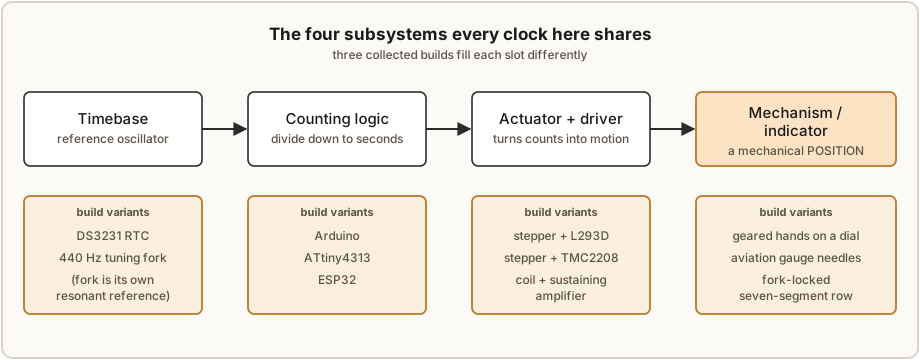
The thing that makes any of these a project is not the timekeeping — a DS3231 module keeps better time than most wristwatches with no effort — but the mechanism: getting a printed gear train to mesh without binding, getting a fork to self-start and hold 440 Hz, or getting three steppers to home to a repeatable zero so the needles read true. The electronics are friendly; the mechanics and the motion control are the craft.
1.2 A one-paragraph history
The mechanical clock is the oldest machine in this hub by six centuries. Weight-driven verge-and-foliot tower clocks appeared in Europe around 1300; the pendulum (Huygens, 1656) and the balance-spring watch (Huygens/Hooke, 1670s) brought accuracy from a quarter-hour a day down to seconds, and the escapement-and-oscillator architecture they established — a resonator that decides the rate and an escapement that feeds it energy and counts it — is exactly the architecture the tuning-fork clock revives in electronic form. The decisive electromechanical leap was the Bulova Accutron of 1960: it replaced the balance wheel with a 360 Hz tuning fork sustained electromagnetically by a single-transistor circuit and an index-and-pawl mechanism that let the fork’s vibration advance a tiny ratchet wheel — the first watch accurate to a couple of seconds a day, and the direct ancestor of the collected fork clock (which counts its fork electronically rather than ratcheting it).1 Quartz (Seiko Astron, 1969) then made an electronic resonator — a crystal — cheaper and far more accurate than any fork, and the quartz oscillator inside a modern RTC is what keeps two of the three collected clocks honest. The mechanical movement, meanwhile, never went away as an object of fascination, and the cheap, repeatable precision of 3D printing and stepper motors has made the gear-train and instrument-needle clock a thriving maker genre — which is where the planetary and aviation builds in this hub come from.
1.3 The three threads, and the clocks that anchor them
This category does not have one canonical build the way the Numitron deep dive does; it has
three distinct threads, each anchored by a complete design held in this hub’s
02-inputs/. The series is organized functionally (timebase, mechanism, actuator, build,
buy, finish) so that the engineering reads cleanly, but every functional volume is written
across all three threads. The anchoring builds:
Table 1 — across all three threads. The anchoring builds
| Thread | Anchor build (collected) | What makes it the project | Brain · timebase |
|---|---|---|---|
| Gear train | PlanetaryGear — a 3D-printed planetary/epicyclic clock by Looman_projects (full STL + DXF set + Instructables) | the printed reduction gearing that paces the hands | Arduino + L293D · DS3231 RTC |
| Resonator timebase | TuningFork — a 440 Hz tuning-fork clock by NuclearLighthouseStudios (KiCad project, firmware, fork mount) | sustaining and counting a real mechanical oscillation | ATtiny4313 · the fork itself (440 Hz) |
| Instrument indicator | Aviation — an ESP32 aviator-gauge clock by Nobby123 (FreeCAD bodies, gauge decals, firmware) | driving and homing three stepper-positioned gauge needles | ESP32 + TMC2208 · DS3231 RTC / NTP |
All three files are on disk and reproduced/walked-through in Vol 9. A note on scope: the aviation gauge clock overlaps the Meter-Movement category (it presents as panel gauges), but it is kept here because its needles are driven by stepper motors through gear reduction, not by the analog deflection of a real meter coil — the mechanism is the gear train and the motor, which is the Mechanical thread. The Meter-Movement deep dive covers clocks that drive a genuine moving-coil meter from a current or voltage.
1.4 The DIY + Buy duality — stated up front
This hub’s distinguishing convention is that every buildable thing is documented along both paths: how to build it yourself, and how to buy a kit or a finished unit instead. For the mechanical category the spectrum is wide and the two ends are genuinely different clocks:
Table 2 — clocks
| # | Path | Effort | Cost | Covered in |
|---|---|---|---|---|
| 1 | Buy a vintage finished resonator — a working Bulova Accutron (the fork clock you can actually own) | none (plus service) | $$–$$$ | Vol 7 |
| 2 | Buy a kit — a printed-gear-clock kit, an instrument/gauge-clock kit, or a mechanical-movement skeleton kit | medium | $–$$ | Vol 7 |
| 3 | Build a collected design — print the planetary movement, etch the fork PCB, or wire the aviation gauge clock from the files in this hub | high | $$ | Vol 6 |
| 4 | Design your own — your own gear train, your own fork oscillator, or your own gauge driver | very high | $ | Vols 3–5 |
The center of gravity is build it yourself — that is where the three collected designs live and what the engineering volumes (3–5) and the build volume (6) are written for.
1.5 Decision tree — which path is right for this build
Work top-down; stop at the first “yes.”
- Do you want to own a real electromechanical fork clock with no building, and the watch-on-the-wrist form factor is fine? → Path 1, a vintage Bulova Accutron. It is the only one of the three threads you can simply buy as a finished, serviceable mechanism (Vol 7).
- Do you want a mechanism on the shelf and enjoy assembly more than design? → Path 2, a kit — a printed-gear desk clock, a skeleton movement, or a gauge-clock kit. Vol 7 covers what is out there and how to judge one.
- Which mechanism excites you most, and are you ready to fabricate?
- love gears and 3D printing → build the PlanetaryGear clock (Vol 6, walk-through Vol 9). You will print the gear set, tune the mesh and backlash (Vol 3), and drive it with an Arduino, a stepper, and a DS3231.
- love analog electronics and the idea of a humming timebase → build the TuningFork clock (Vol 6, walk-through Vol 9). You will etch or order a PCB, get a transistor sustaining amplifier to hold 440 Hz, and count it on an ATtiny4313.
- love instruments, panels, and motion control → build the Aviation gauge clock (Vol 6, walk-through Vol 9). You will print the gauge bodies, wire an ESP32 to three TMC2208-driven NEMA-17 steppers, and write a homing routine against hall sensors.
- Do you want a movement nobody else has? → Path 4. Vols 3–5 are the engineering reference you will live in: gear-train math, motor and coil drive, and timebase/counting logic.
1.6 The mechanisms — a first orientation
You cannot choose a build without choosing a mechanism, so here is the orientation the rest of the series builds on. The three differ in what moves and in what keeps time:
- Planetary (epicyclic) gear train. A central sun gear, several planet gears carried on a rotating carrier, and an outer ring (annulus) gear. Driving one member and holding another fixed produces a large, compact speed reduction in a flat package — ideal for a 3D-printed clock face where the hour hand must turn at 1/12 the minute hand’s rate. The collected clock drives the train from a 1.8°/step stepper through a GT2 belt-and-pulley pre-reduction and paces it from a DS3231 RTC, homing once with an A3144 hall sensor. The gear math is Vol 3.
- Tuning-fork resonator. A precision steel fork rings at a fixed frequency (the collected clock uses a 440 Hz “concert A” fork; the Accutron used 360 Hz). It is kept vibrating by a magnetic drive coil fed by a transistor sustaining amplifier — a guitar-pickup-like sense coil detects the motion, the amplifier feeds it back in phase, a 555 squares the result into clean pulses, and the ATtiny4313 counts 26 400 pulses per minute to keep time. The fork is the timebase; the readout is five 7-segment digits. The drive and counting are Vols 4–5.
- Instrument-gauge needle. A stepper motor behind a printed aviation dial sweeps a needle to a commanded angle. The collected aviation clock uses three NEMA-17 steppers (seconds, minutes, hours) through TMC2208 microstepping drivers for smooth, quiet motion, with a hall sensor per gauge so each needle can find a repeatable zero on power-up. Time comes from a DS3231 / NTP; a JQ6500 module chimes. The drive, microstepping, and homing are Vol 4.
The one idea to carry forward from all three is that position is the display. Where a nixie clock worries about high voltage and a Numitron worries about filament current, a mechanical clock worries about backlash, homing, and repeatability — does the mechanism return to exactly the same place, and does the viewer read the intended time from where the hand or needle actually sits? That concern shapes every design decision in Vols 3 and 4.
1.7 What the owner has collected
Three projects are catalogued in this subproject’s 02-inputs/, one per thread, each a
complete buildable design:
- PlanetaryGear — Looman_projects’ 3D-printed Planetary Gear Clock (Instructables).
The hub holds the build PDF and the full STL + DXF set:
Sun_gear,Planet_gear,Ring_gear,Carrier_back,Hour_hand,Minute_hand,Clock_front, andClock_back. The electronics are an Arduino with an L293D stepper driver, a 1.8°/step NEMA stepper with a GT2 60T/20T belt reduction, a DS3231 RTC (CR2032-backed), an A3144 hall sensor with a neodymium magnet for homing, buttons, and a 5 V 2 A supply. This is the gear-train build of Vol 6 and the walk-through of Vol 9. - TuningFork — NuclearLighthouseStudios’ Tuning Fork Clock. The hub holds the
KiCad project (schematic, PCB, gerbers), the BOM (CSV + XLSX), the fork-mount
CAD/STL, the datasheets (EC12E encoder, SC56 display, 74HC595), the article
(
The tuning fork clock.docx), and the firmware (C source,Makefile, prebuiltclock.hex). The circuit: a 440 Hz fork driven and sensed by two 22 mH coils and a neodymium magnet, a BC547 transistor sustaining amplifier with a ~440 Hz bandpass, a NE555 squarer, an ATtiny4313 counting the pulses, a 74HC595 scanning five SC39-11 7-segment digits, and an L7805 regulator — on a home-etched double-sided board. The display uses a custom Elian-derived script. This is the resonator build of Vol 6 and the walk-through of Vol 9. - Aviation — Nobby123’s ESP32 Aviator Clock (three aviation-style gauges). The hub
holds the FreeCAD bodies and STLs for the case, gauge bezels, NEMA mounts, rotors, and
control panel; the gauge decals/faces (hours, minutes, seconds); the schematic
image; the DCF77 chime and JQ6500 audio packs; and the firmware zips
(
VoltmeterClock_v73web,SecondsClock05, and the dated source export). The circuit: an ESP32-WROOM-32D driving three NEMA-17 steppers through TMC2208 drivers, 3144E hall sensors for per-gauge homing, a DS3231 RTC, a JQ6500 voice module for the chime, a PIR module to wake the display, and an MP1584EN buck supply. This is the instrument-indicator build of Vol 6 and the walk-through of Vol 9.
1.8 How this series is organized
The series moves from principle to practice to project to polish, and every functional volume threads all three mechanisms:
- Principle (Vols 2–5) — how a position reads as a time; the gear math behind a printed train; the motors, coils, and drivers that move things; and the timebases and counting logic. Read these to understand any of the three clocks.
- Project (Vols 6, 9) — the three worked builds start to finish, and a full walk-through of each collected design.
- Buy & polish (Vols 7, 8, 10) — buying a finished resonator or a kit; enclosures, dials, and finishing; and the laminate-ready cheatsheet and glossary.
1.8.1 Volume-by-volume index
Table 3 — 1.8.1 Volume-by-volume index
| Vol | Title | Read it for |
|---|---|---|
| 1 | Overview & Decision Tree | (this volume) — the map, the three threads, the path choice |
| 2 | The Readout — Hands, Dials & Needles | how position encodes time; analog hands vs gauge needles vs the fork clock’s segment row; reading error, parallax, resolution |
| 3 | Gear Trains & Mechanical Reduction | gear/module basics, planetary (epicyclic) ratio math, the 12:1 and 60:1 clock reductions, 3D-printing gears (tolerance, backlash, material) |
| 4 | Motors, Coils & Actuators | synchronous/Lavet/stepper motors, microstepping with the TMC2208, the tuning-fork magnetic sustaining amplifier, hall-sensor homing |
| 5 | Timebases & Counting Logic | the 440 Hz fork + 555 + ATtiny pulse count, the DS3231 RTC, mains and NTP references, calibration and pulses-per-minute tuning |
| 6 | Build It Yourself | the three builds — print the planetary movement, etch/assemble the fork PCB, wire the ESP32 gauge clock — plus mains/etchant/print-shop safety |
| 7 | Buy a Kit or Finished Clock | vintage Accutron, gear-clock and gauge-clock kits, skeleton movements, pricing, skill/time, trade-offs |
| 8 | Enclosure, Dials & Finishing | printed gauge faces and decals, the aviation-panel aesthetic, the planetary case, the fork mount; the Steampunk cross-link |
| 9 | The Collected Projects | full walk-throughs of PlanetaryGear, TuningFork, and Aviation — files, firmware, UI, gotchas |
| 10 | Cheatsheet & Glossary | gear-ratio and fork-frequency formulas, microstep tables, BOM quick-refs, source URLs, A–Z terms |
1.9 What this series is — and is not
It is a build-and-understand reference for electromechanical clocks whose movement is the project — geared hands, a counted tuning fork, and stepper-driven instrument needles — grounded in three complete designs held in this hub.
It is not a horology textbook: it touches the pendulum, the escapement, and the balance wheel as the historical and conceptual backdrop (Vol 2) but does not teach you to build a weight-driven mechanical movement from scratch — the collected designs are all electromechanical, and that is where the depth goes. Nor is it a substitute for the original designers’ documentation when you build a collected clock — Vols 6 and 9 point you at the canonical Instructables / KiCad project / FreeCAD files and reproduce the critical data (BOMs, the gear list, the schematic), but build with the originals open alongside. The Meter-Movement clock (driving a genuine moving-coil meter) and the Steampunk shell have their own deep dives in this hub; this one cross-links to them where the mechanism overlaps.
1.10 Safety, stated once up front
This category is mostly low-voltage — the three collected clocks all run from 5 V supplies, and there is no high-voltage rail anywhere of the kind that makes the nixie or CRT clocks dangerous. The real hazards here are the fabrication, not the running clock, and they are concentrated in the build volume (Vol 6):
- Mains. A few traditional and synchronous-motor movements run directly from line voltage; the collected clocks do not, but their wall-wart supplies and any line-powered bench tools demand the usual mains discipline.
- Etchant chemistry. The tuning-fork board is home-etched — the original used an acetic-acid / hydrogen-peroxide / salt etchant (and ferric chloride is the common alternative). Both are corrosive; gloves, eye protection, ventilation, and proper disposal are mandatory (Vol 6).
- 3D printing and machining. Hot nozzles and beds, fine particulate, and — for any laser or CNC work on enclosures — the usual shop hazards.
- Mechanical pinch and stored energy. Geared mechanisms and (in kit skeleton movements) wound springs can pinch fingers or release stored energy; keep fingers clear of meshing gears under power.
Where a step has a real hazard this series flags it at the point of use; the consolidated
treatment is the safety section of Vol 6 and the hub’s _shared/safety.md.
1.11 Photo policy
Photographs in this series come from three sources, credited in every caption: any of the owner’s own build photos; license-clean images from Wikimedia Commons / Openverse fetched through the project’s Photo Helper (with the full attribution line reproduced verbatim); and, for diagrams, hand-authored SVG in the paper-background house style. Figures that have not yet been sourced are simply absent. No images are scraped from arbitrary copyrighted web pages.
1.12 References (Vol 1)
- PlanetaryGear — Looman_projects, “Planetary Gear Clock,” Instructables. Build PDF + full STL/DXF set (sun, planet, ring gears, carrier, hands, case). Electronics per the supplies list: Arduino, L293D stepper driver, 1.8°/step NEMA stepper, GT2 60T/20T pulleys + 400 mm belt, DS3231 RTC (CR2032-backed), A3144 hall sensor + neodymium magnet, 5 V 2 A supply. Held in
02-inputs/PlanetaryGear/. - TuningFork — NuclearLighthouseStudios, “Tuning Fork Clock” (KiCad project + firmware repo + Hackaday-inspired article
The tuning fork clock.docx). 440 Hz fork, 22 mH drive/sense coils + neodymium magnet, BC547 sustaining amplifier, NE555 squarer, ATtiny4313 (counts 440 × 60 = 26 400 pulses/minute), 74HC595 driving five SC39-11 7-segment displays, L7805 regulator, home-etched double-sided board, custom Elian-derived charset. Firmware video: https://www.youtube.com/watch?v=TgB_1jr5b_c; firmware repo: NuclearLighthouseStudios/Tuning-Fork-Clock-Firmware. Held in02-inputs/TuningFork/. - Aviation — Nobby123, “ESP32 Aviator Clock Using Three Aviation-Style Gauges.” ESP32-WROOM-32D, 3× NEMA-17 steppers via TMC2208 microstepping drivers, 3144E hall sensors for per-gauge homing, DS3231 RTC, JQ6500 voice module (DCF77 chime audio), PIR wake module, MP1584EN buck supply; FreeCAD bodies + STLs + gauge decals. Held in
02-inputs/Aviation/. _shared/comparison.md(cross-technology decision matrix) and_shared/deep_dive_protocol.md.
Footnotes
-
The Bulova Accutron (1960) used a 360 Hz tuning fork sustained electromagnetically by a single-transistor oscillator, advancing a 300-tooth index wheel via a pawl — the first wristwatch accurate to within a couple of seconds per day, and the conceptual ancestor of the collected tuning-fork clock. The collected clock counts its 440 Hz fork electronically rather than ratcheting it. ↩
Comments (0)